USMLE-STEP-2 Exam Details
-
Exam Code
:USMLE-STEP-2 -
Exam Name
:United States Medical Licensing Step 2 -
Certification
:USMLE Certifications -
Vendor
:USMLE -
Total Questions
:738 Q&As -
Last Updated
:May 25, 2026
USMLE USMLE-STEP-2 Online Questions & Answers
-
Question 431:
A 25-year-old male graduate student presents at a university hospital emergency department complaining of a sudden onset of a pounding in his chest, a feeling of choking, and shortness of breath. He reports that things somehow suddenly seem unreal, and he is afraid he is dying of a heart attack. An electrocardiogram (ECG) shows normal sinus rhythm and no abnormalities You encounter this patient 1 year after the onset of his symptoms. He has not been very compliant with his medications, or appointments. Now he reports he rarely leaves his home and avoids places and social situations where he feels he cannot readily escape. When he does go places, he reports having an escape plan arranged. Which of the following best describes this condition?
A. social phobia
B. claustrophobia
C. arachnophobia
D. agoraphobia
E. simple phobia -
Question 432:
You provide health services for employers in your community. The employers explain to you that they appreciate efforts to contain costs because their insurance premiums are experience rated. Which of the following describes why employers are concerned?
A. An experienced management team has set new rates for the employers.
B. The employers pay the cost of service as out of pocket expenses.
C. Everyone in the community pays the same rate for insurance based on community charges and overheads.
D. The employer pays a large deductible premium.
E. An employer's rates reflect past utilization by the employer. -
Question 433:
A 25-year-old male graduate student presents at a university hospital emergency department complaining of a sudden onset of a pounding in his chest, a feeling of choking, and shortness of breath. He reports that things somehow suddenly seem unreal, and he is afraid he is dying of a heart attack. An electrocardiogram (ECG) shows normal sinus rhythm and no abnormalities
If this patient continues to experience similar episodes over the next 2 months, with substantial apprehension about the episodes, which of the following drugs would be most appropriate for the treatment of this patient's condition?
A. paroxetine
B. buspirone
C. ziprasidone
D. propranolol
E. haloperidol -
Question 434:
A 45-year-old man presents to the physician's office for evaluation of a skin lesion on his abdomen. He states that the lesion has been present for 1 year, but has recently enlarged over the last 2 months. The mass is nontender, and he is otherwise asymptomatic. Past history is unremarkable. Examination reveals a 3-cm, pigmented, irregular skin lesion located in the left lower quadrant of the abdomen, as shown in Figure. Heart, lung, and abdominal examination are normal. There are no palpable cervical, axillary, or inguinal lymph nodes. Chest x-ray and liver function tests are normal.
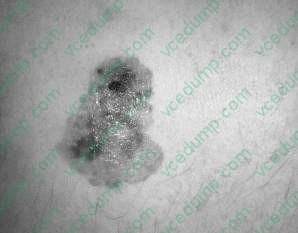
Which of the following is the most appropriate next step in management?
A. wide excision with 2 cm margin
B. wide excision with 2 cm margin and SLN mapping
C. shave biopsy
D. excisional biopsy with 12 mm margins
E. Mohs' surgical excision -
Question 435:
For the screening tests listed below, select the screening schedule that is appropriate for women (as per the U.S. Preventive Services Task Force [USPSTF], The Guide to Clinical Preventive Services, 2006) Fecal occult blood testing (FOBT)
A. do not routinely screen
B. yearly over age 50
C. at first prenatal visit
D. every 12 years at age 40 and older
E. every 12 years at age 50 and older
F. every 3 years following an initial examination, but not after age 65
G. every 3 years at age 50 and older -
Question 436:
A23-year-old university student has lost interest in his master's degree program. His two friends who bring him to the psychiatrist say he has been isolating himself in his room and has covered all electrical appliances and outlets with duct tape claiming that "electromagnetic waves are disturbing the microchip in my brain." He acknowledges that he once took a medication for the same problem with the "microchip," but then he became unbearably restless, could not sit still, and felt that he was "crawling" inside.
According to the patient's psychiatric symptoms, select the most appropriate medication. Presume no medical problems other than those mentioned.
A. amitriptyline
B. clozapine
C. divalproex
D. fluoxetine
E. hypericum perforatum
F. olanzapine
G. lorazepam
H. propranolol
I. temazepam
J. thiothixene -
Question 437:
Several groups of organic compounds are associated with serious toxic effects when used in the manufacture of textiles and materials; often found in manufactured homes
A. nitrosamines
B. epoxy compounds
C. PCBs
D. formaldehydes
E. organophosphorus compounds -
Question 438:
A 12-year-old boy comes to the clinic for a sports physical. He is new to your practice. He comes with his foster mother, who states that he was recently placed in her care because of his mother's problems with drug abuse. Although a complete medical history is not available, she knows that he has not received regular care. He does not have any chronic medical problems. She also knows that his father died of heart disease when he was 35. On physical examination, the boy's height is greater than the 95th percentile. His arm span exceeds his height.
Which of the following is the most likely cause of his tall stature?
A. Ehlers-Danlos syndrome
B. Kleinfelter syndrome
C. Marfan syndrome
D. Noonan syndrome
E. Williams syndrome -
Question 439:
A fourth-year medical student on an emergency medicine clerkship is fascinated by the number of personality disordered patients who come to the emergency room on weekends. Which of the following personality disorders belongs to cluster A (odd, eccentric) in the DSM-IV-TR (Diagnostic and Statistical Manual of Mental Disorders, 4th ed., Text Revision) classification of personality disorders?
A. schizoid personality disorder
B. borderline personality disorder
C. antisocial personality disorder
D. avoidant personality disorder
E. obsessive-compulsive personality disorder -
Question 440:
A 30-year-old woman who has been human immunodeficiency virus (HIV) positive for 4 years was recently diagnosed with AIDS.
Which of the following immunologic abnormalities would be expected?
A. increased numbers of CD4+ (helper) T cells
B. decreased number of CD8+ (suppressor) T cells
C. cutaneous anergy to usual skin test antigens
D. normal B-cell function
E. increased natural killer cell function
Tips on How to Prepare for the Exams
Nowadays, the certification exams become more and more important and required by more and more enterprises when applying for a job. But how to prepare for the exam effectively? How to prepare for the exam in a short time with less efforts? How to get a ideal result and how to find the most reliable resources? Here on Vcedump.com, you will find all the answers. Vcedump.com provide not only USMLE exam questions, answers and explanations but also complete assistance on your exam preparation and certification application. If you are confused on your USMLE-STEP-2 exam preparations and USMLE certification application, do not hesitate to visit our Vcedump.com to find your solutions here.