USMLE USMLE-STEP-2 Online Practice
Questions and Exam Preparation
USMLE-STEP-2 Exam Details
Exam Code
:USMLE-STEP-2
Exam Name
:United States Medical Licensing Step 2
Certification
:USMLE Certifications
Vendor
:USMLE
Total Questions
:738 Q&As
Last Updated
:May 25, 2026
USMLE USMLE-STEP-2 Online Questions &
Answers
Question 421:
A19-year-old primigravid woman at 39 weeks' gestation is in active labor, and her cervix is 4 cm dilated, 90% effaced. Her amniotic membranes have been ruptured for 4 hours. Contractions are strong at 2- to 3- minute intervals and of 60- to 70-second duration. For the past 30 minutes, repetitive variable decelerations of the fetal heart rate have occurred. They have lasted 6090 seconds, and the fetal heart rate has dropped as low as 60 beats per minute (BPM). You explain that there is a risk that the baby will become hypoxic and recommend a cesarean section. She refuses. Which of the following is the most appropriate course of action?
A. obtain permission for the cesarean section from her mother B. perform a cesarean section as an emergency C. obtain a court order permitting a cesarean section D. counsel her carefully about the fetal risks but accede to her wishes E. assign her care to another obstetrician
D. counsel her carefully about the fetal risks but accede to her wishes
Explanation
In many states, a pregnant woman under the age of 21 years is considered an emancipated minor and is the only person who may make legal decisions pertaining to the pregnancy. Although an immediate cesarean section is indicated because of the severe fetal heart rate decelerations, to perform it without her permission violates the ethical principle of autonomy. This is a principle that states that human beings should have their wishes respected as autonomous persons if they are capable of self- determination. Obtaining a court order may fulfill the ethical principle of beneficence, a physician acting to do no harm and to help the patient. In this situation, the ethical (moral) decision is complicated by a conflict between beneficence and autonomy. However, proceeding with a cesarean section exposes the obstetrician to a legal charge of battery. Assigning her care to another physician is a standard and accepted solution when there is a moral conflict between patient and physician. However, this is not an acceptable option in an emergency situation. The obstetrician is at risk for abandonment. Although not a satisfying choice, the choice most ethically sound is to counsel her carefully, but eventually accede to her wishes. Placing her in the lateral position, giving her oxygen by mask, and providing adequate intravenous hydration should be instituted to minimize the risk of fetal hypoxia.
Question 422:
A 55-year-old man presents to the emergency department at 5 a.m. complaining of vomiting blood. After binge drinking last night, the patient began to vomit repeatedly. After a number of episodes, the patient noted blood in the vomitus, followed by a melanotic stool 5 hours later. His past history is pertinent for ethanol abuse and a 40 pack-year smoking history. Vital signs reveal a BP of 100/60 mmHg, pulse rate of 95/min, respiratory rate of 12/min, and temperature of 97°F. Examination reveals a thin man with norma l chest, cardiac, and abdominal findings. Rectal examination reveals heme-positive stool. Laboratory data show normal electrolytes and a hematocrit of 30. A chest x-ray is unremarkable. Volume resuscitation, gastric lavage, and NG tube decompression are initiated. Which of the following is the most appropriate diagnostic test?
A. barium esophagogram B. water-soluble contrast esophagogram C. esophagoscopy D. CT scan E. angiogram
C. esophagoscopy
Explanation
Mallory--Weiss tear involves acute UGI hemorrhage that occurs after retching or vomiting and accounts for 515% of patients with UGI bleeding. The patient is often an alcoholic who vomits after binge drinking. Hematemesis follows vomiting without blood. After resuscitation, esophagoscopy is required to determine the source of bleeding and may be helpful in nonoperative management. Contrast studies are not helpful, and the use of barium would coat the stomach and preclude a diagnostic endoscopic examination. Most patients with Mallory--Weiss tears stop bleeding spontaneously. Angiography may be helpful in selected patients who continue to bleed and in whom the site of hemorrhage cannot be determined endoscopically.
Question 423:
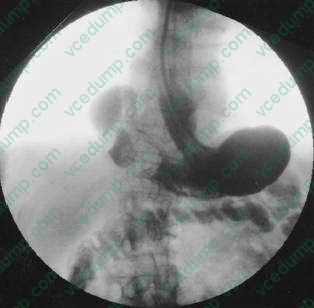
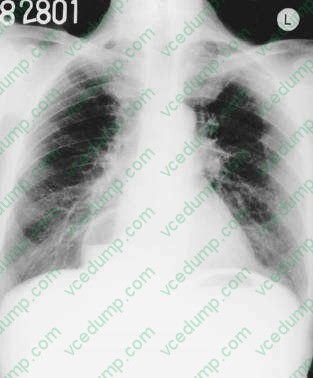
An 85-year-old man presents to the emergency room with an acute onset of midepigastric pain, nausea, vomiting, and hiccups starting 2 days ago. He is unable to keep any food down. Past history is pertinent for a long-standing hiatal hernia, hypertension, and diet-controlled diabetes. Examination reveals vital signs of pulse rate 82/min, BP 100/52 mmHg, respiratory rate 16/min, and temperature 97.2°F. The patient is in no acute distress, but has epigastric tenderness without guarding. Laboratory analysis revealed a hematocrit of 46 and a normal white blood cell (WBC) count. A chest x-ray is shown in Figure. A fluoroscopically guided NG tube was placed using contrast, and his stomach was decompressed.After adequate fluid and electrolyte resuscitation, an upper gastrointestinal (UGI) contrast study was obtained and is shown in Figure.
Which of the following is the most likely diagnosis?
A. sliding hiatal hernia B. hernia of Bochdalek (posterorlateral congenital diaphragmatic hernia) C. hernia of Morgagni (parasternal congenital diaphragmatic hernia) D. paraesophageal hernia E. eventration of the diaphragm (central diaphragm)
D. paraesophageal hernia
Explanation
The most likely diagnosis based on the chest xray and UGI contrast study is a paraesophageal hernia involving the gastric antrum and proximal duodenum. Although some contrast is seen in the transverse colon from that used during fluoroscopic placement of the NG tube, most of the contrast in the UGI study does not leave the stomach and proximal duodenum, suggesting some degree of obstruction. A sliding hiatal hernia involves movement of the gastroesophageal junction into the mediastinum above the diaphragmatic hiatus. The figure shows the gastroesophageal junction below the diaphragmatic hiatus. Hernias of Bochdalek and Morgagni are congenital diaphragmatic hernias involving the posterorlateral and parasternal locations, respectively. Eventration is an attenuation of the central portion of the diaphragm with resultant upward displacement. The most appropriate treatment is laparotomy or laparoscopy with reduction of the hernia and repair. Thoracotomy or thoracoscopy would not allow easy access to the abdominal contents and is associated with increased morbidity.
Delaying surgery may result in strangulation and ischemia. Because the patient did not demonstrate any respiratory compromise, endotracheal intubation was not indicated. Endoscopy is useful to evaluate for mucosal erosions in the case of gastrointestinal bleeding
Question 424:
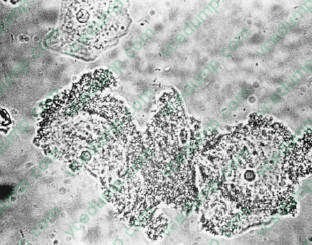
A wet smear of a vaginal discharge is illustrated in Figure.Which of the following is the most likely cause of the discharge?
A. monilial vaginitis B. trichomonas vaginitis C. Chlamydia trachomatis D. N. gonorrhoeae E. bacterial vaginosis
E. bacterial vaginosis
Explanation
Clue cells are shown in Figure. This indicates bacterial vaginosis. Clue cells are vaginal squamous cells with indistinct margins that are studded extensively with coccobacilli. Trichomonas infection is caused by a unicellular protozoon. The organism on wet smear with normal saline is fusiform, slightly larger than white blood cells, and has flagella at one end.
The flagella cause the motion on wet smear that is diagnostic. Monilial vaginitis is best demonstrated by placing a small amount of the discharge in 10% KOH and observing for branching hyphae. N. gonorrhoeae and C. trachomatis cannot be seen on a wet smear.
Question 425:
For each of the diseases listed, select the arthropod vector responsible for its transmission.
Epidemic typhus
A. aegypti B. Anopheles species C. Pediculus humanus corporis D. Dermacentor andersoni E. Sarcoptes scabiei
C. Pediculus humanus corporis
Explanation
Epidemic typhus (classical typhus fever, or louse-borne typhus) has disappeared from most areas of the world but might reappear in conditions of famine, war, or other disasters. There are small areas where it is endemic. The responsible organism, a rickettsia, is conveyed from case to case by the human body louse, P. humanus corporis. Malaria, in its various forms (Plasmodium falciparum, Plasmodium vivax, Plasmodium ovale, and Plasmodium malariae), is spread from human to human by females of the various Anopheles group of mosquitoes. Dengue fever has a worldwide distribution in tropical and subtropical areas. In addition to producing the classical fever with severe myalgia (breakbone fever), it can also cause a hemorrhagic fever. The causative agent, a group B arbovirus with four distinct serogroups, is virus- conveyed from case to case by the A aegypti mosquito. Colorado tick fever occurs mainly in mountainous areas of the United States within the range of its vector, D. andersoni. The highest incidence is in May and June. Several hundred cases are recorded annually, but it is likely that the actual incidence is much higher. Avoidance of tick bites is the principal control measure. Yellow fever, the prototypical viral hemorrhagic fever, is African in origin but has spread to and remains endemic in equatorial regions of Central and South America. The vector, A. aegypti, has also spread worldwide, but surprisingly, cases have not been reported in India and Southeast Asia. The illness varies in severity from a mild, nonspecific fever to a more severe condition with hemorrhagic, hepatic, and renal manifestations.
Question 426:
Doing a retrospective chart review of unmatched cases and controls, you calculate an OR to make an initial assessment of whether women who have had induced abortions are more likely to develop breast cancer. Twenty of 100 women with breast cancer reported a history of induced abortion. Ten of 200 women without breast cancer reported a history of induced abortion.
What are the exposure odds among controls?
A. 3.973 B. 1.682 C. 0.184 D. 0.053 E. 0.009
D. 0.053
Explanation
The odds of exposure among controls are calculated by dividing the probability that a control was exposed by the probability that a control was not exposed: (10/200)/(190/200) = 10/190 = 0.053.
Question 427:
In a patient infected with HIV, which of the following laboratory parameters provides the most useful information about the current immunologic status of the patient?
A. HIV RNA level B. white blood cell (WBC) count C. CD4+ T-cell count D. CD8+ T-cell count E. p24 antigen level
C. CD4+ T-cell count
Explanation
The CD4+ T-cell count provides information on the current immunologic status of a patient infected with HIV. HIV RNA level measures viral load and predicts what will happen to the CD4+ count in the near future. WBC count is a nonspecific marker for infection. The p24 antigen assay is used for direct detection of HIV. CD8+ count typically is not as important in monitoring immunologic status though the CD4+/CD8+ ratio sometimes is used
Question 428:
Apreviously healthy 28-year-old woman develops significant postpartum hemorrhage, with a rapid drop in hematocrit to 18%. Despite aggressive IV fluid resuscitation, the patient has a persistent tachycardia, labile systolic blood pressure, and poor urine output. Ongoing resuscitation includes emergency transfusion with 2 units of O-negative packed red blood cells. During transfusion of the second unit, the patient develops chills, fever, vomiting, and hypertension. These symptoms are most likely the result of which of the following?
A. a febrile nonhemolytic transfusion reaction B. an anaphylactic transfusion reaction C. ABO incompatibility with acute hemolytic transfusion reaction D. delayed hemolytic transfusion reaction E. acute bacterial infection transmitted in the blood product
A. a febrile nonhemolytic transfusion reaction
Explanation
Afebrile nonhemolytic transfusion reaction is usually caused by an interaction between recipient antibodies and leukocytes in the transfused blood. Treatment is discontinuation of the transfusion and antipyretics. If further transfusion is required, further reactions can be prevented by filtration of blood products for leukocyte reduction. Anaphylactic transfusion reactions are rare. Patients develop urticaria, flushing, hypotension, and bronchospasm. O blood type is characterized by the absence of ABO antigens on the red blood cell surface. Therefore, type O blood is universally accepted as the donor type for transfusion therapy, making an acute hemolytic transfusion reaction from ABO incompatability impossible. Delayed hemolytic reactions usually occur 13 weeks after a first transfusion and are manifested by an unexplained drop in hematocrit, associated with unconjugated hyperbilirubinemia. Acute bacterial infection transmitted through blood products is extremely rare and has been reported only in association with platelet concentrates stored at room temperature
Question 429:
A 39-year-old woman presents to the physician's office for evaluation of a palpable nodule in the neck of 2 years' duration. Her past history is pertinent for Hashimoto's disease diagnosed 5 years ago, for which she takes thyroid hormone. She has a history of low-dose chest irradiation for an enlarged thymus gland during infancy. On examination, a 2.5-cm nodule is palpable in the left lobe of the thyroid and is firm and nontender.
Which of the following portions of her history increases the risk for thyroid cancer?
A. age group of 2040 years B. female gender C. low-dose irradiation during infancy D. chronicity of the nodule E. past history of Hashimoto's disease
C. low-dose irradiation during infancy
Explanation
Factors that increase the risk for carcinoma include exposure to low-dose irradiation, age under 20 or over 60, male gender (especially over age 40), and recent onset. An increased incidence of thyroid carcinoma in patients with Hashimoto's thyroiditis has not been substantiated. For diagnosis, FNA is highly accurate and has become the preferred diagnostic modality. FNA is the most important diagnostic test for selecting patients for operation, supplanting all other diagnostic tests.
Question 430:
A woman at 31 weeks' gestation complains of feeling dizzy and lightheaded when she lies on her back. She is Rh negative but denies vaginal bleeding, abdominal trauma, or abdominal pain. The diagnosis is probably the supine hypotensive syndrome.
During this woman's labor, the nurse describes the presenting part as engaged when the woman is 6 cm dilated. Which of the following is the most accurate definition of engagement in a woman with a vertex presentation?
A. The vertex has passed through the pelvic inlet. B. The vertex reaches the pelvic floor. C. The biparietal diameter has passed through the pelvic inlet. D. The biparietal diameter has reached the pelvic floor. E. The vertex is at plus 1 station.
C. The biparietal diameter has passed through the pelvic inlet.
Explanation
The strict definition of the cardinal movement of labor, called engagement, is given as choice C. Among other things, this means that the presenting part is fixed in the true pelvis and a prolapsed umbilical cord is unlikely to occur. Often, the fetal head is considered to be engaged when the vertex is at 0 station, the level of the ischial spines. Although engagement is conclusive evidence of an adequate pelvic inlet, its absence is not always indicative of pelvic contraction. Nevertheless, the incidence of pelvic contraction is higher in primigravid women whose presenting part is not engaged.
Nowadays, the certification exams become more and more important and required by more and more
enterprises when applying for a job. But how to prepare for the exam effectively? How to prepare
for the exam in a short time with less efforts? How to get a ideal result and how to find the
most reliable resources? Here on Vcedump.com, you will find all the answers.
Vcedump.com provide not only USMLE exam questions,
answers and explanations but also complete assistance on your exam preparation and certification
application. If you are confused on your USMLE-STEP-2 exam preparations
and USMLE certification application, do not hesitate to visit our
Vcedump.com to find your solutions here.