USMLE USMLE-STEP-2 Online Practice
Questions and Exam Preparation
USMLE-STEP-2 Exam Details
Exam Code
:USMLE-STEP-2
Exam Name
:United States Medical Licensing Step 2
Certification
:USMLE Certifications
Vendor
:USMLE
Total Questions
:738 Q&As
Last Updated
:May 25, 2026
USMLE USMLE-STEP-2 Online Questions &
Answers
Question 451:
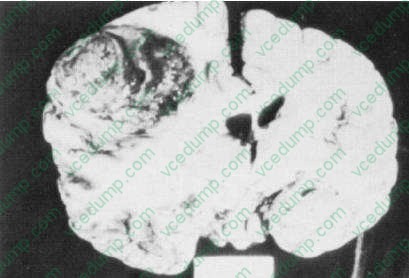
A 57-year-old man complains of worsening headache, nausea, and vomiting for 2 months. On examination, he is lethargic, confused, and has right-sided weakness. While waiting for a computed tomography (CT) scan, he develops status epilepticus, suffers cardiorespiratory arrest, and dies. His brain at autopsy is shown in the figure below. Which of the following is the most likely diagnosis?
A. glioma B. meningioma C. craniopharyngioma D. pituitary adenoma E. acoustic neuroma
A. glioma
Explanation
The autopsy specimen illustrated in Figure contains a large, multicolored, irregular tumor invading the left hemisphere. There is hemorrhage, necrosis, and surrounding edema. The clinical and pathologic findings are most compatible with a diagnosis of malignant glioma (astrocytoma). Glioma is a highly malignant tumor of astrocytic cells and is the most common primary brain tumor. It infiltrates widely, often involving multiple lobes, as well as the opposite hemisphere via the corpus callosum. Prognosis is poor, with an average survival time of 6 months after diagnosis. Meningiomas are benign primary brain tumors that are usually slow growing and occur outside of the hemispheres, where they are well encapsulated and compressed but do not invade brain tissue. Craniopharyngiomas arise from remnants of Rathke's pouch (the craniopharyngeal anlage). They are usually benign, well encapsulated, and found in or near the sella turcica. Acoustic neuromas arise from the root of the eighth cranial nerve in the cerebellopontine angle. Like meningiomas, they are encapsulated and compressed rather than invade brain substance
Question 452:
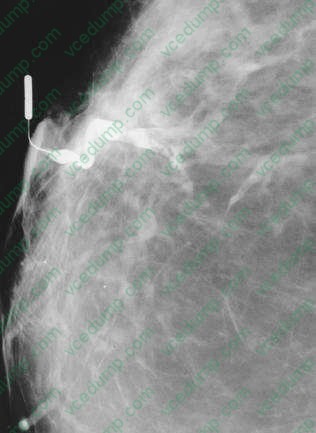
A 51-year-old woman presents to the physician's office with a 2-month history of a right breast bloodtinged nipple discharge. Past history is unremarkable. Family history is positive for postmenopausal breast cancer in a maternal grandmother. Examination reveals no palpable masses or regional adenopathy, but a serous discharge is easily elicited from a single duct in the right breast. Bilateral mammograms show no abnormalities. Cytology from the discharge was not diagnostic. A ductogram was ordered, and the results are shown in the figure below.
Which of the following is the most appropriate next step in management?
A. collection of discharge for repeat cytologic analysis B. observation, with repeat examination and imaging studies in 36 months C. modified radical mastectomy D. central lumpectomy (including removal of the nipple/areolar complex) E. terminal duct excision (microdochectomy)
E. terminal duct excision (microdochectomy)
Explanation
The most common cause of a nipple discharge is an intraductal papilloma. Galactography can often demonstrate a filling defect in the terminal ducts as is demonstrated in the figure. Duct ectasia may also cause a discharge, but the discharge is usually thick and pasty. Carcinoma is an uncommon cause of nipple discharge. The next step in management would be excision of the terminal duct containing the papilloma. Repeat cytology would not be useful because a negative result does not preclude biopsy.
Observation would not be prudent, because a diagnosis of carcinoma must be excluded, and the papilloma may enlarge, requiring a more extensive operation at a later date. A more extensive operation, such as a central lumpectomy or mastectomy, would be unnecessary because the lesion is benign.
Question 453:
A 48-year-old woman had a biopsy of a friable, bleeding lesion on her cervix. She had not had a pelvic examination or Pap smear for about 12 years. The biopsy is reported as invasive squamous cell carcinoma of the cervix. On bimanual examination, there is induration to the side wall of her pelvis.
Which of the following is the most important prognostic factor for 5-year survival after appropriate treatment of cervical cancer?
A. presence of high-risk strains of human papilloma virus (HPV) B. stage of the cancer C. age of the patient D. histologic grade of the tumor E. presence of positive regional (pelvic) lymph nodes
B. stage of the cancer
Explanation
Stage of the cancer is the most important prognostic factor. Women with stage IA cervical cancer have a 95% 5-year survival. This decreases progressively to 80, 64, 38, and 14% for stages IB, II, III, and IV, respectively. The other choices are prognostic factors but relate to the stage of the cancer. Women with high-risk serotypes (strains) of HPV tend to develop cervical neoplasia at a younger age. More advanced stages of cervical cancer tend to have less differentiated tumors and a greater probability of pelvic and paraaortic lymph node metastasis. Pelvic lymph node metastasis will be found in 5% or fewer of women with stage I cervical cancer, with a progressive increase as the stage advances to 55% of women with stage IV cervical cancer
Question 454:
A 13-year-old girl presents with parental concerns of poor posture. She has not had any back pain. On examination, she has unequal shoulder height, asymmetric flank creases, and a forward- bending test that shows rib asymmetry. The physical examination is otherwise normal. Which of the following is the most likely cause of her condition?
A. congenital scoliosis B. leg length inequality C. idiopathic scoliosis D. postural roundback E. Scheuermann kyphosis
C. idiopathic scoliosis
Explanation
Idiopathic scoliosis is the most common back deformity in children. The incidence peaks in early adolescence and is much more common in girls. Screening for scoliosis should be part of every well check and sports physical in children at Tanner (IIV) stages. Congenital scoliosis is caused by failure of formation or fusion of the ossific nuclei of the vertebrae. It can present at any age, depending on the degree of curvature, and is much less common than idiopathic scoliosis. Patients with leg length inequality present with a limp. Patients with Scheuermann kyphosis usually present with back pain and have a sharp kyphotic angulation with forward bending. Postural roundback is an exaggerated kyphotic appearance often seen in adolescents.
Question 455:
Routine examination of an otherwise healthy kindergarten child with a history of asthma reveals a BP of 140/90 mmHg. Which of the following is the most likely cause of the hypertension?
A. theophylline toxicity B. chronic lung disease C. renal disease D. coarctation of the aorta E. obesity
C. renal disease
Explanation
The most common causes of hypertension in young children are renal in origin. Polycystic kidney disease, congenital vascular anomalies, tumors, and infections all are causes. Urologic evaluation is imperative for the child described in the question. Theophylline toxicity that is severe enough to elevate BP significantly would be unlikely in the absence of jitteriness, nausea, or tachycardia. Chronic lung disease would not elevate the systemic BP in an otherwise healthy child. Coarctation of the aorta is a less common cause of hypertension in this age group. BPs taken on all extremities would be helpful in the diagnosis.
Question 456:
Select the organism associated with the following clinical findings:
Approximately 12 hours after a banquet, most of those who ate stew report abdominal cramps and diarrhea which subsided after 12 days.
A. aureus B. beta-hemolytic Streptococcus C. perfringens D. Mycoplasma pneumoniae E. Haemophilus pertussis F. Helicobacter pylori G. Escherichia coli H. Rickettsia prowazekii I. Giardia lamblia
J
Explanation
Giardiasis may cause cramping and a chronic diarrheal syndrome, with malabsorption and weight loss. Its distribution is worldwide, particularly where hygienic standards are not high. It also occurs sporadically in high-risk individuals. Streptococcal pyoderma, including erysipelas and impetigo, has been demonstrated to precede acute glomerulonephritis. Even when appropriate antibiotics are given in adequate dosage and duration for these conditions, renal damage may still result. Prevention thus consists of wound care, including cleaning wounds well and removal of crust. Mycoplasma infections are particularly common in families with younger children. They are frequently imported to the family by school-aged children, leading to a low-grade fever and persisting tracheobronchitis in the parents, or more acutely, an atypical pneumonia. G. lamblia is found in up to 20% of homosexual males, and may cause chronic diarrhea, although in these patients it tends to be asymptomatic. E. coli was first reported as a cause of watery diarrhea in nurseries in the 1940s. Although nursery epidemics with enteropathogenic serotypes had decreased in recent years in the United States, the increase of infant- child day care centers has resulted in their relatively frequent occurrence. Furunculosis is most frequently caused by coagulase-positive staphylococcal infections. The public health significance of this largely relates to the hazards of skin infections in food handlers and subsequent staphylococcal toxin in the food, leading to staphylococcal intoxication food-borne disease. H. pylori has been associated with gastric ulcers, but not with duodenal ulcers. Otitis media, whether acute or with effusion, commonly results from viral infection, such as by RSV. Various other organisms may be responsible including Streptococcu pneumoniae, H. influenzae, and others. C. perfringens, with rare exceptions, is transmitted in a meat dish prepared in bulk. Under propitious circumstances for the organism, especially on cooling of the food, bacterial multiplication can be very rapid. Symptoms begin to occur in the affected population in about 12 hours. Epidemic typhus is a rickettsial illness. Man is the host and long-term reservoir. The vectors are body lice (P. humanus corporis). The rickettsia are not present in human excretions and cannot be transmitted by person-to-person contact.
Question 457:
A pregnant woman is being followed by a nephrologist for chronic glomerulonephritis. Which of the following findings is normal at 28 weeks' gestation?
A. blood pressure of 132/86 mmHg B. blood urea nitrogen (BUN) of 21 mg/100 mL C. serum creatinine of 1.1 mg/100 mL D. glomerular filtration rate (GFR) of 130 mL/min E. glycosuria with a plasma glucose of 130 mg/100 mL
D. glomerular filtration rate (GFR) of 130 mL/min
Explanation
Blood pressure tends to drop slightly in normal pregnancy. This woman's blood pressure of 132/86 mmHg is definitely higher than would be expected and suggests the possibility of chronic hypertension. Because the GFR in pregnancy increases normally by as much as 50% to a peak of approximately 160 mL/min, serum creatinine and BUN should be less than 0.9 and 13 mg/100 mL, respectively. The observed values in this patient are elevated or pregnancy. The renal threshold for glucose normally decreases in pregnancy. Therefore, glycosuria does not always mean diabetes in pregnancy. Several plasma glucose measurements should be obtained in pregnant women with glycosuria to correlate urinary and plasma glucose levels.
Question 458:
A study finds that the relative risk of stomach cancer after the consumption of a new sugar substitute is 3.5 with a 95% confidence interval of 1.15.3. Which of the following best describes the true relative risk?
A. If repeated samples are taken from the population, 95% of the time the relative risk will fall between 1.1 and 5.3. B. If repeated samples are taken from the population and confidence intervals are found for each sample, 95% of the confidence intervals will include the true population relative risk. C. If repeated samples are taken from the population and confidence intervals are found for each sample, 95% of the confidence intervals will fall somewhere between 1.1 and 5.3. D. If repeated samples are taken from the population, 95% of the time the true relative risk for the population will fall between 1.1 and 5.3. E. Ninety-five percent of individuals from a particular sample will have a relative risk between 1.1 and 5.3.
B. If repeated samples are taken from the population and confidence intervals are found for each sample, 95% of the confidence intervals will include the true population relative risk.
Explanation
A confidence interval gives an estimated range of values which is likely to include an unknown population parameter, in this case the relative risk of stomach cancer with consumption of the sugar substitute. The estimated range is calculated from a given set of sample data. If independent samples are taken repeatedly from the same population, and a confidence interval calculated for each sample, then a certain percentage of the intervals will include the unknown population parameter.
Question 459:
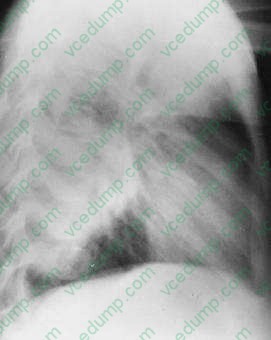
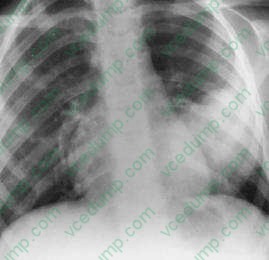
A10-year-old boy presents with a 1-day history of fever, cough, and chest pain. He has not been eating and has been listless. He does not have any previous history of health problems. On physical examination, his temperature is 40°C, and he is tachypneic. He looks ill. He has rales on his left posterior lower lung fields. You order a chest x-ray. Which of the following organisms is most likely responsible for his pneumonia?
A. Haemophilus influenzae B. Mycoplasma pneumoniae C. Pneumocystis carinii D. Staphylococcus aureus E. Streptococcus pneumoniae
E. Streptococcus pneumoniae
Explanation
This is a "round pneumonia," most commonly caused by S. pneumoniae. Onset of this disease is relatively acute. H. influenzae type B is an uncommon cause of systemic infections because of routine immunization. Mycoplasma is the most common cause of communityacquired pneumonia in this age group. Patients typically have a more gradual onset of symptoms. Pneumocystis does not cause pneumonia in otherwise healthy children. S. aureus can cause pneumonia in healthy children, but it is not as common as S.
pneumoniae or Mycoplasma.
Question 460:
A4-month-old baby is in for a well-child check and routine immunizations. The baby had a fever of 39°C the day he received his 2-month immunizations. The parents have read about the vaccine on the Internet and express their concerns. Which of the following is an absolute contraindication to giving the diphtheria and tetanus toxoids and acellular pertussis (DTaP)?
A. history of fever >38°C after previous vaccination B. history of local reaction after previous vaccination (redness, soreness, swelling) C. family history of seizures D. encephalopathy within 7 days of administration of previous dose of vaccine E. current antibiotic therapy
D. encephalopathy within 7 days of administration of previous dose of vaccine
Explanation
Absolute contraindications to use of DTP/DTaP include history of anaphylactic reaction to the vaccine or history of encephalopathy. The following are precautions. These circumstances should be carefully reviewed, and if vaccine benefits outweigh the risks, the vaccine should be given. Precautions include any of the following after a prior dose of DTP/DTaP: temperature of 40.5°C within 48 hours; collapse or sh ock- like state (hypotonichyporesponsive episode) within 48 hours; seizures within 3 days;
persistent inconsolable crying lasting 3 hours within 48 hours. Moderate or severe illness with or without a fever may be considered a precaution; however, a mild illness, such as an upper respiratory infection, is not a contraindication. Low-grade fevers and local reactions are common and are not contraindications; nor are antibiotic therapy or a family history of seizures.
Nowadays, the certification exams become more and more important and required by more and more
enterprises when applying for a job. But how to prepare for the exam effectively? How to prepare
for the exam in a short time with less efforts? How to get a ideal result and how to find the
most reliable resources? Here on Vcedump.com, you will find all the answers.
Vcedump.com provide not only USMLE exam questions,
answers and explanations but also complete assistance on your exam preparation and certification
application. If you are confused on your USMLE-STEP-2 exam preparations
and USMLE certification application, do not hesitate to visit our
Vcedump.com to find your solutions here.