USMLE USMLE-STEP-1 Online Practice
Questions and Exam Preparation
USMLE-STEP-1 Exam Details
Exam Code
:USMLE-STEP-1
Exam Name
:United States Medical Licensing Step 1
Certification
:USMLE Certifications
Vendor
:USMLE
Total Questions
:847 Q&As
Last Updated
:May 25, 2026
USMLE USMLE-STEP-1 Online Questions &
Answers
Question 681:
Mosaicism refers to a condition in which an individual has two or more genetically distinct cell types, derived from a single zygote, but that differ because of mutation or chromosomal aberration. Mosaicism occurs with a frequency of approximately 30% in females who are phenotypically normal but harbor gonadal dysgenesis, sexual immaturity, and infertility. These affected females also are short in stature, have webbing of the neck, and swelling of the hands and feet, as well as cardivascular and renal abnormalities. These symptoms are associated with which of the following diseases?
A. achondroplasia B. Duchenne muscular dystrophy C. fragile X syndrome D. Kleinfelter syndrome E. Turner syndrome
E. Turner syndrome
Explanation
Section: Biochemistry Turner syndrome is characterized by phenotypically normal females who are sexually immature and have gonadal dysgenesis and a host of somatic abnormalities. These symptoms arise due to chromosomal abnormalities in one of the X chromosome as well as due to monosomy for the X chromosome. Only around 5% of monosomy X fetuses survive to birth. Some 15% of Turner syndrome females are mosaic for the karyotype 45,X:46,XX and another 15% are mosaic for a 45,X cell line plus a 46,X, abnormal X cell line or a 47,XXX cell line. Achondroplasia (choice A) is the single most common form of dwarfism, which results from two specific defects in the gene encoding fibroblast growth factor receptor 3 (FGFR3). Symptoms of achondroplasia include rhizomelic short stature, midface hypoplasia, short ribs, and trident hand. DMD (choice B) is an X-linked condition whose symptoms occur in affected males in early childhood and only very rarely affects females. DMD is caused by defects in the dystrophin protein, which is involved in the contractile apparatus of muscle cells. Fragile X syndrome (choice C) is the most common form of inherited mental retardation. The symptoms result from the loss of a portion of the X chromosome due to a site of fragility caused by the amplification of a trinucleotide repeat sequence in the FMR1 gene. Symptoms of fragile X are most severe in males (affected females have much milder symptoms) and include severe mental retardation and facial abnormalities such as prominent jaw, forehead, and ears. Kleinfelter syndrome (choice D) is associated with males harboring two or more X chromosomes (e.g., 47,XXY). Symptoms appear in puberty and affected individuals have a greater than expected frequency of social pathology. Although significant mental retardation is not associated with most Kleinfelter patients, the more X chromosomes and individual harbors the higher likelihood of mental retardation.
Question 682:
Loss of the hepatic protein hepcidin can lead to severe iron overload with symptoms resembling those of hemochromatosis. Which of the following functions of hepcidin accounts for the iron overload when the protein is deficient?
A. activates the expression of the ironresponse element-binding protein that regulates transferring receptor and ferritin mRNA translation B. decreases the level of intestinal membrane iron transporters, resulting in reduced iron uptake C. facilitation of the interaction of transferring with the transferrin receptor D. forms a complex with ferritin allowing for higher intracellular storage E. promotes the formation of hemosiderin, thus detoxifying iron
B. decreases the level of intestinal membrane iron transporters, resulting in reduced iron uptake
Explanation
Section: Biochemistry Hepcidin is a hepatically synthesized iron regulatory protein that functions by inhibiting the presentation of one or more of the iron transporters [e.g., DMT1 and Ireg1 (ferroportin)] in intestinal membranes. With a high iron diet, the level of hepcidin mRNA increases and conversely its levels decrease when dietary iron is low. This is occurring simultaneous to reciprocal changes in the levels of the transporters proteins themselves. Loss of hepcidin activity would then lead to unregulated iron uptake from the intestines leading to iron overload. In fact, it is now considered that defects in hepcidin function contribute to the development of hemochromatosis. Hepcidin does not activate expression of iron-response elementbinding protein (choice A), facilitate transferring interaction with the transferring receptor (choice C), form a complex with ferritin (choice D), nor promote the formation of hemosiderin (choice E).
Question 683:
You are examining the biochemical characteristics of the liver dysfunction in your patient, who is exhibiting signs of a glycogen storage disease. You have isolated the microsomal fraction (contains the endoplasmic reticulum) of a liver biopsy homogenate from your patient and a control individual for your studies. Incubation with radioactive phosphate-labeled glucose-6-phosphate results in an increase in isotope associated with the microsomes from your control sample but no increase in association with the microsomes from your patient. These results are best explained by a defect in which of the following?
A. glucose-6-phosphatase activity in the microsomes B. microsomal glucose-6-phosphate transporter C. cytosolic glucose-6-phosphatase D. microsomal glucose transport E. microsomal phosphate transporter
B. microsomal glucose-6-phosphate transporter
Question 684:
Sara is a 15-year-old healthy female. With which of the following would one expect a girl of her age to spend a lot of time?
A. a mixed group of peers B. adults C. animals D. furry toys E. older females
A. a mixed group of peers
Explanation
Section: Behavioral Science and Biostatics An adolescent veers away from childish toys and develops an interest in the opposite sex. Peer relationships include members of the opposite as well as the same sex.
Question 685:
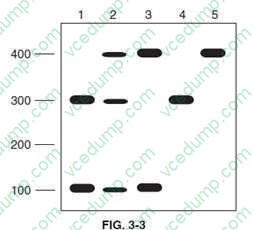
In an assay for the presence of a specific disease gene alelle in several individuals, you isolate genomic DNA from each and perfom polymerase chain reaction (PCR) using gene-specific primers. The PCR product is expected to have a recognition site for the restriction endonuclease BamHI. Following PCR and BamHI digestion, the products are separated by gel electrophoresis and the results are shown in below figure. Which lane corresponds to the individual demonstrating heterozygosity for the BamHI site?
A. 1 B. 2 C. 3 D. 4 E. 5
B. 2
Explanation
Section: Biochemistry Someone who exhibits heterozygosity would harbor two distinct alelles. In the case of this analysis, they would be identified as containing a copy of the gene that does not harbor the BamHI site and a copy that does harbor the site. The presence of the BamHI site in the PCR product in this example would result in the generation of 300 and 100 bp fragments. The lack of the site would yield a product of 400 bp. Thus, following PCR amplification and BamHI digestion of DNA from a heterozygote, one would be able to observe three bands of equal intensity. A person who was homozygous for having the BamHI-containing sequence would result in two bands (choice A) whose intensities would be greater than the three of the heterozygote. A person homozygous for the lack of the BamHI site would yield a single 400 bp band (choice D). The banding patterns observed in lanes 3 (choice C) and 5 (choice E) would not be possible from this analysis.
Question 686:
Which of the following peptide hormones is released in response to stimulation of pituitary gonadotropes?
A. ACTH B. follicle-stimulating hormone C. growth hormone D. prolactin E. thyroid-stimulating hormone
B. follicle-stimulating hormone
Explanation
Section: Biochemistry The pituitary gonadotrophs are cells that secrete the gonadotrophic peptide hormones, follicle- stimulating hormone (FSH), and leutinizing hormone (LH). FSH acts on Sertoli cells of the testis inducing androgen- binding protein synthesis, which maintains a high concentration of testosterone in tubules increasing spermatogenesis. In the ovary, FSH stimulates aromatase activity in the granulose cells stimulating ovum maturation and estradiol production. Pituitary orticotrophs are the ACTH- secreting cells (choice A), somatotrophs secrete growth hormone (choice C), lactotrophs secrete prolactin (choice D), and thyrotrophs secrete thyroid-stimulating hormone (choice E).
Question 687:
A 30-year-old man presents symptoms and signs consistent with primary syphilis. Which of the following pairs of tests are more likely to provide a definitive confirmation of this diagnosis?
A. dark-field microscopy followed by Venereal Disease Research Lab (VDRL) test B. examination of sample taken from a chancre by dark-field microscopy followed by fluorescent antibody (FA) technique C. silver staining of sample taken from the patient followed by VDRL D. VDRL followed by FA E. VDRL followed by Fluorescent Treponemal Antibody Absorption (FTA-Abs) test
E. VDRL followed by Fluorescent Treponemal Antibody Absorption (FTA-Abs) test
Explanation
Section: Microbiology/Immunology The fluorescent treponemal antibody absorption test (FTA-ABS) is the confirmatory test of choice for syphilis. This is a standard indirect fluorescent antibody test. It uses killed T. pallidum as a specific antigen, the patient's serum which has been absorbed with an extract of nonpathogenic spirochetes to remove cross-reacting antibodies, and the fluorescein isothiocynate-labeled antihuman antibody versus the regular florescent antibody (FA) alone. This test is positive earlier in primary syphilis, and remains positive in more patients with latent syphilis than the VDRL, RPR, or other tests for syphilis. The VDRL and the RPR tests are known as the nontreponemal tests for syphilis, and they are used for screening large groups of people. They measure nonspecific IgG and IgM called reagins, which are directed against a cardiolipin extracted from normal mammalian tissues. The silver stain (choice C) is used to detect P. jroveci cysts in specimens from AIDS patients. The correct procedure for primary syphilis diagnosis confirmation would be to screen a serum with a general screening test (VDRL) and onfirm a positive VDRL with a more specific FTA-Abs test specific for antisyphilis antibodies (choice E).
Question 688:
A 36-year-old man is now in his third year of steroid therapy since being diagnosed with a systemic vasculitis. Prior to initiating treatment in the acute phase of the disorder, he underwent a biopsy of a medium-sized artery. This biopsy specimen displayed fibrinoid necrosis of the media accompanied by a transmural acute inflammatory infiltrate. Significant negative clinical findings included a normal aortic arch, absence of giant cells in the artery biopsy, normal upper airway examination, and no history of tobacco use. Which of the following disorders best correlates with these findings?
A. Kawasaki disease B. polyarteritis nodosa C. Takayasu disease D. temporal arteritis E. thromboangiitis obliterans
B. polyarteritis nodosa
Explanation
Section: Pathology and Path physiology Polyarteritis nodosa is a systemic vasculitis primarily seen in young adult males. Fibrinoid necrosis and acute inflammation are seen microscopically in the acute phase. Mucocutaneous lymph node syndrome (Kawasaki disease) (choice A) is a childhood disorder with coronary vasculitis, cervical lymphadenopathy, and acute onset. Takayasu disease (choice C) is characterized by fibrosis of the upper aorta. The classic patient is a Japanese woman with HLA-DR4. Temporal or giant cell arteritis (choice D) is a granulomatous arterial inflammation seen in the elderly. The superficial temporal and intercranial arteries are preferentially involved. Thromboangiitis obliterans (choice E) is an occlusive disease of small arteries strongly related to cigarette smoking
Question 689:
Which of the following acts as a folate antagonist in the treatment of malaria?
A. amodiaquine B. chloroquine C. mefloquine D. proguanil E. quinine
D. proguanil
Explanation
Section: Pharmacology Proguanil is a prodrug that is converted to cycloguanil, an inhibitor of malarial dihydrofolate reductase. Amodiaquine (choice A) and chloroquine (choice C) are similar and probably interfere with metabolism of heme in the vacuoles of the parasite. Mefloquine (choice C) and quinine (choice E) have unknown mechanisms of action but are not folate antagonists.
Question 690:
A 4-month-old male infant is brought to the clinic because of excessive noisy respiration. On examination, the infant is within the normal range of growth, appears healthy, and does not show respiratory distress. Phonation is normal, along with head and neck examination findings. However, the child displays stridor (highpitched breathing sound) on inspiration, accentuated in the supine position. The parents report that the same stridor is heard during feeding or when the child is agitated. The attending physician places the child in the prone position and the stridor is relieved. To confirm, she holds the child in a neck extended position, which also relieves the stridor. An endoscopic laryngeal examination reveals bulky arytenoids cartilages and the diagnosis of laryngomalacia is established. During development, the arytenoids cartilages arise from which of the following?
A. first pharyngeal arch B. second pharyngeal arch C. third pharyngeal arch D. fifth pharyngeal arch E. sixth pharyngeal arch
E. sixth pharyngeal arch
Explanation
Section: Anatomy The arytenoid cartilages arise as swellings from the sixth pharyngeal (branchial) arch at 32 days of gestation. They are located between the caudal end of the hypobranchial eminence and the cranial end of the laryngotracheal tube. The swellings will grow cranially to form the arytenoids and corniculate cartilages along with the primitive aryepiglottic folds. In laryngomalacia, the bulky arytenoids cartilages prolapsed anteromedially on inspiration, resulting in stridor. The first (choice A), second (choice B), and third (choice C) pharyngeal arches do not participate in the development of laryngeal cartilages. The fifth (choice D) pharyngeal arch remains rudimentary and does not give rise to any adult structure.
Nowadays, the certification exams become more and more important and required by more and more
enterprises when applying for a job. But how to prepare for the exam effectively? How to prepare
for the exam in a short time with less efforts? How to get a ideal result and how to find the
most reliable resources? Here on Vcedump.com, you will find all the answers.
Vcedump.com provide not only USMLE exam questions,
answers and explanations but also complete assistance on your exam preparation and certification
application. If you are confused on your USMLE-STEP-1 exam preparations
and USMLE certification application, do not hesitate to visit our
Vcedump.com to find your solutions here.