USMLE USMLE-STEP-1 Online Practice
Questions and Exam Preparation
USMLE-STEP-1 Exam Details
Exam Code
:USMLE-STEP-1
Exam Name
:United States Medical Licensing Step 1
Certification
:USMLE Certifications
Vendor
:USMLE
Total Questions
:847 Q&As
Last Updated
:May 25, 2026
USMLE USMLE-STEP-1 Online Questions &
Answers
Question 701:
A female 44-year-old patient suffers from acute bacterial sinusitis localized to the frontal sinus. The patient displays a mucopurulent greenish discharge from the nose bilaterally, with associated fever and malaise. The patient also complains of pain over the forehead with headache.
Which of the following innervates the frontal sinus?
A. anterior ethmoidal nerve B. lacrimal nerve C. nasociliary nerve D. posterior ethmoidal nerve E. supraorbital nerve
E. supraorbital nerve
Explanation
Section: Anatomy The frontal sinus is innervated by the supraorbital and supratrochlear branches of the frontal nerve. All nerves mentioned in this question are branches of ophthalmic division (V1) of the trigeminal (fifth cranial) nerve. The anterior (choice A) and the posterior (choice D) ethmoidal nerves arise from the nasociliary nerve (choice C). They innervate the ethmoid and sphenopalatine sinuses. The lacrimal nerve (choice B) carries in its terminal segment the parasympathetic innervations to the lacrimal gland and provides sensory innervation to the upper eyelid.
Question 702:
Which of the following chemical agents is a powerful oxidizing agent used to kill microorganisms?
A. benzoic acid B. chlorine C. ethyl alcohol D. ethylene oxide E. mercury
B. chlorine
Explanation
Section: Microbiology/Immunology Chlorine (choice B) is a halogen that is often used for microbial disinfection and antisepsis. Many compounds can release various forms of chlorine (OCl-, HOCl, Cl2) that can kill microorganisms by oxidation. These include sodium hypochlorite, chlorine dioxide, and sodium dichlaroisocyanrate, oxidizing agents that destroy the cellular activity of proteins. Hypochlorous acid is the active ingredient for bactericidal and viruscidal effects. Such compounds may be sporocidal. Iodine (I2) may also be bactericidal, fungicidal, tuberculocidal, viruscidal, and sporocidal. Mercury (choice E) is antimicrobial but dangerous to humans. Ethanol (choice C) has limited killing ability for bacteria. Benzoic acid (choice A) has limited antimicrobial use, which ethylene oxide (choice D) is able to sterilize (completely kill all organisms) materials, but is very dangerous to humans as well.
Question 703:
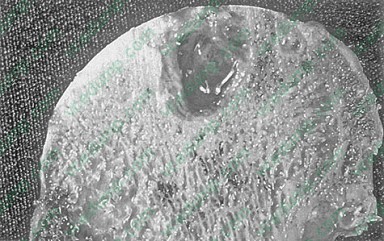
A 66-year-old woman with a 3-year history of right hip pain undergoes a prosthetic hipreplacement. A photograph of her diseased femoral head is displayed in below figure. What is the likely cause of this abnormality?
A. benign neoplastic process B. coagulopathy C. degenerative process D. infection E. malignant neoplastic process
C. degenerative process
Explanation
Section: Pathology and Path physiology The femoral head shows marked degenerative osteoarthritis. The gradual destruction of articular cartilage can eventually lead to joint compromise through eburnation, osteophyte formation, subchondral cysts, and osteochondral loose body formation. Clinically, these anatomic changes are reflected as joint pain and a restricted range of motion. Figure does not display evidence of a benign neoplasm (choice A), coagulopathy (choice B), infection (choice D), or malignant neoplastic process (choice E).
Question 704:
A 47-year-old woman has a 3-month history of fatigue and pruritus. A percutaneous liver biopsy reveals a nonsuppurative, granulomatous distention of medium-sized intrahepatic bile ducts. What is the most common etiology of this disorder?
A. acquired vascular abnormality B. alcohol abuse C. autoimmune disease D. parasitic infection E. viral infection
C. autoimmune disease
Explanation
Section: Pathology and Path physiology Primary biliary cirrhosis is an autoimmune disorder. Autoantibodies against mitochondria are usually present. Hyperbilirubinemia, steatorrhea, portal hypertension, and osteomalacia may be seen in the later stages of the disease. Vascular abnormalities (choice A), alcohol abuse (choice B), parasitic infections (choice D), and viral infections (choice E) all may mimic the clinical picture of primary biliary cirrhosis. They are not, however, the usual etiologic agents.
Question 705:
Multiple sclerosis is a relatively common nervous system demyelinating disease. It is autoimmune and restricted to the central nervous system. Nerve conduction velocity is depressed in almost all affected individuals. Manipulations which prolong action potential duration seem to mitigate symptoms, possibly by facilitating conduction through sections of membrane which are no longer myelinated. Application of which type of drug might be expected to prolong action potential duration and thus be a potential therapeutic tool?
A. activates potassium channels B. blocks L-type calcium channels C. blocks potassium channels D. blocks sodium channels E. increases sodium channel inactivation
C. blocks potassium channels
Explanation
Section: Physiology In clinical trials, a class of drugs, the aminopyridines, that blocks certain potassium channels has shown some promise for symptomatic relief of the symptoms of multiple sclerosis. The neuronal action potential is terminated by sodium channel inactivation and potassium channel activation. A drug that blocks potassium channels would thus prolong the action potential. Activating potassium channels (choice A) or increasing sodium channel inactivation (choice E) would shorten the action potential. Blocking sodium channels (choice D) would either shorten the action potential or block it altogether. Since calcium channels are not involved in the neuronal action potential, calcium channel blockade would not be expected to have much effect (choice B).
Question 706:
Antiarrhythmic drugs have a variety of adverse effects that must be monitored carefully. Which of the following drugs is associated with discoloration of the skin, photosensitivity, thyroid dysfunction, and pulmonary complications?
A. amiodarone B. diltiazem C. ibutilide D. lidocaine E. procainamide
A. amiodarone
Explanation
Section: Pharmacology Amiodarone is a large, insoluble molecule that deposits in skin (and the cornea) and causes photosensitivity. It contains two iodine atoms, which may be responsible for binding to thyroid receptors and the observed thyroid problems. It is associated with pulmonary fibrosis (sometimes fatal), but the mechanism is unknown. In spite of these adverse effects, it is extremely useful in arrhythmia treatment. Diltiazem (choice B) is associated with constipation and cardiac depression; ibutilide (choice C) with torsade de pointe arrhythmia, lidocaine (choice D) with convulsions, and procainamide (choice E) with torsade de pointe arrhythmia and drug-induced lupus.
Question 707:
Which of the following drugs exerts its effects through inhibition of cyclic GMP phosphodiesterase?
A. hydralazine B. minoxidil C. nitroprusside D. prazosin E. sildenafil
E. sildenafil
Explanation
Section: Pharmacology Vasodilators act by one of three mechanisms: increasing cyclic GMP (cGMP) levels in vascular smooth muscle cells; opening potassium channels; or blocking calcium channels. The organic nitrates and nitroprusside (nitrovasodilators) increase cGMP synthesis by generating nitric oxide (NO), which subsequently activates a soluble form of guanylyl cyclase. Activation of muscarinic receptors on vascular endothelial cells results in formation of NO (earlier identified as endothelium-derived relaxing factor) that diffuses to smooth muscle cells and relaxes them through increased cGMP levels. Erection of the penis involves neuronally regulated formation of NO, increased cGMP levels in the corpus cavernosum, and relaxation of cavernosal and vascular smooth muscle in erectile tissue. Rather than stimulating guanylyl cyclase, sildenafil (Viagra) acts as a selective inhibitor of cGMP phosphodiesterase type 5 to increase the half-life of cGMP in the tissues. The fact that sildenafil acts downstream of NO stimulation of guanylyl cyclase accounts for the toxic interactions between it and nitrovasodilators. The mechanism for relaxation of vascular smooth muscle by hydralazine (choice A) is unknown, but may involve NO. Minoxidil (choice B) is metabolized to minoxidil sulfate, which activates an ATP-sensitive potassium channel in smooth muscle. Nitroprusside (choice C) is a nitrovasodilator that spontaneously releases NO by a mechanism distinct from that of the organic nitrates. Prazosin (choice D) produces vasodilation by inhibiting alpha-1- adrenoreceptors on arteriolar smooth muscle.
Question 708:
You are examining a 12-year-old male patient who has a slowly enlarging, painless swelling in the left inferior region of the neck. After careful palpation and consideration of the results of the radioimaging studies, you diagnose a branchial cyst in the left inferior parathyroid gland. This gland arose in development from which of the following pharyngeal pouches?
A. fifth B. first C. fourth D. second E. third
E. third
Explanation
Section: Anatomy The inferior parathyroid glands and the thymus arise from the third pharyngeal pouch. The superior parathyroid glands develop from the fourth pharyngeal pouch (choice C). The fifth pharyngeal pouch (choice A) in the human is rudimentary or absent. The first pharyngeal pouch (choice B) gives rise to the tympanic membrane, tympanic cavity, mastoid antrum, and pharyngotympanic tube. The palatine tonsil along with the tonsillar sinus and crypts develop from the second pharyngeal pouch (choice D).
Question 709:
The mechanism of anesthetic action for lidocaine involves which of the following?
A. blockade of axonal voltage-dependent calcium channels B. blockade of axonal voltage-dependent sodium channels C. hyperpolarization of axons via enhanced chloride influx D. hyperpolarization of axons via enhanced potassium efflux E. inhibition of nerve terminal pain receptors
B. blockade of axonal voltage-dependent sodium channels
Explanation
Section: Pharmacology Local anesthetic agents such as lidocaine inhibit nerve conduction through state- and use-dependent blockade of voltage-dependent fast sodium channels. As a result, the threshold of excitability of the nerve is increased, and the ability of the nerve to propagate an action potential is decreased. Ultimately, transmission of sensory stimuli to the CNS is suppressed, and motor function involving small fibers in the vicinity of the injection is also lost. Inhibition of nerve conduction via blockade of calcium channels (choice A) is not a mechanism for local anesthetic agents. Hyperpolarization of neurons via enhanced chloride influx (choice C) is not a mechanism for local anesthetic agents, but is the mechanism for inhibition of repetitive neuronal firing by the benzodiazepines, barbiturates, and other GABA-mimetic and -enhancing agents that act on the GABAA receptor-chloride channel of neurons. Enhanced potassium efflux (choice D) does not occur with local anesthetics. Inhibition of pain receptors (choice E) is not a mechanism for currently available analgesic agents, although antagonists at the neurokinin receptors involved in nociception (pain perception) are an area of intense research.
Question 710:
Which of the following is an adaptive response to moving from sea level to higher elevation?
A. bronchial relaxation B. decreased cardiac output C. decreased circulating levels of EPO D. decreased levels of 2,3-diphosphoglycerate (2,3-DPG) in erythrocytes E. hyperventilation
Nowadays, the certification exams become more and more important and required by more and more
enterprises when applying for a job. But how to prepare for the exam effectively? How to prepare
for the exam in a short time with less efforts? How to get a ideal result and how to find the
most reliable resources? Here on Vcedump.com, you will find all the answers.
Vcedump.com provide not only USMLE exam questions,
answers and explanations but also complete assistance on your exam preparation and certification
application. If you are confused on your USMLE-STEP-1 exam preparations
and USMLE certification application, do not hesitate to visit our
Vcedump.com to find your solutions here.