USMLE-STEP-1 Exam Details
-
Exam Code
:USMLE-STEP-1 -
Exam Name
:United States Medical Licensing Step 1 -
Certification
:USMLE Certifications -
Vendor
:USMLE -
Total Questions
:847 Q&As -
Last Updated
:May 25, 2026
USMLE USMLE-STEP-1 Online Questions & Answers
-
Question 671:
Calcium disodium edetate is most effective as an antidote for poisoning with which of the following?
A. arsenic
B. atropine
C. iron
D. lead
E. mercury -
Question 672:
During surgical resection of the gastrointestinal tract for treatment of long-standing irritable bowel syndrome, a surgery resident is asked to select a surgical site coinciding with the termination of the vagal innervation. Which of the following does she select?
A. duodenojejunal junction
B. ileocolic junction
C. junction of the second part and third part of the duodenum
D. left colic (splenic) flexure
E. right colic (hepatic) flexure -
Question 673:
A patient with AIDS has bacterial meningitis and is being treated with an antimicrobial agent cleared by both hepatic metabolism and renal excretion. The volume of distribution is 10 L and the half-life for elimination is 7 hours in this patient. If the renal contribution to the plasma clearance of the drug is 8.3 mL/ min, approximately what percentage of the drug's elimination can be attributed to hepatic metabolism?
A. 10%
B. 25%
C. 50%
D. 75%
E. 90% -
Question 674:
An adult man suffered from stable angina pectoris for 15 years, during which time there was progressive heart failure and repeated pulmonary thromboembolism. On his death at age 63, autopsy disclosed enormous cardiomyopathy (1100 g), cardiac storage of globotriaosylceramide (11 mg lipid/g wet weight), and restricted cardiocytes. Which of the following lipid storage diseases would result in these clinical findings?
A. Fabry disease
B. Gaucher disease
C. Krabbe disease
D. Niemann-Pick disease (NPD) type I A
E. Tay-Sachs disease -
Question 675:
Opioid peptides are an important physiological mechanism of the body for relief from painful stimuli. Used as pharmacologic agents, they are highly valuable tools for pain management, although side effects are usually inevitable. Which of the following problems are most likely during opiate treatments?
A. difficulty sleeping
B. hypermotility of the GI tract
C. placebo effects
D. respiratory alkalosis
E. tolerance (need for higher dosage to achieve the same therapeutic effect) -
Question 676:
Sensations from the thoracic and abdominal organs are usually difficult to localize. They are conveyed by general visceral afferent (GVA) fibers, which synapse in which of the following nuclei?
A. ambiguus nucleus
B. dorsal motor nucleus of the vagus
C. hypoglossal nucleus
D. solitary nucleus
E. spinal (descending) trigeminal nucleus -
Question 677:
Measurement of the rate of creatinine clearance is used as a key determinant of renal function. In which of the following tissues is creatinine generated?
A. adipose
B. kidney
C. liver
D. lung
E. skeletal muscle -
Question 678:
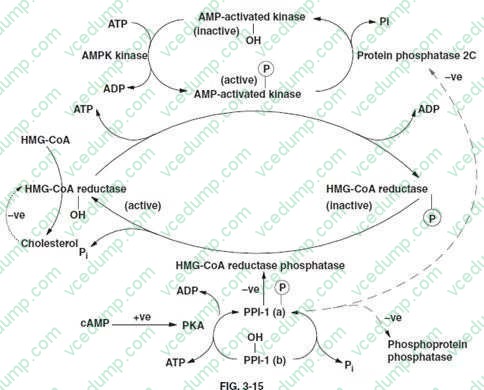
Glucagon binding to liver cells induces an increase in intracellular cAMP concentration. The rate- limiting step in cholseterol biosynthesis is regulated as a consequence of this glucagon-mediated rise in cAMP. The effect of increased cAMP on the rate of cholesterol biosynthesis occurs because of which of the following?
A. AMP-activated protein kinase (AMPK) is activated and directly phosphorylates human menopausal gonadotropin (HMG)-CoA reductase, leading to an increase in the activity of the latter enzyme.
B. Cyclic AMP-dependent protein kinase (PKA) is activated and directly phosphorylates HMG-CoA reductase, reducing the activity of the latter enzyme.
C. PKA is activated and phosphorylates AMP-regulated kinase, which then phosphorylates and activates HMGCoA reductase.
D. Removal of phosphate from HMG-CoA reductase increases its activity. Activated PKA results in a reduced level of phosphate removal from HMG-CoA reductase so that the latter enzyme is kept less active.
E. The increased cAMP directly inhibits HMG-CoA reductase. -
Question 679:
Which of the following occurs in the lipidosis known as Tay-Sachs disease?
A. Ganglioside GM2 is not catabolized by lysosomal enzymes.
B. Phosphoglycerides accumulate in the brain.
C. Synthesis of a specific ganglioside is decreased.
D. Synthesis of a specific ganglioside is excessive.
E. Xanthomas, due to cholesterol deposition, are observed. -
Question 680:
A 57-year-old obese woman has Type II (noninsulindependent) diabetes mellitus of 15 years duration. Because her hyperglycemia is not well controlled with diet and oral hypoglycemic agents, she selfadministers insulin by injection. She comes to her physician's office with a fever and a draining external ear infection; Pseudomonas aeruginosa is cultured from the drainage fluid. Which of the following drugs or drug combinations is appropriate treatment for the P. aeruginosa infection in this diabetic patient?
A. chloramphenicol
B. nafcillin plus kanamycin
C. sulfamethoxazole plus trimethoprim
D. tetracycline
E. ticarcillin plus tobramycin
Tips on How to Prepare for the Exams
Nowadays, the certification exams become more and more important and required by more and more enterprises when applying for a job. But how to prepare for the exam effectively? How to prepare for the exam in a short time with less efforts? How to get a ideal result and how to find the most reliable resources? Here on Vcedump.com, you will find all the answers. Vcedump.com provide not only USMLE exam questions, answers and explanations but also complete assistance on your exam preparation and certification application. If you are confused on your USMLE-STEP-1 exam preparations and USMLE certification application, do not hesitate to visit our Vcedump.com to find your solutions here.