USMLE USMLE-STEP-1 Online Practice
Questions and Exam Preparation
USMLE-STEP-1 Exam Details
Exam Code
:USMLE-STEP-1
Exam Name
:United States Medical Licensing Step 1
Certification
:USMLE Certifications
Vendor
:USMLE
Total Questions
:847 Q&As
Last Updated
:May 25, 2026
USMLE USMLE-STEP-1 Online Questions &
Answers
Question 691:
An 8-year-old male patient is brought to a rural hospital with a history of recurrent infection. The patient has a characteristic facies with a high, broad nasal bridge, long face, narrow palpebral fissures, and an abnormally small mandible. The patient also has a cleft palate. The patient is diagnosed with DiGeorge syndrome, an inherited immunodeficiency disease due to a chromosome 22q11.2 deletion. In this syndrome, the production of which of the following cells is affected in the thymus?
A. B cells B. endothelial cells C. macrophages D. neutrophils E. T cells
E. T cells
Explanation
Section: Anatomy In DiGeorge syndrome, the cortical epithelial cells of the thymus fail to develop and the thymus is hypoplastic. As a result, bone marrow-derived T-cell precursors cannot differentiate and functional T- cell production is markedly reduced. The development of B cells (choice A) is not affected in DiGeorge syndrome. Endothelial cells (choice B) forming the vascular walls are not affected by thymic maldevelopment, nor are the cells of myeloid lineage, the macrophages (choice C), and the neutrophils (choice D).
Question 692:
Severe combined immunodeficiency disease (SCID) is characterized by a complete lack of cell- mediated and humoral immunity. This disorder results from a deficiency in which of the following enzymes?
A. adenosine deaminase B. asparatate transcarbamoylase C. HGPRT D. orotic acid decarboxylase E. purine nucleotide phosphorylase
A. adenosine deaminase
Explanation
Section: Biochemistry ADA catalyzes the deamination of adenosine to inosine during the catabolism of purines. Loss of ADAleads to significantly elevated levels of phosphorylated deoxyadenosine (in particular deoxyadenosine triphosphate, dATP). Levels of dATP in ADA deficiency can reach 50 times normal. High concentrations of dATP inhibit ribonucleotide reductase, which is required for the generation of deoxynucleotides from ribonucleotides. The inhibition of ribonucleotide reductase leads to severely impaired cellular DNA synthesis. Since lymphocytes must be able to proliferate dramatically in response to antigenic challenge, the loss of ADA activity results in a near complete lack of immune function. ATC (choice B) is a component of a multifunctional enzyme, which catalyzes the rate- limiting reaction of pyrimidine biosynthesis. No known deficiencies in this enzyme have been identified, likely due to the embryonic lethality predicted if the enzyme were defective. HGPRT (choice C) catalyzes the salvage of hypoxanthine to IMP and guanine to GMP. Deficiency in HGPRT results in Lesch-Nyhan syndrome. Orotic acid decarboxylase (choice D) catalyzes the decarboxylation of OMP to UMP. Deficiency in this enzyme results in orotic aciduria, type II. PNP (choice E) is also a purine catabolic enzyme, which converts inosine to hypoxanthine and guanosine to guanine. Deficiency in PNP leads to a mild immunodeficiency.
Question 693:
A 7-year-old boy is examined by his pediatrician because of complaints of severe cramping pain in his legs whenever he rides his bike. He also expriences nausea and vomiting during these attacks. The child has noted that the severity of the cramps is most intense after dinners that include baked potatoes or pasta, and sometimes bread. Clinical studies undertaken following a treadmill test demonstrate myoglobinuria, hyperuricemia, and increased serum bilirubin. Which of the following enzyme deficiencies is associated with these clinical findings?
A. glucose-6-phosphatase B. glycogen synthase C. liver glycogen debranching enzyme D. muscle phosphofructokinase E. muscle phosphorylase
D. muscle phosphofructokinase
Explanation
Section: Biochemistry A deficiency in muscle phosphofructokinase results in glycogen storage disease type VII (Tarui disease). Clinically, the symptoms seen in Tarui disease are very similar to those seen in muscle phosphorylase deficiency (choice E), glycogen storage disease type V (McArdle disease) such as exercise-induced cramping and early fatigue. There are five clinical characteristics allowing distinction between Tarui and McArdle diseases: exercise intolerance is evident in childhood, is more severe, and is associated with nausea and vomiting; the intolerance is particularly acute following meals rich in carbohydrates; hyperuricemia is more severe; compensated hemolytic anemia is evidenced by increased serum bilirubin and reticulocyte count, and lastly; an abnormal polysaccharide is present in muscle fibers. Deficiency in glucose-6-phosphatase (choice A) is one cause of glycogen storage disease type I (specifically type Ia, von Gierke disease). Classic symptoms of this deficiency include neonatal hypoglycemia and lactic acidosis. If symptoms do not appear until the third or fourth month they include hepatomegaly and hypoglycemic seizures. Liver glycogen synthase deficiency (choice B) presents with morning fatigue and ketotic hypoglycemia on fasting--both of which rapidly disappear on feeding. Symptoms can be rapidly relieved and chemical signs corrected by introducing frequent protein-rich meals and nighttime feedings of suspensions of uncooked corn starch. Deficiency in glycogen debranching enzyme (choice C) results in glycogen storage disease type III (Cori or Forbes disease). Symptoms of type III disease are short stature, variable skeletal myopathy, cardiomyopathy, hepatomegaly, and hypoglycemia.
Question 694:
Parents of an 18-month-old boy bring their child to their pediatrician as they are concerned about their son's recurring skin and lung infections. Biopsy of one of the boy's current skin lesions reveals the presence of neutrophils, lymphocytes, and scattered epithelioid cell granulomas. Culture of the lesion is positive for Staphylococcus aureus. Which of the following would best account for this patient's condition?
A. absence of T-helper cell activity B. adenosine deaminase enzyme deficiency C. complement C3b opsonization abnormality D. decreased hydrogen peroxide production E. defective macrophage phagocytosis
D. decreased hydrogen peroxide production
Question 695:
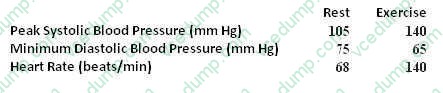
Exhibit: *missing* A healthy 27-year-old male is given a treadmill stress test. His cardiovascular values at rest and during exercise were:
When compared to rest, what was the change in his arterial pulse pressure?
A. decreased from 140 to 65 B. increased from 30 to 75 C. increased from 68 to 140 D. increased from 115 to 140 E. remained unchanged since heart rate and systolic pressure both increased
B. increased from 30 to 75
Explanation
Section: Physiology By definition, arterial pulse pressure is the difference between peak systolic and minimum diastolic pressure. His resting pulse pressure was 105 - 75 = 30 and his exercise pulse pressure increased to 140
- 65 = 75.
Question 696:
In the skull, a network of thick-walled vessels named dural venous sinuses drains the cerebrospinal fluid and the venous blood from the brain. These vessels are formed by reflections of the dura mater, which also form partitions between major parts of the brain. Which of the following dural venous sinuses is associated with the falx cerebri?
A. cavernous sinus B. inferior petrosal sinus C. sigmoid sinus D. superior sagittal sinus E. transverse sinus
D. superior sagittal sinus
Explanation
Section: Anatomy The falx cerebri is the dural partition separating the hemispheres of the brain, above the corpus callosum. It has in its superior edge the superior sagittal sinus and in its inferior border, the inferior sagittal sinus. The cavernous sinus (choice A) is a dural pocket in the middle cranial fossa and is located on either side of the sella turcica. It is unusual because it contains the internal carotid artery and cranial nerves III, IV, V1, V2, and VI. The sigmoid sinus (choice C) is located in the posterior cranial fossa, below the level of the tentorium cerebelli, which contains in its posterior border the transverse sinus (choice E).
Question 697:
Which of the following drugs is selectively antifungal because of the difference between cholesterol (in mammalian cell membranes) and ergosterol (in fungal membranes)?
A. amphotericin B B. caspofungin C. fluconazole D. griseofulvin E. terbinafine
A. amphotericin B
Explanation
Section: Pharmacology Amphotericin B binds selectively to ergosterol and forms artificial pores in fungal membranes. These pores result in loss of homeostasis and death of the fungal cell. Caspofungin (choice B) is a member of the echinocandins, the newest antifungal antibiotics. These agents disrupt the fungal cell wall by inhibiting the synthesis of beta(1-3) glucan. Fluconazole (choice C) and other azoles (ketoconazole, itraconazole, voriconazole, posaconazole) inhibit ergosterol synthesis. Griseofulvin (choice D) interferes with microtubule function and cell division in fungi. Terbinafine (choice E) inhibits squalene epoxidase in fungi and reduces ergosterol synthesis.
Question 698:
The patient is a 43-year-old male. He is anemic, with a hemoglobin level of 12.2 g/dL (normal is 15.5 g/dL). The erythrocytes are microcytic (MCV = 70 fL, with normal MCV = 80100 fL). Which of the following would most likely be present in this patient?
A. acute bleeding B. folate deficiency C. iron deficiency D. vitamin deficiency E. vitamin K deficiency
C. iron deficiency
Question 699:
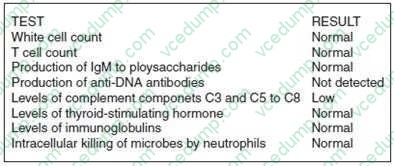
A 6-year-old girl has been having recurrent pyogenic bacterial infections of the sinus and respiratory tract. The latest one has been caused by N. meningitidis. The results of her diagnostic tests are shown in below figure.
These results are consistent with a diagnosis of which of the following?
A. chronic granulomatous disease B. deficiency in the opsonization of microbes by phagocytes C. Graves disease D. systemic lupus erythematosus E. Wiskott-Aldrich syndrome
B. deficiency in the opsonization of microbes by phagocytes
Explanation
Section: Microbiology/Immunology The diagnostic tests ordered by the physician are consistent with a deficiency in the C3, C5C8 components of complement. Individuals with these deficiencies have recurrent pyogenic infections, and show enhanced susceptibility to meningococcal infections. All other choices are not consistent with the laboratory findings. Chronic granulomatous disease (choice A) entails a defect in the intracellular killing of microbes by neutrophils. Graves disease (choice C) involves autoantibody production to thyroid- stimulating hormone receptors. Systemic lupus erythematosus (choice D) involves production of anti-nuclear antibodies (ANA). Wiskott-Aldrich syndrome (choice E) is associated with recurrent pyogenic infections, but is due to an inability of plasma cells to produce IgM against bacterial polysaccharides, and it occurs only in male infants.
Question 700:
Which of the following antitubercular agents is a strong inducer of hepatic cytochrome P450?
A. ethambutol B. isoniazid C. rifampin D. streptomycin E. sulfisoxazole
C. rifampin
Explanation
Section: Pharmacology Rifampin selectively inhibits bacterial DNA-dependent RNA polymerase. It is very useful in treating mycobacterial infections since it can penetrate cells and kill intracellular organisms. It is one of the most potent inducers of cytochrome P450 known, leading to increased hepatic clearance of many other drugs including the oral anticoagulants, cyclosporine, propranolol, digitoxin, corticosteroids, and oral contraceptives. Ethambutol (choice A) is often combined with isoniazid in antitubercular regimens. Clearance is primarily via renal excretion. Isoniazid (choice B) is the most widely used antitubercular agent. It functions by inhibiting mycolic acid biosynthesis. Isoniazid is cleared by metabolism via N- acetylase and hydrolytic activity. Streptomycin (choice D) was the first effective drug for the treatment of tuberculosis, but, because of its ototoxicity and nephrotoxicity and the development of less toxic agents, use of streptomycin is limited to more severe forms of the disease. Sulfisoxazole (choice E) may rarely be used in antitubercular regimens in combination with other drugs. Clearance is primarily via glomerular filtration.
Nowadays, the certification exams become more and more important and required by more and more
enterprises when applying for a job. But how to prepare for the exam effectively? How to prepare
for the exam in a short time with less efforts? How to get a ideal result and how to find the
most reliable resources? Here on Vcedump.com, you will find all the answers.
Vcedump.com provide not only USMLE exam questions,
answers and explanations but also complete assistance on your exam preparation and certification
application. If you are confused on your USMLE-STEP-1 exam preparations
and USMLE certification application, do not hesitate to visit our
Vcedump.com to find your solutions here.