USMLE USMLE-STEP-1 Online Practice
Questions and Exam Preparation
USMLE-STEP-1 Exam Details
Exam Code
:USMLE-STEP-1
Exam Name
:United States Medical Licensing Step 1
Certification
:USMLE Certifications
Vendor
:USMLE
Total Questions
:847 Q&As
Last Updated
:May 25, 2026
USMLE USMLE-STEP-1 Online Questions &
Answers
Question 661:
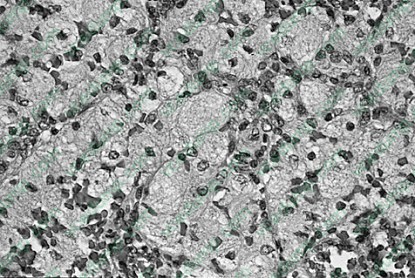
The bone marrow biopsy depicted in below figure was obtained from an infant with hepatosplenomegaly and mental retardation. The pathologic basis of this disorder is best explained by which of the following?
A. deficient cellular immunity that permits continued intracellular bacterial proliferation B. exposure to excessive radiation during embryogenesis C. hereditary defect of a catabolic enzyme leading to abnormal intracellular accumulation of lipids D. oncogenic viral integration into host's DNA that initiates unregulated cellular proliferation E. traumatic injury during delivery
C. hereditary defect of a catabolic enzyme leading to abnormal intracellular accumulation of lipids
Explanation
Section: Pathology and Path physiology figure depicts macrophages filled with lipids from an infant with Gaucher disease. The disease is due to a genetic lack of the catabolic enzyme glucocerebrosidase, which fosters the abnormal accumulation of glucocerebroside within the reticuloendothelial cells and neurons. Gaucher disease is not caused by deficient cellular immunity (choice A), radiation (choice B), viral infection (choice D), or trauma (choice E).
Question 662:
A similar virus was isolated from several students in a day-care school that experienced a respiratory disease outbreak. This virus passes through a 50 nm filter, grows best in human diploid fibroblasts at 33°C, is not inactivated by chloroform, is inactivated at pH 3, and is inhibited by compounds that interact with the interior of grooves on the viral surface that attach to cell receptor molecules. Which of the following is the most likely virus based upon its identifying characteristics?
A. coronaviruses B. Influenza virus B C. respiratory syncytial virus D. rhinovirus E. rubella virus
D. rhinovirus
Explanation
Section: Microbiology/Immunology Rhinoviruses (choice D) are common cold viruses that belong to the picornavirus group. They are small (2830 nanometers), have a positive-sense linear RNA genome, and no lipid envelope. The viral receptor is located in a groove or canyon in the capsid coat where the cellular receptor (ICAM-1) attaches in the initial cell infection process. The incubation period is brief (12 days), allowing many infections to occur in a crowded or closed living situation. Coronaviruses (choice A) are also common cold viruses but larger than 50 nm and has a lipid envelope. Influenza viruses (choice B) are also larger than 50 nm and possess lipid envelopes. RSV (choice C) and rubella virus (choice E) are similar, being larger than 50 nm with lipid envelopes.
Question 663:
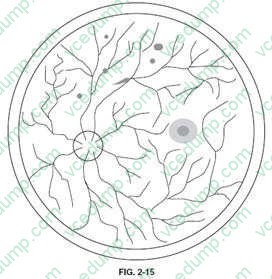
The eye examination of a patient with diabetes mellitus reveals no cataract or glaucoma. The patient's ophthalmoscopic picture of his left eye is shown in the below figure. Which of the following is most likely affected?
A. color vision B. high acuity vision C. near point vision D. scotopic vision E. spatial vision
D. scotopic vision
Explanation
Section: Physiology The picture, representing the back of the retina as seen through the ophthalmoscope, shows a normal optic disk, a normal macula lutea, and no obvious neovascularization. On the other hand, there are dot hemorrhages as well as one flame-shape hemorrhage site present in the peripheral retina. This indicates an early stage of diabetic retinopathy, known as background retinopathy, in which microaneurysms occur due to damage of existing blood vessels. Since the damage occurred in the peripheral retina, rod vision, also called scotopic vision, is affected. There is no obvious damage yet in the macula lutea and the fovea centralis. At these places, cones are found in the greatest number. Since cones are responsible for color vision, choice Ais incorrect. Since the fovea centralis is the place for high acuity vision, choice B is incorrect. Changes in near point vision (choice C) indicate an error in the refractive power of the eye which is associated with abnormalities at the cornea, the lens, or the geometry of the eyeball. Spatial vision (choice E) refers to the ability to discriminate between spatially defined features. It is mainly determined by visual neuronal networks that enhance visual acuity and contrast, which are both associated with photopic vision.
Question 664:
Physical examination reveals severe laryngeal edema resulting in a marked hoarseness when the 17- year- old girl attempts to speak. Also, her lips and tongue show significant swelling. Which of the following chemicals most likely caused this edematous swelling?
A. corticosteroids B. cromolyn sodium C. epinephrine D. histamine E. 5-lipoxygenase
D. histamine
Explanation
Section: Microbiology/Immunology Histamine is among the class of preformed (primary) mediators released from mast cells upon degranulation and is classified as a biogenic amine. It is a potent pharmacologically active substance that can dilate small blood vessels and increase vascular permeability, allowing fluid to leak into tissues. These vascular changes can give rise to swelling and redness. Histamine can stimulate production of mucus from the epithelium, thus contribute to congestion of airways. It can cause smooth muscles around the bronchial airways and the intestine to contract. Prostaglandins and leukotrienes like histamine can also cause constriction of the bronchial tubes and vascular dilation. Corticosteroids are anti-inflammatory drugs that are used for the treatment of asthma, autoimmune diseases, or graft rejection (choice A). Epinephrine and cromolyn sodium counteract the action of histamine or other mediators of type I hypersensitivity reaction and are used for the treatment of anaphylactic reactions (choices B and C). 5- lipoxygenase retards production of several leukotrienes (choice E).
Question 665:
A 25-year-old female presents to her doctor's office with a rash over the malar eminences of her face, sparing the nasolabial folds; a skin rash due to exposure to sunlight; and painless nasopharyngeal ulcers. Suspecting an autoimmune disorder, her physician obtains an antinuclear antibody test of her blood and finds high titers of anti-double-stranded DNA antibodies. Which one of the following diseases is most likely responsible for this immunological reaction?
A. Goodpasture syndrome B. multiple sclerosis C. myasthenia gravis D. rheumatoid arthritis E. systemic lupus erythematosus
E. systemic lupus erythematosus
Explanation
Section: Microbiology/Immunology SLE is characterized by development of auto-antibodies against double-stranded DNA, and other components of the nucleus. These auto-antibodies are involved in the production of immune complexes that lead to activation of complement, tissue damage, including vasculitis, glomerulonephritis, or arthritis. Rheumatoid arthritis (choice D) is due to production of auto-antibodies (of the IgM type) against IgG. In multiple sclerosis (choice B), auto-activated T cells and macrophages cause demyelization of the white matter of the brain. Goodpasture syndrome (choice A) is caused by the development of auto-antibodies to the collagen component of the basement membrane of the lungs and kidneys. In myasthenia gravis (choice C), auto-antibodies are generated against the acetylcholine receptors of the neuromuscular junction.
Question 666:
A 4-month-old Caucasian male infant with a temperature of 38.4°C is examined by his pediatrician. His mother indicates that he has had the fever for the past 4 days, been listless, vomiting, and has watery stools. Blood work indicates the infant is hypoglycemic but this condition does not respond to either epinephrine or glucose administration. In addition, his blood pH is slightly acidic and shows reduced bicarbonate. Other untoward blood chemistry includes elevated triglycerides, cholesterol, and liver enzymes. The child has a protruberant abdomen, thin extremities, and a doll-like face. The pediatrician suspects a specific condition and orders a liver biopsy to test for the activity of which of the following enzyme activities?
A. glucose-6-phosphatase B. glycogen synthase C. muscle phosphofructokinase D. muscle phosphorylase E. pyruvate kinase
A. glucose-6-phosphatase
Explanation
Section: Biochemistry Deficiency in glucose-6-phosphatase (choice A) is one cause of glycogen storage disease type I (specifically type Ia, von Gierke disease). Hallmarks of the disease are hypoglycemia, lactic acidosis, hyperuricemia, and hyperlipidemia. If symptoms do not appear until the third or fourth month they include hepatomegaly and hypoglycemic seizures. Afflicted children have a protruberant abdomen due to the massive hepatomegaly. Outward physical signs also include extremely thin extremities, short stature, and chubby doll-like faces. Liver glycogen synthase deficiency (choice B) presents with morning fatigue and ketotic hypoglycemia on fasting--both of which rapidly disappear on feeding. Symptoms can be rapidly relieved and chemical signs corrected by introducing frequent protein-rich meals and nighttime feedings of suspensions of uncooked corn starch. Adeficiency in muscle phosphofructokinase (choice C) results in glycogen storage disease type VII (Tarui disease). Clinically, the symptoms seen in Tarui disease are very similar to those seen in muscle phosphorylase deficiency (choice D), glycogen storage disease type V (McArdle disease) such as exercise-induced cramping and early fatigue. There are five clinical characteristics allowing distinction betweeen Tarui and McArdle disease: exercise intolerance is evident in childhood and more severe and is associated with nausea and vomiting; the intolerance is particularly acute following meals rich in carbohydrates; hyperuricemia is more severe;
compensated hemolytic anemia is evidenced by increased serum bilirubin and reticulocyte count, and lastly; an abnormal polysaccharide is present in muscle fibers. Deficiency in PK (choice E) is the most common enzyme deficiency leading to hemolytic anemia and the disorder is characterized by lifelong episodes. The most severe deficiency will result in embryonic lethality.
Question 667:
A patient presents with fever (her core temperature equals 39°C, with normal core temperature equaling 3637.5°C) as well as an elevated white cell count. Which of the following statements is true regarding the patient's elevated core body temperature?
A. Bacterial toxins act directly on skeletal muscle to increase muscle contractile activity, therebygenerating heat and elevating core temperature. B. Core body temperature now exceeds the hypothalamic set point temperature. C. Increased core body temperature is due to increased heat production by leukocytes. D. Increased prostaglandins have raised the hypothalamic set point temperature. E. The patient will be sweating in an effort to further elevate core temperature.
D. Increased prostaglandins have raised the hypothalamic set point temperature.
Explanation
Section: Physiology In fever, cytokines act to increase prostaglandin levels in the hypothalamus. By an undefined mechanism, prostaglandins increase the hypothalamic set point temperature. The body's heat- generating mechanisms are activated to increase core body temperature until it approaches the new set point. Core temperature will approach but not exceed the set point temperature (choice B). Sweating lowers core temperature (choice E). Though bacterial toxins can be important in the etiology of fever, they do not act directly to increase muscle heat production (choice A). Leukocytes generate cytokines, which act centrally to influence the hypothalamus (choice C). The cellular activity that is most important in heat generation is muscle contraction.
Question 668:
Exhibit:
Please refer to the exhibit.
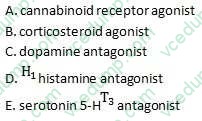
Apatient is to receive chemotherapy for cancer. The oncologist plans to use ondansetron to reduce the nausea and vomiting associated with the chemotherapeutic agents. What is the mechanism of action of ondansetron?
A. A B. B C. C D. D E. E
E. E
Question 669:
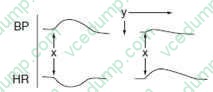
In a study of cardiovascular drugs, normal volunteers were given drug X in a small bolus dose while blood pressure and heart rate were recorded. After recovery, a long-acting blocking agent, Y, was administered. The direct effects of Y were not recorded. After drug Y had equilibrated with the tissues of the body, drug X was repeated in the same dosage. The results are shown in below figure.
Drug X behaves most like which of the following?
A. bethanechol B. epinephrine C. isoproterenol D. norepinephrine E. phenylephrine
D. norepinephrine
Explanation
Section: Pharmacology Elevated blood pressure typically evokes a compensatory baroreceptor reflex with slowing of heart rate. Thus, the decrease in heart rate shown in the initial data can be interpreted as a reflex bradycardia. Bethanechol (choice A) is a muscarinic agonist and typically causes vasodilation, with a drop in blood pressure and a compensatory tachycardia. Epinephrine (choice B), an alpha-1-, alpha-2-, beta-1-, and beta-2-agonist, causes hypertension at high doses, but usually also causes tachycardia. Isoproterenol (choice C) is a beta-1-, beta-2- agonist, and does not cause hypertension or bradycardia. Norepinephrine (choice D) and phenylephrine (choice E) can both cause hypertension and reflex bradycardia. However, norepinephrine has beta-1-agonist action, whereas phenylephrine has only alpha effects. Thus, in the presence of an alpha-blocking agent, norepinephrine causes a beta-1-mediated tachycardia; phenylephrine has no effect on heart rate.
Question 670:
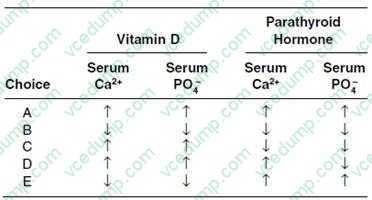
Which of the choices in the table below most accurately describes the actions of vitamin D and arathyroid hormone on calcium and phosphate in the blood?
A. Option A B. Option B C. Option C D. Option D E. Option E
D. Option D
Explanation
Section: Pharmacology Although there are several forms of vitamin D and both vitamin D and parathyroid hormone act on the intestine, kidney, and bone, the net effect of vitamin D is to increase serum calcium and phosphate, while parathyroid hormone increases serum calcium and decreases phosphate. None of the other options (choices AC, E) correctly reflects the actions of vitamin D or parathyroid hormone.
Nowadays, the certification exams become more and more important and required by more and more
enterprises when applying for a job. But how to prepare for the exam effectively? How to prepare
for the exam in a short time with less efforts? How to get a ideal result and how to find the
most reliable resources? Here on Vcedump.com, you will find all the answers.
Vcedump.com provide not only USMLE exam questions,
answers and explanations but also complete assistance on your exam preparation and certification
application. If you are confused on your USMLE-STEP-1 exam preparations
and USMLE certification application, do not hesitate to visit our
Vcedump.com to find your solutions here.