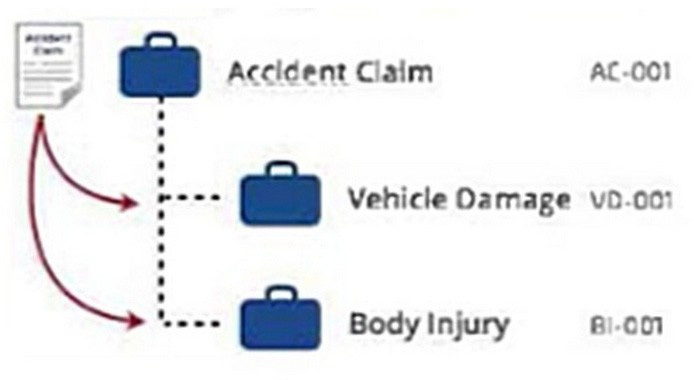
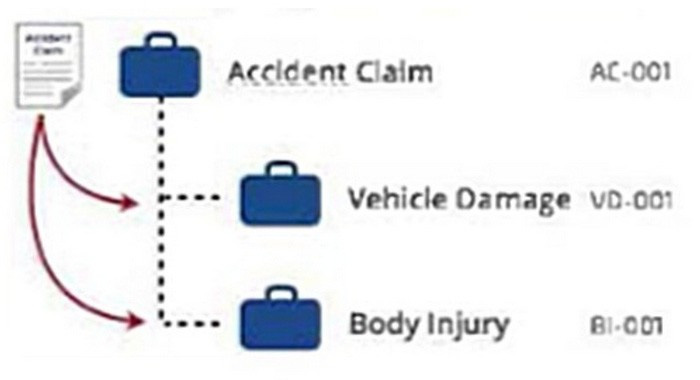
You are configuring an accident claim case with two child cases for an automobile insurance company, as shown in the following figure: The business requirement changes to allow the parent case to continue independently of the child case processes, what do you configure the Wait step for this requirement?
A. Configure the step so that users can continue with the parent case process regardless of child case status. B. Configure the step to continue the parent case when the child cases reach auditor approval. C. Configure the step to continue the parent case when the child cases reach the payment pending review status. D. Configure the step so that only one child case must be resolved before the parent case can continue.
A. Configure the step so that users can continue with the parent case process regardless of child case status. explanation:
Explanation/Reference:
To configure a parent case to continue independently of its child cases, you need to adjust the Wait step settings in the parent case. By configuring the Wait step so that users can continue with the parent case process regardless of the child case status, the parent case does not need to wait for the child cases to reach a certain status or be resolved. This allows for parallel processing where the parent case progresses independently of the child cases.
Question 2:
You need to fetch exchange rates that are updated on a daily basis from a web service and make them available in your application using a data page .
Which scope would you select for the data page?
A. Application B. Request C. Node D. Thread
B. Request explanation:
Explanation/Reference:
it fetches exchange rates that are updated on a daily basis from a web service and makes them available in your application using a data page. A request scope for a data page means that the data page is loaded once per user session and is
refreshed when the user logs out and logs back in. This way, the data page can provide the most up-to-date exchange rates for each user session.
References:
https://academy.pega.com/library/87/pega-certified-business-architect-pcba-87v1 (Module 10: Data Pages)
Question 3:
Direct Capture of Objectives (DCO) provides many benefits . Which of the following are benefits of DCO? (Choose Two)
A. Provide real-time awareness of project development to all project participants. B. Automatically define and store application requirements. C. Easily convert legacy operations to automated business processes. D. Use working models to better facilitate business and IT collaboration.
A. Provide real-time awareness of project development to all project participants. D. Use working models to better facilitate business and IT collaboration. explanation:
Explanation/Reference:
These two are benefits of DCO because they involve capturing, organizing, and storing information by using Pega's integrated solution, the Pega Platform. DCO enables business and IT to collaborate using a shared visual model that can automatically generate documentation and working models. DCO also provides real-time awareness of project development by using Pega tools and best practices to track progress and outcomes. References: https://www.pega.com/insights/articles/what-pega-dco
Question 4:
A retail company wants to provide a tracking tool for customers to enter their order number and see the order status, package location, and estimated delivery date. A small number of customers have requested a visualization tool that allows them to see a map with the path their package has traveled.
Which option fits the scope for the minimum lovable product (MLP) based on Pega best practices?
A. A view that presents the order status and delivery date details B. A view where the customer can enter their order number C. A view that presents the order status, delivery date details, and a map with the path the package has traveled D. A view that updates with order status and delivery date details when the customer enters the order number
D. A view that updates with order status and delivery date details when the customer enters the order number explanation:
Explanation/Reference:
This option fits the scope for the minimum lovable product (MLP) based on Pega best practices. An MLP is the smallest version of an application that delivers value to customers and stakeholders while meeting their core needs and expectations. Pega best practices suggest that you should focus on building an MLP that solves one problem well, provides immediate feedback, and creates positive emotions for users. The option D satisfies these criteria by allowing customers to enter their order number and see the order status and delivery date details in one view. References: https://community.pega.com/knowledgebase/articles/application-development/86/defining-minimum-lovable-product
Question 5:
Customers check their membership status with a company loyalty program by entering their full name and member ID number. Once the membership status is returned, the customer either abandons the case or makes changes to their membership. If the member chooses to make changes, a case ID is assigned to the request.
Which two configurations, when applied in combination, achieve this behavior? (Choose Two)
A. Configure the case type to create temporary cases. B. Add a decision shape to the process. C. Configure the stage to resolve the case. D. Add a Persist case step to the case life cycle.
A. Configure the case type to create temporary cases. D. Add a Persist case step to the case life cycle. explanation:
Explanation/Reference:
These answers are correct because they achieve the behavior of creating a case ID only when the customer chooses to make changes to their membership. Temporary cases are cases that are not stored in the database until a Persist case
step is reached in the case life cycle. This way, the case can be abandoned without creating any records or consuming any resources.
References:
https://academy.pega.com/library/87/pega-certified-business-architect-pcba-87v1 (Module 4: Case Design)
Question 6:
In a purchase order case the vendor assigned might not respond to a customer query in the desired amount of time required by policy. The vendor must respond within the time required according to policy.
Both the vendor and customer should be notified at each milestone.
To satisfy this requirement, create a service level that specifies two of the following options. (Choose Two)
A. Set the goal to be the required response time based on policy and send notifications to both parties. B. Set the deadline to be the required response time based on policy and send notifications to both parties. C. Set the deadline to be the desired response time based on policy and sends notifications to both parties. D. Set the goal to be the desired response time based on policy and send notifications to both parties.
A. Set the goal to be the required response time based on policy and send notifications to both parties. B. Set the deadline to be the required response time based on policy and send notifications to both parties. explanation:
Explanation/Reference:
To satisfy this requirement, you need to create a service level that specifies both A and B options. A service level is a rule that defines time intervals and actions for completing an assignment or resolving a case. A service level has two components: goal and deadline. The goal defines when an assignment or case should be completed ideally, while the deadline defines when an assignment or case must be completed at latest. You can also configure actions to perform at each component, such as sending notifications, escalating urgency, etc. References: https://community.pega.com/knowledgebase/articles/case-management/86/configuring-service-levels
Question 7:
How do you adjust the urgency value of an aging assignment to increase the likelihood that the assignment is completed before the deadline?
A. Apply an urgency value to the deadline interval. B. Adjust the default assignment urgency value. C. Apply an urgency value to the goal interval. D. Add an escalation action to the goal interval.
C. Apply an urgency value to the goal interval. explanation:
Explanation/Reference:
This answer is correct because it adjusts the urgency value of an aging assignment to increase the likelihood that the assignment is completed before the deadline. The goal interval in the service level defines the desired time for completing a
case or an assignment. If the goal interval is reached, an urgency value can be applied to increase the priority of the case or assignment and make it more visible in the work queue or work list.
As a customer, I want to be able to cancel an open service request at any time.
Select the configuration option that satisfies the user story.
A. Configure the Cancel button on the user views to resolve the case. B. Add an alternate stage to the case life cycle. C. Add a case wide action to the case workflow. D. Add a stage-only action to each stage in the case workflow.
C. Add a case wide action to the case workflow. explanation:
Explanation/Reference:
To satisfy this user story, you need to add a case wide action to the case workflow. A case wide action is an action that users can perform at any point in the case life cycle, regardless of their current stage or assignment status. You can add
a case wide action to allow users to cancel an open service request at any time and resolve the case accordingly.
Select the use case that requires an integration by using robotic process automation (RPA).
A. An online ordering application submits credit card information to a payment processor through a web service. B. An order management application updates a customer profile in a legacy system that lacks an exposed API. C. A drug trial management application submits trial data to a protected system through a secure connection. D. A service management application lists paint options sourced from a Pega Platform data object.
B. An order management application updates a customer profile in a legacy system that lacks an exposed API. explanation:
Explanation/Reference:
This use case requires an integration by using robotic process automation (RPA). RPA is a technology that automates tasks by mimicking human interactions with user interfaces of applications or systems. You can use RPA to integrate with legacy systems that lack an exposed API or a standard protocol for data exchange. For example, you can use RPA to update a customer profile in a legacy system by launching the system's application, entering the customer data, and clicking the save button. References: https://community.pega.com/knowledgebase/articles/application-development/86/integrating-robotic-process-automation
Question 10:
Which two requirements demonstrate the need to configure correspondence? (Choose Two)
A. Assign a new insurance claim to a case worker to process. B. Phone a customer for additional information about the case. C. Fax a new insurance claim to the auto repair shop. D. Text the customer with status changes in an insurance claim.
C. Fax a new insurance claim to the auto repair shop. D. Text the customer with status changes in an insurance claim. explanation:
Explanation/Reference:
These answers are correct because they demonstrate the need to configure correspondence, which is a way of communicating with external parties through email, fax, letter, or text message. Correspondence can be configured to send
information or documents related to a case to customers, stakeholders, or other parties involved in the case.
Nowadays, the certification exams become more and more important and required by more and more
enterprises when applying for a job. But how to prepare for the exam effectively? How to prepare
for the exam in a short time with less efforts? How to get a ideal result and how to find the
most reliable resources? Here on Vcedump.com, you will find all the answers.
Vcedump.com provide not only Pegasystems exam questions,
answers and explanations but also complete assistance on your exam preparation and certification
application. If you are confused on your PEGAPCBA87V1 exam preparations
and Pegasystems certification application, do not hesitate to visit our
Vcedump.com to find your solutions here.