PEGACPSA88V1 Exam Details
-
Exam Code
:PEGACPSA88V1 -
Exam Name
:Certified Pega System Architect (CPSA) 8.8V1 -
Certification
:Pegasystems Certifications -
Vendor
:Pegasystems -
Total Questions
:82 Q&As -
Last Updated
:Jul 13, 2026
Pegasystems PEGACPSA88V1 Online Questions & Answers
-
Question 1:
You are configuring an external data source using the Integration Designer. You have the REST, Dev, Stage, and Prod endpoint URLs, and a name for the data source. What other information do you need to configure the external data source?
A. The name of the database where the source data is stored
B. The data views using the external data source
C. A plan for mapping the data and REST response fields
D. A backup endpoint URL if the configured URL refuses to connect -
Question 2:
You are configuring routing for a customer warranty service request. All warranty servicerequests are routed to the warranty resolution group except for warranty service requests for betanrelease product that requires review by the vice president of service. How do you configure assignment routing to review warranty service requests?
A. Route the assignment to the vice president of service who routes assignments to the warranty resolution group as needed.
B. Route the assignment to the warranty resolution group who sends an email notification to the vice president of service for the beta-release product.
C. Route the assignment to the skilled group for the beta release when the request is for the beta release. Otherwise, route the assignment to the warranty resolution group.
D. Route the assignment to the vice president of service when the request is for the beta release. Otherwise, route the assignment to the warranty resolution group. -
Question 3:
Which two field types are specialized versions of the Query field type? (Choose two ) Available Choices (select all choices that are correct)
A. A Picklist
B. Case reference
C. Data reference
D. Embedded data -
Question 4:
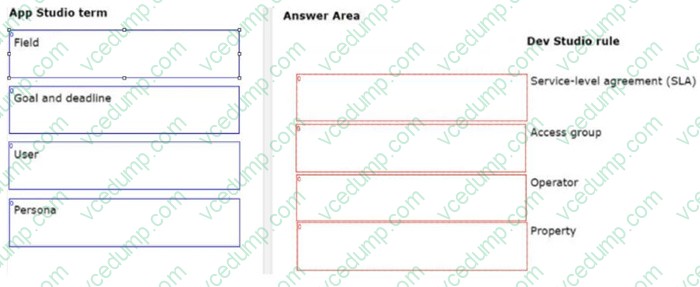
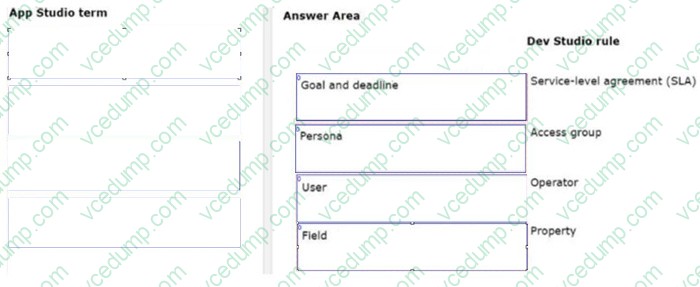
DRAG DROP
Drag the term that is used in App Studio from the left to the rule that you use in Dev Studio on the right.
Select and Place:
-
Question 5:
Sales managers must be able to approve sales quote proposals by email and from their mobile devices How do you implement this requirement?
Available Choices (select all choices that are correct)
A. Add an Approve/Reject step and enable email notifications on the case type
B. Add an Approve /Reject step and enable approval from email and mobile
C. Add an Approve/Reject step and a Send Email step
D. Add an Approve/Reject step with mobile approval enabled and add a Send Email step -
Question 6:
You want to unit test a rule to ensure that the rule executes as intended, you need to populate a test page with valid data.
Which two options allow you to populate a test page before testing the rule? (Choose two)
Available Choices (select all choices that are correct)
A. Configure an assertion to define the required data
B. Configure a validate rule to populate the page with the necessary data
C. Run a data transform to create the test page.
D. Copy data from an existing clipboard page -
Question 7:
An order fulfillment case type allows a customer to update user profile information during the order placement stage The user profile consists of the following three pages:
Account ID and password
Customer contact information
A list of open orders with the status of each order
How do you configure the case type to allow customers to update any of the user profile pages individually?
Available Choices (select all choices that are correct)
A. Add an alternate stage to the case life cycle.
B. Add a button for each profile page to each assignment
C. Add an optional process to the case workflow
D. Add a set of optional actions to the case workflow -
Question 8:
You are developing a case type that processes scholarship applications. Scholarship applications advance based on the standardized test scores of the applicants. A decision shape directs the process flow. You want to test whether the process flows correctly, but you have not fully configured the user interface so that applicants can enter their standardized test scores.
How do you test that the process flows correctly based on the decision?
A. Use the Run Rule window to create a unit test to evaluate the flow rule.
B. Use a declare expression to set a value for the standardized test score field.
C. Use Live Ul to see how the case processes and if an error occurs.
D. Use the Clipboard tool to set a value for the standardized test score field. -
Question 9:
Which of the following statements about responsive breakpoints is true?
Available Choices (select all choices that are correct)
A. Responsive breakpoints rely on fixed widths
B. Responsive breakpoint behavior changes based on the device brand
C. By default tables have two responsive breakpoints
D. Custom responsive breakpoints are configured in App Studio -
Question 10:
Which two statements are true about insights? (Choose two.)
Available Choices (select all choices that are correct)
A. You can transform data queries into sharable visualizations.
B. You can edit application data directly in an insight.
C. You can transform sharable visualizations into data queries.
D. You can search for and select the fields that you want to include in an insight.
Related Exams:
-
PEGACLSA74V1
Certified Pega Lead System Architect Pega Architecture (CLSA) 74V1 -
PEGACLSA74V1-A
LSA Pega Architecture 74V1 -
PEGACPBA24V1
Certified Pega Business Architect 24 -
PEGACPBA73V1
Certified Pega Business Architect (CPBA) 73V1 -
PEGACPBA74V1
Certified Pega Business Architect (CPBA) 74V1 -
PEGACPDC25V1
Certified Pega Decisioning Consultant 25 -
PEGACPDC74V1
Certified Pega Decisioning Consultant (CPDC) 74V1 -
PEGACPLSA23V1
Certified Pega Lead System Architecture (LSA) 23 -
PEGACPMC74V1
Certified Pega Marketing Consultant (CPMC) 74V1 -
PEGACPSA23V1
Certified Pega System Architect (CPSA) 23V1
Tips on How to Prepare for the Exams
Nowadays, the certification exams become more and more important and required by more and more enterprises when applying for a job. But how to prepare for the exam effectively? How to prepare for the exam in a short time with less efforts? How to get a ideal result and how to find the most reliable resources? Here on Vcedump.com, you will find all the answers. Vcedump.com provide not only Pegasystems exam questions, answers and explanations but also complete assistance on your exam preparation and certification application. If you are confused on your PEGACPSA88V1 exam preparations and Pegasystems certification application, do not hesitate to visit our Vcedump.com to find your solutions here.