PCNSE Exam Details
-
Exam Code
:PCNSE -
Exam Name
:Palo Alto Networks Certified Network Security Engineer - PAN-OS 11.x (PCNSE) -
Certification
:Palo Alto Networks Certifications -
Vendor
:Palo Alto Networks -
Total Questions
:860 Q&As -
Last Updated
:Mar 23, 2026
Palo Alto Networks PCNSE Online Questions & Answers
-
Question 121:
An administrator has configured PAN-OS SD-WAN and has received a request to find out the reason for a session failover for a session that has already ended. Where would you find this in Panorama or firewall logs?
A. Traffic Logs
B. System Logs
C. Session Browser
D. You cannot find failover details on closed sessions -
Question 122:
You are auditing the work of a co-worker and need to verify that they have matched the Palo Alto Networks Best Practices for Anti-Spyware Profiles. For Which three severity levels should single-packet captures be enabled to meet the Best Practice standard? (Choose three)
A. High
B. Medium
C. Critical
D. Informational
E. Low -
Question 123:
Review the screenshot of the Certificates page.
An administrator for a small LLC has created a series of certificates as shown, to use for a planned Decryption roll out. The administrator has also installed the self-signed root certificate in all client systems.
When testing, they noticed that every time a user visited an SSL site, they received unsecured website warnings.
What is the cause of the unsecured website warnings?
A. The forward untrust certificate has not been signed by the self-singed root CA certificate.
B. The forward trust certificate has not been installed in client systems.
C. The self-signed CA certificate has the same CN as the forward trust and untrust certificates.
D. The forward trust certificate has not been signed by the self-singed root CA certificate. -
Question 124:
An engineer is tasked with enabling SSL decryption across the environment. What are three valid parameters of an SSL Decryption policy? (Choose three.)
A. URL categories
B. source users
C. source and destination IP addresses
D. App-ID
E. GlobalProtect HIP -
Question 125:
A firewall has been assigned to a new template stack that contains both "Global" and "Local" templates in Panorama, and a successful commit and push has been performed. While validating the configuration on the local firewall, the engineer
discovers that some settings are not being applied as intended.
The setting values from the "Global" template are applied to the firewall instead of the "Local" template that has different values for the same settings.
What should be done to ensure that the settings in the "Local" template are applied while maintaining settings from both templates?
A. Move the "Global" template above the "Local" template in the template stack.
B. Perform a commit and push with the "Force Template Values" option selected.
C. Move the "Local" template above the "Global" template in the template stack.
D. Override the values on the local firewall and apply the correct settings for each value. -
Question 126:
How can a firewall engineer bypass App-ID and content inspection features on a Palo Alto Networks firewall when troubleshooting?
A. Create a custom application, define its properties and signatures, and ensure all scanning options in the "Advanced" tab are unchecked
B. Create a custom application, define its properties, then create an application override and reference the custom application
C. Create a new security rule specifically for the affected traffic, but do not reference any Security Profiles inside the rule
D. Create a new security rule specifically for the affected traffic, and select "Disable Server Response Inspection" -
Question 127:
An engineer is monitoring an active/active high availability (HA) firewall pair.
Which HA firewall state describes the firewall that is experiencing a failure of a monitored path?
A. Initial
B. Passive
C. Active-secondary
D. Tentative -
Question 128:
Given the Sample Log Forwarding Profile shown, which two statements are true? (Choose two.)
A. All traffic from source network 192.168.100.0/24 is sent to an external syslog target.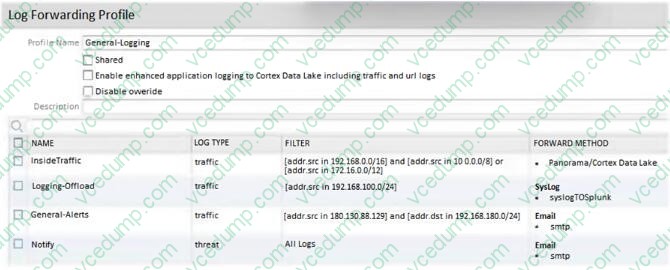
B. All threats are logged to Panorama.
C. All traffic logs from RFC 1918 subnets are logged to Panorama / Cortex Data Lake.
D. All traffic from source network 172.12.0.0/24 is sent to Panorama / Cortex Data Lake. -
Question 129:
Which log type would provide information about traffic blocked by a Zone Protection profile?
A. Data Filtering
B. IP-Tag
C. Traffic
D. Threat -
Question 130:
A security engineer needs to mitigate packet floods that occur on a set of servers behind the internet facing interface of the firewall. Which Security Profile should be applied to a policy to prevent these packet floods?
A. URL Filtering profile
B. Vulnerability Protection profile
C. Data Filtering profile
D. DoS Protection profile
Related Exams:
-
PAN-CSP
Palo Alto Networks Cloud Security Professional -
PAN-NGFE
Palo Alto Networks Network Next-Generation Firewall Engineer -
PAN-NSA
Palo Alto Networks Network Security Analyst -
PAN-NSG
Palo Alto Networks Network Security Professional -
PAN-NSP
Palo Alto Networks Network Security Professional -
PAN-SDWE
Palo Alto Networks SD-WAN Engineer -
PAN-SOP
Palo Alto Networks Security Operations Professional -
PAN-SSEE
Palo Alto Networks Security Service Edge Engineer -
PAN-XDRA
Palo Alto Networks XDR Analyst -
PAN-XDRE
Palo Alto Networks XDR Engineer
Tips on How to Prepare for the Exams
Nowadays, the certification exams become more and more important and required by more and more enterprises when applying for a job. But how to prepare for the exam effectively? How to prepare for the exam in a short time with less efforts? How to get a ideal result and how to find the most reliable resources? Here on Vcedump.com, you will find all the answers. Vcedump.com provide not only Palo Alto Networks exam questions, answers and explanations but also complete assistance on your exam preparation and certification application. If you are confused on your PCNSE exam preparations and Palo Alto Networks certification application, do not hesitate to visit our Vcedump.com to find your solutions here.