PCNSE Exam Details
-
Exam Code
:PCNSE -
Exam Name
:Palo Alto Networks Certified Network Security Engineer - PAN-OS 11.x (PCNSE) -
Certification
:Palo Alto Networks Certifications -
Vendor
:Palo Alto Networks -
Total Questions
:860 Q&As -
Last Updated
:Mar 23, 2026
Palo Alto Networks PCNSE Online Questions & Answers
-
Question 111:
A firewall administrator has been tasked with ensuring that all Panorama configuration is committed and pushed to the devices at the end of the day at a certain time. How can they achieve this?
A. Use the Scheduled Config Export to schedule Commit to Panorama and also Push to Devices.
B. Use the Scheduled Config Push to schedule Push lo Devices and separately schedule an API call to commit all Panorama changes.
C. Use the Scheduled Config Export to schedule Push to Devices and separately schedule an API call to commit all Panorama changes.
D. Use the Scheduled Config Push to schedule Commit to Panorama and also Push to Devices. -
Question 112:
Refer to the exhibit.
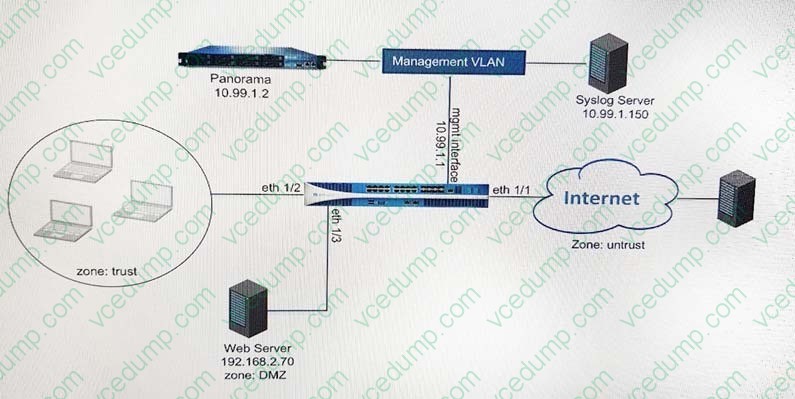
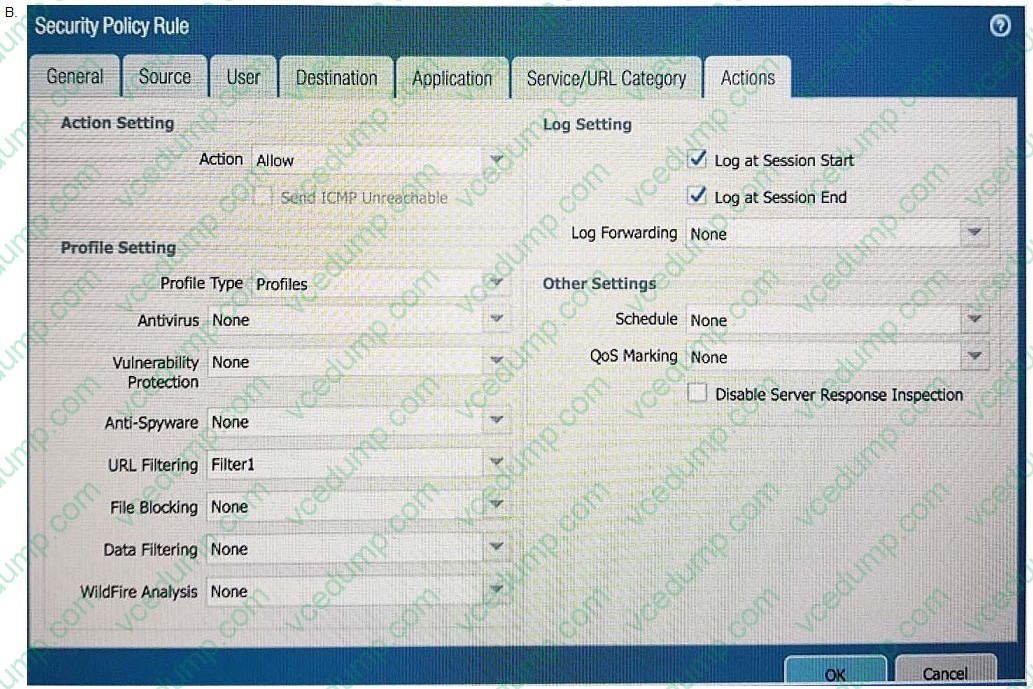
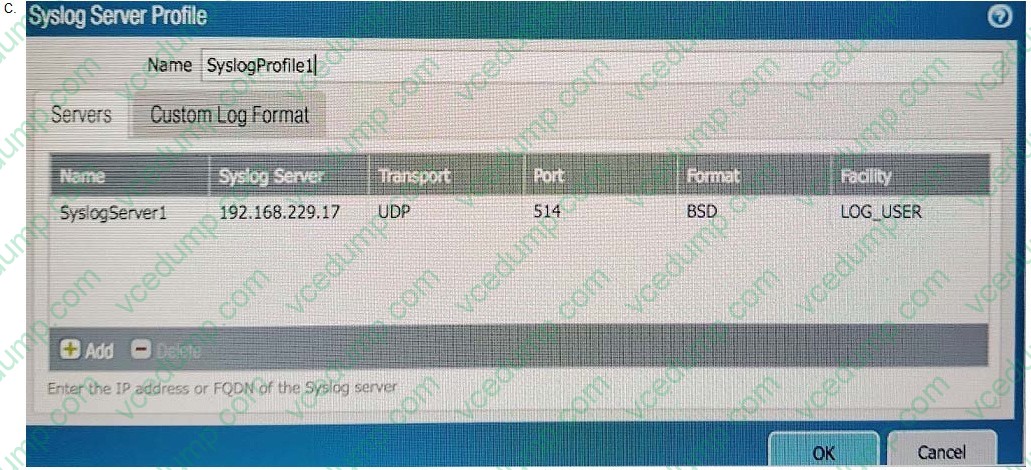
An administrator cannot see any of the Traffic logs from the Palo Alto Networks NGFW on Panorama. The configuration problem seems to be on the firewall side. Where is the best place on the Palo Alto Networks NGFW to check whether the configuration is correct?
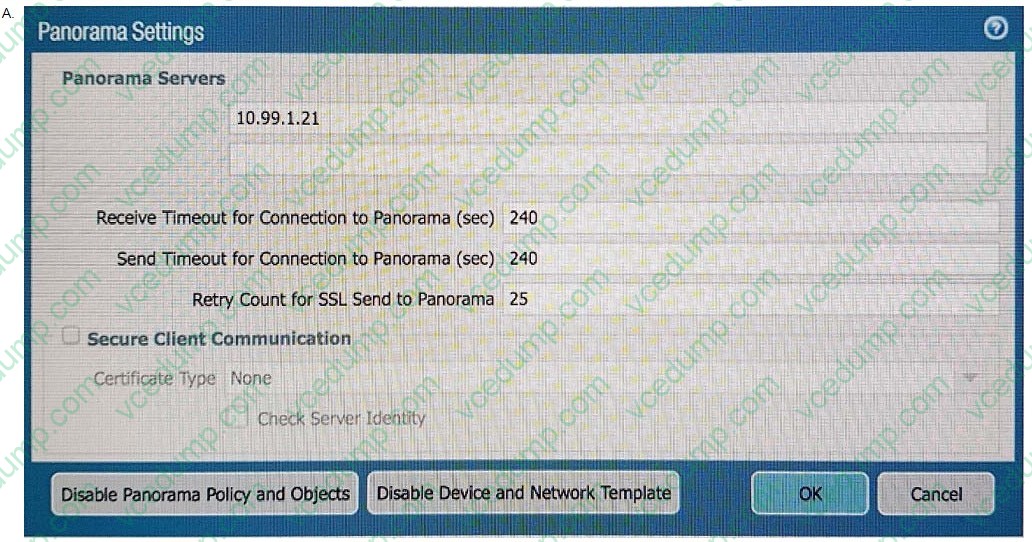
A. Option A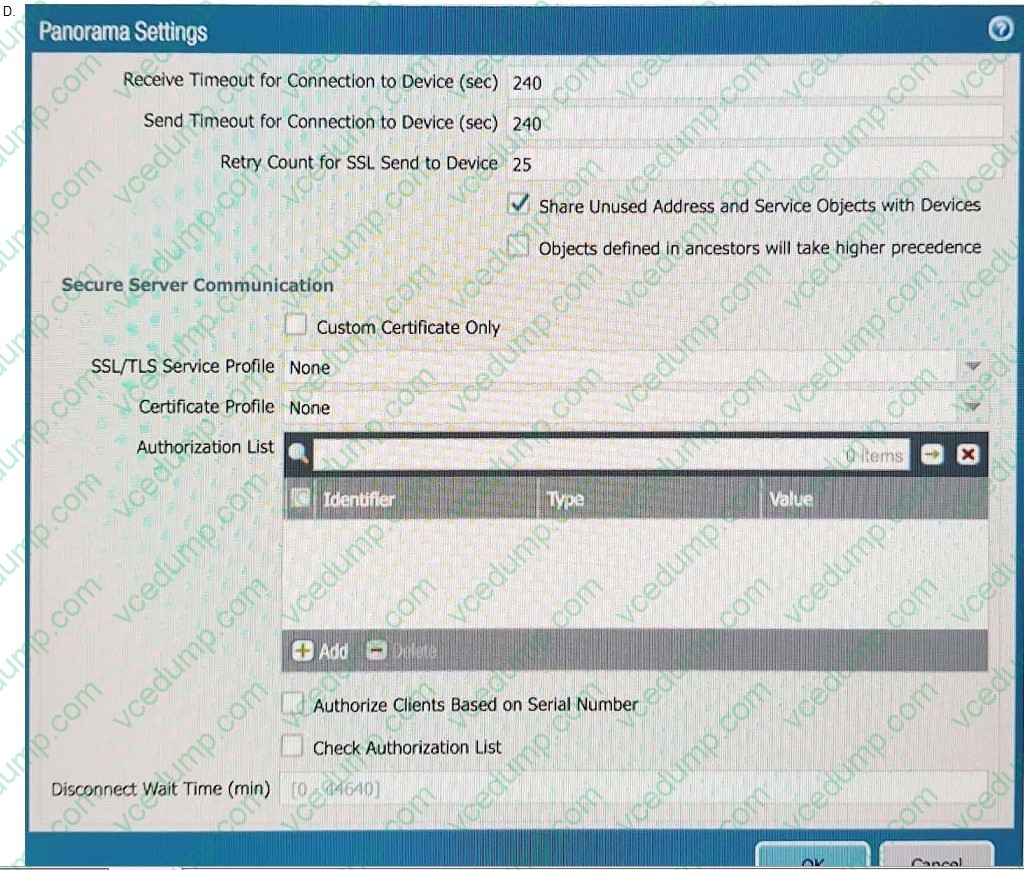
B. Option B
C. Option C
D. Option D -
Question 113:
A firewall engineer creates a source NAT rule to allow the company's internal private network 10.0.0.0/23 to access the internet. However, for security reasons, one server in that subnet (10.0.0.10/32) should not be allowed to access the internet, and therefore should not be translated with the NAT rule.
Which set of steps should the engineer take to accomplish this objective?
A. 1. Create a NAT rule (NAT-Rule-1) and set the source address in the original packet to 10.0.0.10/32. 2. Check the box for negate option to negate this IP from the NAT translation.
B. 1. Create a NAT rule (NAT-Rule-1) and set the source address in the original packet to 10.0.0.0/23. 2. Check the box for negate option to negate this IP subnet from NAT translation.
C. 1. Create a source NAT rule (NAT-Rule-1) to translate 10.0.0/23 with source address translation set to dynamic IP and port. 2.Create another NAT rule (NAT-Rule-2) with source IP address in the original packet set to 10.0.0.10/32 and source translation set to none. 3.Place (NAT-Rule-2) above (NAT-Rule-1).
D. 1. Create a source NAT rule (NAT-Rule-1) to translate 10.0.0/23 with source address translation set to dynamic IP and port. 2.Create another NAT rule (NAT-Rule-2) with source IP address in the original packet set to 10.0.0.10/32 and source translation set to none. 3.Place (NAT-Rule-1) above (NAT-Rule-2). -
Question 114:
A network security administrator wants to begin inspecting bulk user HTTPS traffic flows egressing out of the internet edge firewall. Which certificate is the best choice to configure as an SSL Forward Trust certificate?
A. A self-signed Certificate Authority certificate generated by the firewall
B. A Machine Certificate for the firewall signed by the organization's PKI
C. A web server certificate signed by the organization's PKI
D. A subordinate Certificate Authority certificate signed by the organization's PKI -
Question 115:
In which two types of deployment is active/active HA configuration supported? (Choose two.)
A. TAP mode
B. Layer 2 mode
C. Virtual Wire mode
D. Layer 3 mode -
Question 116:
An administrator using an enterprise PKI needs to establish a unique chain of trust to ensure mutual authentication between Panorama and the managed firewalls and Log Collectors. How would the administrator establish the chain of trust?
A. Use custom certificates
B. Enable LDAP or RADIUS integration
C. Set up multi-factor authentication
D. Configure strong password authentication -
Question 117:
Which Zone Pair and Rule Type will allow a successful connection for a user on the internet zone to a web server hosted in the DMZ zone?
The web server is reachable using a destination Nat policy in the Palo Alto Networks firewall.
A. Zone Pair: Source Zone: Internet Destination Zone: DMZ Rule Type: "intrazone"
B. Zone Pair: Source Zone: Internet Destination Zone: DMZ Rule Type: "intrazone" or "universal"
C. Zone Pair: Source Zone: Internet Destination Zone: Internet Rule Type: "intrazone" or "universal"
D. Zone Pair: Source Zone: Internet Destination Zone: Internet Rule Type: "intrazone" -
Question 118:
Which feature must you configure to prevent users form accidentally submitting their corporate credentials to a phishing website?
A. URL Filtering profile
B. Zone Protection profile
C. Anti-Spyware profile
D. Vulnerability Protection profile -
Question 119:
When configuring forward error correction (FEC) for PAN-OS SD-WAN, an administrator would turn on the feature inside which type of SD-WAN profile?
A. Certificate profile
B. Path Quality profile
C. SD-WAN Interface profile
D. Traffic Distribution profile -
Question 120:
An engineer is pushing configuration from Panorama lo a managed firewall.
What happens when the pushed Panorama configuration has Address Object names that duplicate the Address Objects already configured on the firewall?
A. The firewall rejects the pushed configuration, and the commit fails.
B. The firewall renames the duplicate local objects with "-1" at the end signifying they are clones; it will update the references to the objects accordingly and fully commit the pushed configuration.
C. The firewall fully commits all of the pushed configuration and overwrites its locally configured objects
D. The firewall ignores only the pushed objects that have the same name as the locally configured objects, and it will commit the rest of the pushed configuration.
Related Exams:
-
PAN-CSP
Palo Alto Networks Cloud Security Professional -
PAN-NGFE
Palo Alto Networks Network Next-Generation Firewall Engineer -
PAN-NSA
Palo Alto Networks Network Security Analyst -
PAN-NSG
Palo Alto Networks Network Security Professional -
PAN-NSP
Palo Alto Networks Network Security Professional -
PAN-SDWE
Palo Alto Networks SD-WAN Engineer -
PAN-SOP
Palo Alto Networks Security Operations Professional -
PAN-SSEE
Palo Alto Networks Security Service Edge Engineer -
PAN-XDRA
Palo Alto Networks XDR Analyst -
PAN-XDRE
Palo Alto Networks XDR Engineer
Tips on How to Prepare for the Exams
Nowadays, the certification exams become more and more important and required by more and more enterprises when applying for a job. But how to prepare for the exam effectively? How to prepare for the exam in a short time with less efforts? How to get a ideal result and how to find the most reliable resources? Here on Vcedump.com, you will find all the answers. Vcedump.com provide not only Palo Alto Networks exam questions, answers and explanations but also complete assistance on your exam preparation and certification application. If you are confused on your PCNSE exam preparations and Palo Alto Networks certification application, do not hesitate to visit our Vcedump.com to find your solutions here.