NSE7_EFW-7.2 Exam Details
-
Exam Code
:NSE7_EFW-7.2 -
Exam Name
:Fortinet NSE 7 - Enterprise Firewall 7.2 -
Certification
:Fortinet Certifications -
Vendor
:Fortinet -
Total Questions
:80 Q&As -
Last Updated
:Jul 15, 2026
Fortinet NSE7_EFW-7.2 Online Questions & Answers
-
Question 51:
Which statement about ADVPN is true?
A. lt only uses BGP for dynamic routing
B. It requires all the devices must be on the same AS for inter-region ADVPN topology
C. lt is a combination of hub-and spoke and full-mesh topologies
D. It supports only on single hub-and spoke architecture -
Question 52:
Exhibit.
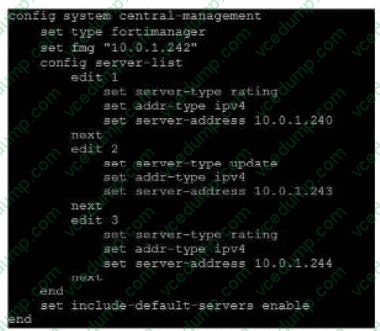
Refer to exhibit, which shows a central management configuration
Which server will FortiGate choose for web filler rating requests if 10.0.1.240 is experiencing an outage?
A. Public FortiGuard servers
B. 10.0.1.242
C. 10.0.1.244
D. 10.0.1.243 -
Question 53:
In which two ways does FortiManager function when it is deployed as a local FDS? (Choose two.)
A. It caches available firmware updates for both managed and unmanaged devices
B. It can be configured as an update server a rating server or both
C. It functions as rating server only for web filtering and antispam services
D. It downloads license information for registered and unregistered devices -
Question 54:
Exhibit.
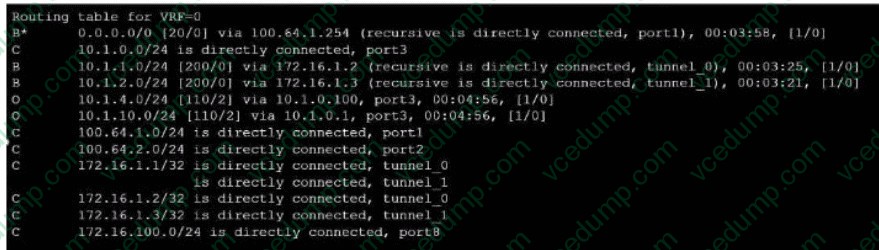
Refer to the exhibit, which shows a partial touting table What two concisions can you draw from the corresponding FortiGate configuration? (Choose two.)
A. IPSec Tunnel aggregation is configured
B. net-device is enabled in the tunnel IPSec phase 1 configuration
C. OSPI is configured to run over IPSec.
D. add-route is disabled in the tunnel IPSec phase 1 configuration. -
Question 55:
Refer to the exhibit, which shows a routing table.

What two options can you configure in OSPF to block the advertisement of the 10.1.10.0 prefix? (Choose two.)
A. Remove the 16.1.10.C prefix from the OSPF network
B. Configure a distribute-list-out
C. Configure a route-map out
D. Disable Redistribute Connected -
Question 56:
Which statement about the designated router (DR) and backup designated router (BDR) in an OSPF multi-access network is true?
A. Only the DR receives link state information from non-DR routers.
B. Non-DR and non-BDR routers form full adjacencies to DR only.
C. FortiGate first checks the OSPF ID to elect a DR.
D. Non-DR and non-BDR routers send link state updates and acknowledgements to 224.0.0.6. -
Question 57:
What is true about the Fitter override option in the application control profile?
A. Helps to configure actions for predefined categories
B. Helps to categorize applications based on behavior risk or on technology
C. Helps to view the application control signatures for a specific category
D. Helps to control specific signature and applications -
Question 58:
Which two statements about bfd are true? (Choose two)
A. It can support neighbor only over the next hop in BGP
B. You can disable it at the protocol level
C. It works for OSPF and BGP
D. You must configure n globally only -
Question 59:
You created a VPN community using VPN Manager on FortiManager. You also added gateways to the VPN community. Now you are trying to create firewall policies to permit traffic over the tunnel however, the VPN interfaces do not appear as available options.
A. Create interface mappings for the IPsec VPN interfaces before you use them in a policy.
B. Refresh the device status using the Device Manager so that FortiGate populates the IPSec interfaces
C. Configure the phase 1 settings in the VPN community that you didnt initially configure. FortiGate automatically generates the interfaces after you configure the required settings
D. install the VPN community and gateway configuration on the fortiGate devices so that the VPN interfaces appear on the Policy Objects on fortiManager. -
Question 60:
Refer to the exhibit, which contains a partial BGP combination.
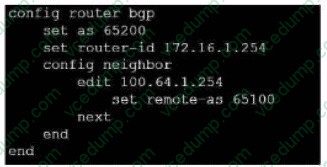
You want to configure a loopback as the OGP source.
Which two parameters must you set in the BGP configuration? (Choose two)
A. ebgp-enforce-multihop
B. recursive-next-hop
C. ibgp-enfoce-multihop
D. update-source
Related Exams:
-
EMEA-ADVANCED-SUPPORT
Fortinet EMEA Advanced Support -
FCP_FAC_AD-6.5
FCP - FortiAuthenticator 6.5 Administrator -
FCP_FAZ_AD-7.4
FCP - FortiAnalyzer 7.4 Administrator -
FCP_FAZ_AN-7.4
FCP - FortiAnalyzer 7.4 Analyst -
FCP_FAZ_AN-7.6
Fortinet NSE 5 - FortiAnalyzer 7.6 Analyst -
FCP_FCT_AD-7.2
FCP - Forti Client EMS 7.2 Administrator -
FCP_FCT_AD-7.4
Fortinet NSE 6 - FortiClient EMS 7.4 Administrator -
FCP_FGT_AD-7.4
FCP - FortiGate 7.4 Administrator -
FCP_FGT_AD-7.6
FortiGate 7.6 Administrator FCP_FGT_AD-7.6 -
FCP_FMG_AD-7.4
FCP - FortiManager 7.4 Administrator
Tips on How to Prepare for the Exams
Nowadays, the certification exams become more and more important and required by more and more enterprises when applying for a job. But how to prepare for the exam effectively? How to prepare for the exam in a short time with less efforts? How to get a ideal result and how to find the most reliable resources? Here on Vcedump.com, you will find all the answers. Vcedump.com provide not only Fortinet exam questions, answers and explanations but also complete assistance on your exam preparation and certification application. If you are confused on your NSE7_EFW-7.2 exam preparations and Fortinet certification application, do not hesitate to visit our Vcedump.com to find your solutions here.