MULESOFT-PLATFORM-ARCHITECT-I Exam Details
-
Exam Code
:MULESOFT-PLATFORM-ARCHITECT-I -
Exam Name
:Salesforce Certified MuleSoft Platform Architect (Mule-Arch-201) -
Certification
:Salesforce Certifications -
Vendor
:Salesforce -
Total Questions
:154 Q&As -
Last Updated
:Jul 10, 2026
Salesforce MULESOFT-PLATFORM-ARCHITECT-I Online Questions & Answers
-
Question 131:
Refer to the exhibit.
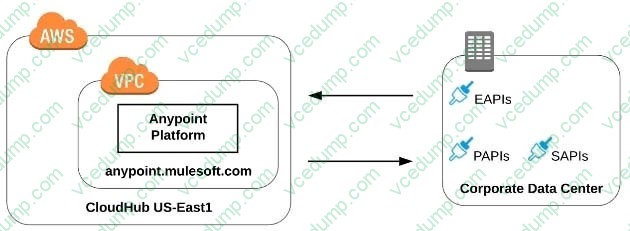
what is true when using customer-hosted Mule runtimes with the MuleSoft-hosted Anypoint Platform control plane (hybrid deployment)?
A. Anypoint Runtime Manager initiates a network connection to a Mule runtime in order to deploy Mule applications
B. The MuleSoft-hosted Shared Load Balancer can be used to load balance API invocations to the Mule runtimes
C. API implementations can run successfully in customer-hosted Mule runtimes, even when they are unable to communicate with the control plane
D. Anypoint Runtime Manager automatically ensures HA in the control plane by creating a new Mule runtime instance in case of a node failure -
Question 132:
Due to a limitation in the backend system, a system API can only handle up to 500 requests per second. What is the best type of API policy to apply to the system API to avoid overloading the backend system?
A. Rate limiting
B. HTTP caching
C. Rate limiting - SLA based
D. Spike control -
Question 133:
An organization wants to make sure only known partners can invoke the organization's APIs. To achieve this security goal, the organization wants to enforce a Client ID Enforcement policy in API Manager so that only registered partner applications can invoke the organization's APIs. In what type of API implementation does MuleSoft recommend adding an API proxy to enforce the Client ID Enforcement policy, rather than embedding the policy directly in the application's JVM?
A. A Mule 3 application using APIkit
B. A Mule 3 or Mule 4 application modified with custom Java code
C. A Mule 4 application with an API specification
D. A Non-Mule application -
Question 134:
The responses to some HTTP requests can be cached depending on the HTTP verb used in the request. According to the HTTP specification, for what HTTP verbs is this safe to do?
A. PUT, POST, DELETE
B. GET, HEAD, POST
C. GET, PUT, OPTIONS
D. GET, OPTIONS, HEAD -
Question 135:
What Mule application deployment scenario requires using Anypoint Platform Private Cloud Edition or Anypoint Platform for Pivotal Cloud Foundry?
A. When it Is required to make ALL applications highly available across multiple data centers
B. When it is required that ALL APIs are private and NOT exposed to the public cloud
C. When regulatory requirements mandate on-premises processing of EVERY data item, including meta-data
D. When ALL backend systems in the application network are deployed in the organization's intranet -
Question 136:
A customer wants to monitor and gain insights about the number of requests coming in a given time period as well as to measure key performance indicators (response times, CPU utilization, number of active APIs). Which tool provides these data insights?
A. Anypoint Monitoring
B. APT Manager
C. Runtime Alerts
D. Functional Monitoring -
Question 137:
An Anypoint Platform organization has been configured with an external identity provider (IdP) for identity management and client management. What credentials or token must be provided to Anypoint CLI to execute commands against the Anypoint Platform APIs?
A. The credentials provided by the IdP for identity management
B. The credentials provided by the IdP for client management
C. An OAuth 2. 0 token generated using the credentials provided by the IdP for client management
D. An OAuth 2. 0 token generated using the credentials provided by the IdP for identity management -
Question 138:
How can the application of a rate limiting API policy be accurately reflected in the RAML definition of an API?
A. By refining the resource definitions by adding a description of the rate limiting policy behavior
B. By refining the request definitions by adding a remaining Requests query parameter with description, type, and example
C. By refining the response definitions by adding the out-of-the-box Anypoint Platform rate-limit-enforcement securityScheme with description, type, and example
D. By refining the response definitions by adding the x-ratelimit-* response headers with description, type, and example -
Question 139:
Once an API Implementation is ready and the API is registered on API Manager, who should request the access to the API on Anypoint Exchange?
A. None
B. Both
C. API Client
D. API Consumer -
Question 140:
A retail company is using an Order API to accept new orders. The Order API uses a JMS queue to submit orders to a backend order management service. The normal load for orders is being handled using two (2) CloudHub workers, each configured with 0.2 vCore. The CPU load of each CloudHub worker normally runs well below 70%. However, several times during the year the Order API gets four times (4x) the average number of orders. This causes the CloudHub worker CPU load to exceed 90% and the order submission time to exceed 30 seconds. The cause, however, is NOT the backend order management service, which still responds fast enough to meet the response SLA for the Order API. What is the MOST resource-efficient way to configure the Mule application's CloudHub deployment to help the company cope with this performance challenge?
A. Permanently increase the size of each of the two (2) CloudHub workers by at least four times (4x) to one (1) vCore
B. Use a vertical CloudHub autoscaling policy that triggers on CPU utilization greater than 70%
C. Permanently increase the number of CloudHub workers by four times (4x) to eight (8) CloudHub workers
D. Use a horizontal CloudHub autoscaling policy that triggers on CPU utilization greater than 70%
Related Exams:
-
201-COMMERCIAL-BANKING-FUNCTIONAL
Salesforce enCino 201 Commercial Banking Functional -
ADM-201
Salesforce Certified Platform Administrator (Plat-Admn-201) -
ADM-211
Administration Essentials for Experienced Admin (ADM-211) -
ADM-261
Service Cloud Administration (SU24) -
ADVANCED-ADMINISTRATOR
Salesforce Certified Advanced Administrator -
ADVANCED-CROSS-CHANNEL
Marketing Cloud Advanced Cross Channel Accredited Professional -
ADX-201
Administrative Essentials for New Admins in Lightning Experience -
ADX-271
Salesforce Certified Community Cloud Consultant (ADX-271) -
AGENTFORCE-SPECIALIST
Salesforce Certified Agentforce Specialist (AI-201) -
ALS-CON-201
Salesforce Certified Agentforce Life Sciences Consultant
Tips on How to Prepare for the Exams
Nowadays, the certification exams become more and more important and required by more and more enterprises when applying for a job. But how to prepare for the exam effectively? How to prepare for the exam in a short time with less efforts? How to get a ideal result and how to find the most reliable resources? Here on Vcedump.com, you will find all the answers. Vcedump.com provide not only Salesforce exam questions, answers and explanations but also complete assistance on your exam preparation and certification application. If you are confused on your MULESOFT-PLATFORM-ARCHITECT-I exam preparations and Salesforce certification application, do not hesitate to visit our Vcedump.com to find your solutions here.