MULESOFT-PLATFORM-ARCHITECT-I Exam Details
-
Exam Code
:MULESOFT-PLATFORM-ARCHITECT-I -
Exam Name
:Salesforce Certified MuleSoft Platform Architect (Mule-Arch-201) -
Certification
:Salesforce Certifications -
Vendor
:Salesforce -
Total Questions
:154 Q&As -
Last Updated
:Jul 10, 2026
Salesforce MULESOFT-PLATFORM-ARCHITECT-I Online Questions & Answers
-
Question 111:
When should idempotency be taken into account?
A. When making requests to update currently locked entities
B. When storing the results of s previous request for use in response to subsequent requests
C. When sending concurrent update requests for the same entity
D. When preventing duplicate processing from multiple sent requests -
Question 112:
An organization has several APIs that accept JSON data over HTTP POST. The APIs are all publicly available and are associated with several mobile applications and web applications.
The organization does NOT want to use any authentication or compliance policies for these APIs, but at the same time, is worried that some bad actor could send payloads that could somehow compromise the applications or servers running
the API implementations.
What out-of-the-box Anypoint Platform policy can address exposure to this threat?
A. Shut out bad actors by using HTTPS mutual authentication for all API invocations
B. Apply an IP blacklist policy to all APIs; the blacklist will Include all bad actors
C. Apply a Header injection and removal policy that detects the malicious data before it is used
D. Apply a JSON threat protection policy to all APIs to detect potential threat vectors -
Question 113:
An IT Security Compliance Auditor is assessing which nonfunctional requirements (NFRs) are already being implemented to meet security measures.
1. The Web API has Rate-Limiting SLA
2. Basic Authentication - LDAP
3. JSON Threat Protection
4. TP Allowlist policies applied Which two NFRs-are enforced?
A. The API invocations are coming from a known subnet range
B. Username/password supported to validate login credentials
C. Sensitive data is masked to prevent compromising critical information
D. The API is protected against XML invocation attacks
E. Performance expectations are to be allowed up to 1,000 requests per second -
Question 114:
What should be ensured before sharing an API through a public Anypoint Exchange portal?
A. The visibility level of the API instances of that API that need to be publicly accessible should be set to public visibility
B. The users needing access to the API should be added to the appropriate role in Anypoint Platform
C. The API should be functional with at least an initial implementation deployed and accessible for users to interact with
D. The API should be secured using one of the supported authentication/authorization mechanisms to ensure that data is not compromised -
Question 115:
A company deploys Mule applications with default configurations through Runtime Manager to customer-hosted Mule runtimes. Each Mule application is an API implementation that exposes RESTful interfaces to API clients. The Mule
runtimes are managed by the MuleSoft-hosted control plane. The payload is never used by any Logger components.
When an API client sends an HTTP request to a customer-hosted Mule application, which metadata or data (payload) is pushed to the MuleSoft-hosted control plane?
A. Only the data
B. No data
C. The data and metadata
D. Only the metadata -
Question 116:
An organization is deploying their new implementation of the OrderStatus System API to multiple workers in CloudHub. This API fronts the organization's on-premises Order Management System, which is accessed by the API implementation over an IPsec tunnel.
What type of error typically does NOT result in a service outage of the OrderStatus System API?
A. A CloudHub worker fails with an out-of-memory exception
B. API Manager has an extended outage during the initial deployment of the API implementation
C. The AWS region goes offline with a major network failure to the relevant AWS data centers
D. The Order Management System is Inaccessible due to a network outage in the organization's on-premises data center -
Question 117:
Refer to the exhibit.
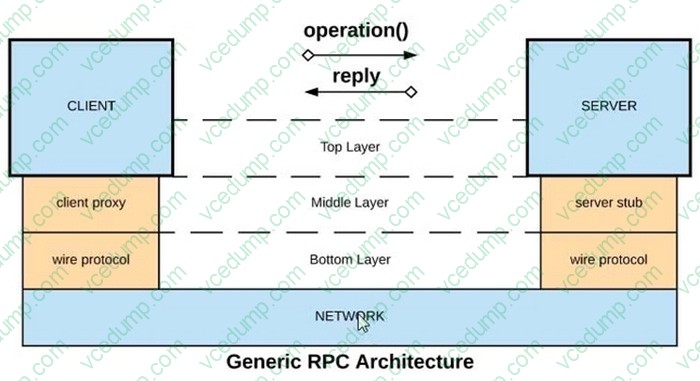
What is a valid API in the sense of API-led connectivity and application networks?
A. Option A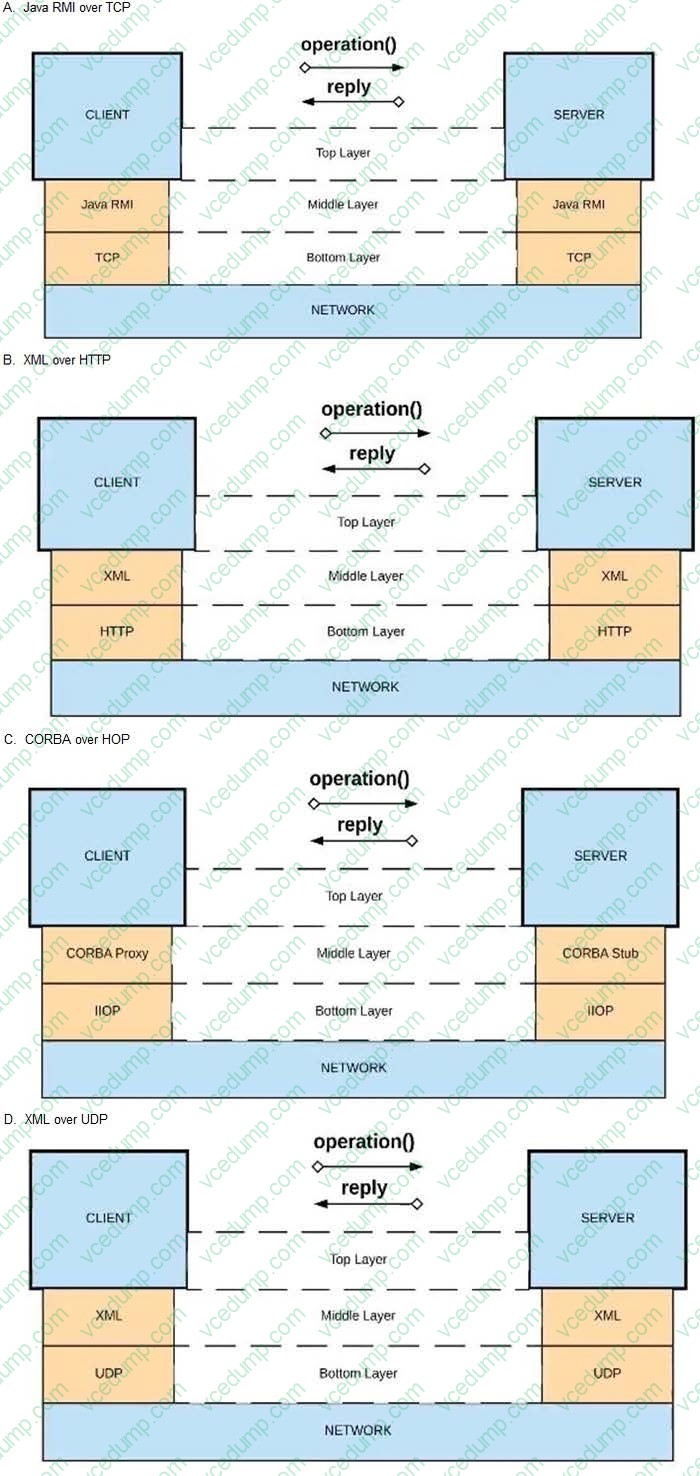
B. Option B
C. Option C
D. Option D -
Question 118:
What is true about the technology architecture of Anypoint VPCs?
A. The private IP address range of an Anypoint VPC is automatically chosen by CloudHub
B. Traffic between Mule applications deployed to an Anypoint VPC and on-premises systems can stay within a private network
C. Each CloudHub environment requires a separate Anypoint VPC
D. VPC peering can be used to link the underlying AWS VPC to an on-premises (non AWS) private network -
Question 119:
What is the main change to the IT operating model that MuleSoft recommends to organizations to improve innovation and clock speed?
A. Drive consumption as much as production of assets; this enables developers to discover and reuse assets from other projects and encourages standardization
B. Expose assets using a Master Data Management (MDM) system; this standardizes projects and enables developers to quickly discover and reuse assets from other projects
C. Implement SOA for reusable APIs to focus on production over consumption; this standardizes on XML and WSDL formats to speed up decision making
D. Create a lean and agile organization that makes many small decisions everyday; this speeds up decision
E. making and enables each line of business to take ownership of its projects -
Question 120:
What is true about automating interactions with Anypoint Platform using tools such as Anypoint Platform REST APIs, Anypoint CU, or the Mule Maven plugin?
A. Access to Anypoint Platform APIs and Anypoint CU can be controlled separately through the roles and permissions in Anypoint Platform, so that specific users can get access to Anypoint CLI white others get access to the platform APIs
B. Anypoint Platform APIs can ONLY automate interactions with CloudHub, while the Mule Maven plugin is required for deployment to customer-hosted Mule runtimes
C. By default, the Anypoint CLI and Mule Maven plugin are NOT included in the Mule runtime, so are NOT available to be used by deployed Mule applications
D. API policies can be applied to the Anypoint Platform APIs so that ONLY certain LOBs have access to specific functions
Related Exams:
-
201-COMMERCIAL-BANKING-FUNCTIONAL
Salesforce enCino 201 Commercial Banking Functional -
ADM-201
Salesforce Certified Platform Administrator (Plat-Admn-201) -
ADM-211
Administration Essentials for Experienced Admin (ADM-211) -
ADM-261
Service Cloud Administration (SU24) -
ADVANCED-ADMINISTRATOR
Salesforce Certified Advanced Administrator -
ADVANCED-CROSS-CHANNEL
Marketing Cloud Advanced Cross Channel Accredited Professional -
ADX-201
Administrative Essentials for New Admins in Lightning Experience -
ADX-271
Salesforce Certified Community Cloud Consultant (ADX-271) -
AGENTFORCE-SPECIALIST
Salesforce Certified Agentforce Specialist (AI-201) -
ALS-CON-201
Salesforce Certified Agentforce Life Sciences Consultant
Tips on How to Prepare for the Exams
Nowadays, the certification exams become more and more important and required by more and more enterprises when applying for a job. But how to prepare for the exam effectively? How to prepare for the exam in a short time with less efforts? How to get a ideal result and how to find the most reliable resources? Here on Vcedump.com, you will find all the answers. Vcedump.com provide not only Salesforce exam questions, answers and explanations but also complete assistance on your exam preparation and certification application. If you are confused on your MULESOFT-PLATFORM-ARCHITECT-I exam preparations and Salesforce certification application, do not hesitate to visit our Vcedump.com to find your solutions here.