MULESOFT-PLATFORM-ARCHITECT-I Exam Details

  • Exam Code
    :MULESOFT-PLATFORM-ARCHITECT-I
  • Exam Name
    :Salesforce Certified MuleSoft Platform Architect I
  • Certification
    :Salesforce Certifications
  • Vendor
    :Salesforce
  • Total Questions
    :154 Q&As
  • Last Updated
    :Jan 18, 2026

Salesforce MULESOFT-PLATFORM-ARCHITECT-I Online Questions & Answers

  • Question 1:

    A client has several applications running on the Salesforce service cloud. The business requirement for integration is to get daily data changes from Account and Case Objects.

    Data needs to be moved to the client's private cloud AWS DynamoDB instance as a single JSON and the business foresees only wanting five attributes from the Account object, which has 219 attributes (some custom) and eight attributes from the Case Object.

    What design should be used to support the API/ Application data model?

    A. Create separate entities for Account and Case Objects by mimicking all the attributes in SAPI, which are combined by the PAPI and filtered to provide JSON output containing 13 attributes.
    B. Request client's AWS project team to replicate all the attributes and create Account and Case JSON table in DynamoDB. Then create separate entities for Account and Case Objects by mimicking all the attributes in SAPI to transfer ISON data to DynamoD for respective Objects
    C. Start implementing an Enterprise Data Model by defining enterprise Account and Case Objects and implement SAPI and DynamoDB tables based on the Enterprise Data Model,
    D. Create separate entities for Account with five attributes and Case with eight attributes in SAPI, which are combined by the PAPI to provide JSON output containing 13 attributes.

  • Question 2:

    A team is planning to enhance an Experience API specification, and they are following API- led connectivity design principles.

    What is their motivation for enhancing the API?

    A. The primary API consumer wants certain kinds of endpoints changed from the Center for Enablement standard to the consumer system standard
    B. The underlying System API is updated to provide more detailed data for several heavily used resources
    C. An IP Allowlist policy is being added to the API instances in the Development and Staging environments
    D. A Canonical Data Model is being adopted that impacts several types of data included in the API

  • Question 3:

    A customer wants to host their MuleSoft applications in CloudHub 1.0, and these applications should be available at the domain https://api.acmecorp.com.

    After creating a dedicated load balancer (DLB) called acme-dib-prod, which further action must the customer take to complete the configuration?

    A. Configure the DLB with a TLS certificate for api.acmecorp.com and create an A record for api.acmecorp.com to the public IP addresses associated with their DLB
    B. Configure the DLB with a TLS certificate for api.acmecorp.com and create a CNAME record from api.acmecorp.com to acme-dib-prod.|lb.anypointdns.net
    C. Configure the DLB with a TLS certificate for acme-dib-prod.Jb.anypointdns.net and create a CNAME record from api.acmecorp:com to acme-dlb-prod.lb.anypointdns.net
    D. Configure the DLB with a TLS certificate for aplacmecorp.com and create a CNAME record from api.aomecorp.com to acme-dib-prod.ei.cloubhub.io

  • Question 4:

    An established communications company is beginning its API-led connectivity journey, The company has been using a successful Enterprise Data Model for many years.

    The company has identified a self-service account management app as the first effort for API- led, and it has identified the following APIs:

    1. Experience layer: Mobile Account Management EAPI, Browser Account Management EAPI

    2. Process layer: Customer Lookup PAPI, Service Lookup PAPI, Account Lookup PAPI

    3. System layer: Customer SAPI, Account SAPI, Product SAPI, Service SAPI

    According to MuleSoft's API-led connectivity approach, which API would not be served by the Enterprise Data Model?

    A. Customer SAPI
    B. Customer Lookup PAPI
    C. Mobile Account Management EAPI
    D. Service SAPI

  • Question 5:

    Which two statements are true about the technology architecture of an Anypoint Virtual Private Cloud (VPC)? Choose 2 answers

    A. Ports 8081 and 8082 are used
    B. CIDR blacks are used
    C. Anypoint VPC is responsible for load balancing the applications
    D. Round-robin load balancing is used to distribute client requests across different applications
    E. By default, HTTP requests can be made from the public internet to workers at port 6091

  • Question 6:

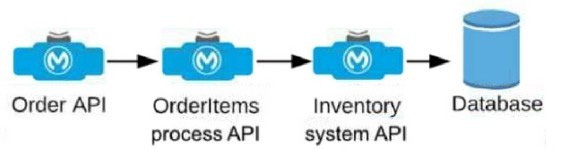
    An Order API triggers a sequence of other API calls to look up details of an order's items in a back-end inventory database. The Order API calls the OrderItems process API, which calls the Inventory system API. The Inventory system API performs database operations in the back-end inventory database.

    The network connection between the Inventory system API and the database is known to be unreliable and hang at unpredictable times. Where should a two-second timeout be configured in the API processing sequence so that the Order API never waits more than two seconds for a response from the Orderltems process API?

    A. In the Orderltems process API implementation
    B. In the Order API implementation
    C. In the Inventory system API implementation
    D. In the inventory database

  • Question 7:

    An organization has built an application network following the API-led connectivity approach recommended by MuleSoft.

    To protect the application network against attacks from malicious external API clients, the organization plans to apply JSON Threat Protection policies.

    To which API-led connectivity layer should the JSON Threat Protection policies most commonly be applied?

    A. All layers
    B. System layer
    C. Process layer
    D. Experience layer

  • Question 8:

    An organization requires several APIs to be secured with OAuth 2. 0, and PingFederate has been identified as the identity provider for API client authorization.

    The PingFederate Client Provider is configured in access management, and the PingFederate OAuth 2. 0 Token Enforcement policy is configured for the API instances required by the organization.

    The API instances reside in two business groups (Group A and Group B) within the Master Organization (Master Org).

    What should be done to allow API consumers to access the API instances?

    A. The API administrator should configure the correct client discovery URL in both child business groups, and the API consumer should request access to the API in Ping Identity
    B. The API administrator should grant access to the API consumers by creating contracts in the relevant API instances in API Manager
    C. The APL consumer should create a client application and request access to the APT in Anypoint Exchange, and the API administrator should approve the request
    D. The APT consumer should create a client application and request access to the API in Ping Identity, and the organization's Ping Identity workflow will grant access

  • Question 9:

    When should idempotency be taken into account?

    A. When making requests to update currently locked entities
    B. When storing the results of s previous request for use in response to subsequent requests
    C. When sending concurrent update requests for the same entity
    D. When preventing duplicate processing from multiple sent requests

  • Question 10:

    An API is protected with a Client ID Enforcement policy and uses the default configuration. Access is requested for the client application to the API, and an approved contract now exists between the client application and the API

    How can a consumer of this API avoid a 401 error "Unauthorized or invalid client application credentials"?

    A. Send the obtained token as a header in every call
    B. Send the obtained: client_id and client_secret in the request body
    C. Send the obtained clent_id and clent_secret as URI parameters in every call
    D. Send the obtained clent_id and client_secret in the header of every API Request call

Tips on How to Prepare for the Exams

Nowadays, the certification exams become more and more important and required by more and more enterprises when applying for a job. But how to prepare for the exam effectively? How to prepare for the exam in a short time with less efforts? How to get a ideal result and how to find the most reliable resources? Here on Vcedump.com, you will find all the answers. Vcedump.com provide not only Salesforce exam questions, answers and explanations but also complete assistance on your exam preparation and certification application. If you are confused on your MULESOFT-PLATFORM-ARCHITECT-I exam preparations and Salesforce certification application, do not hesitate to visit our Vcedump.com to find your solutions here.