MULESOFT-PLATFORM-ARCHITECT-I Exam Details
-
Exam Code
:MULESOFT-PLATFORM-ARCHITECT-I -
Exam Name
:Salesforce Certified MuleSoft Platform Architect (Mule-Arch-201) -
Certification
:Salesforce Certifications -
Vendor
:Salesforce -
Total Questions
:154 Q&As -
Last Updated
:Jul 10, 2026
Salesforce MULESOFT-PLATFORM-ARCHITECT-I Online Questions & Answers
-
Question 121:
Which statement is true about identity management and client management on Anypoint Platform?
A. If an external identity provider is configured, the SAML 2. 0 bearer tokens issued by the identity provider cannot be used for invocations of the Anypoint Platform web APIs
B. If an external client provider is configured, it must be configured at the Anypoint Platform organization level and cannot be assigned to individual business groups and environments
C. Anypoint Platform supports configuring one external identity provider
D. Both client management and identity management require an identity provider -
Question 122:
An online store's marketing team has noticed an increase in customers leaving online baskets without checking out.
They suspect a technology issue is at the root cause of the baskets being left behind.
They approach the Center for Enablement to ask for help identifying the issue.
Multiple APIs from across all the layers of their application network are involved in the shopping application.
Which feature of the Anypoint Platform can be used to view metrics from all involved APIs at the same time?
A. Custom dashboards
B. Built-in dashboards
C. Functional monitoring
D. API Manager -
Question 123:
A customer wants to host their MuleSoft applications in CloudHub 1.0, and these applications should be available at the domain https://api.acmecorp.com.
After creating a dedicated load balancer (DLB) called acme-dib-prod, which further action must the customer take to complete the configuration?
A. Configure the DLB with a TLS certificate for api.acmecorp.com and create an A record for api.acmecorp.com to the public IP addresses associated with their DLB
B. Configure the DLB with a TLS certificate for api.acmecorp.com and create a CNAME record from api.acmecorp.com to acme-dib-prod.|lb.anypointdns.net
C. Configure the DLB with a TLS certificate for acme-dib-prod.Jb.anypointdns.net and create a CNAME record from api.acmecorp:com to acme-dlb-prod.lb.anypointdns.net
D. Configure the DLB with a TLS certificate for aplacmecorp.com and create a CNAME record from api.aomecorp.com to acme-dib-prod.ei.cloubhub.io -
Question 124:
A large organization with an experienced central IT department is getting started using MuleSoft. There is a project to connect a siloed back-end system to a new Customer Relationship Management (CRM) system. The Center for Enablement is coaching them to use API-led connectivity.
What action would support the creation of an application network using API-led connectivity?
A. Invite the business analyst to create a business process model to specify the canonical data model between the two systems
B. Determine if the new CRM system supports the creation of custom: REST APIs, establishes 4 private network with CloudHub, and supports GAuth 2. 0 authentication
C. To expedite this project, central IT should extend the CRM system and back-end systems to connect to one another using built in integration interfaces
D. Create a System API to unlock the data on the back-end system using a REST API -
Question 125:
An enterprise is embarking on the API-led digital transformation journey, and the central IT team has started to define System APIs. Currently there is no Enterprise Data Model being defined within the enterprise, and the definition of a clean Bounded Context Data Model requires too much effort.
According to MuleSoft's recommended guidelines, how should the System API data model be defined?
A. If there are misspellings of the data fields in the back-end system, Systerm APIs should not correct it, and expose it as-is to mirror the back-end systems
B. The data model of the System APIs should make use of data types that approximately mirror those from the back-end systems
C. The data model should define its own naming convention, and not follow the same naming as the back-end systems
D. The System APIs should expose all back-end system fields -
Question 126:
An organization has created an API-led architecture that uses various API layers to integrate mobile clients with a backend system. The backend system consists of a number of specialized components and can be accessed via a REST API. The process and experience APIs share the same bounded-context model that is different from the backend data model. What additional canonical models, bounded-context models, or anti-corruption layers are best added to this architecture to help process data consumed from the backend system?
A. Create a bounded-context model for every layer and overlap them when the boundary contexts overlap, letting API developers know about the differences between upstream and downstream data models
B. Create a canonical model that combines the backend and API-led models to simplify and unify data models, and minimize data transformations.
C. Create a bounded-context model for the system layer to closely match the backend data model, and add an anti-corruption layer to let the different bounded contexts cooperate across the system and process layers
D. Create an anti-corruption layer for every API to perform transformation for every data model to match each other, and let data simply travel between APIs to avoid the complexity and overhead of building canonical models -
Question 127:
What is typically NOT a function of the APIs created within the framework called API-led connectivity?
A. They provide an additional layer of resilience on top of the underlying backend system, thereby insulating clients from extended failure of these systems.
B. They allow for innovation at the user Interface level by consuming the underlying assets without being aware of how data Is being extracted from backend systems.
C. They reduce the dependency on the underlying backend systems by helping unlock data from backend systems In a reusable and consumable way.
D. They can compose data from various sources and combine them with orchestration logic to create higher
E. level value. -
Question 128:
What Mule application can have API policies applied by Anypoint Platform to the endpoint exposed by that Mule application?
A. A Mule application that accepts requests over HTTP/1.x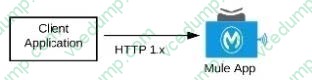
B. A Mule application that accepts JSON requests over TCP but is NOT required to provide a response
C. A Mute application that accepts JSON requests over WebSocket
D. A Mule application that accepts gRPC requests over HTTP/2 -
Question 129:
A client has several applications running on the Salesforce service cloud. The business requirement for integration is to get daily data changes from Account and Case Objects.
Data needs to be moved to the client's private cloud AWS DynamoDB instance as a single JSON and the business foresees only wanting five attributes from the Account object, which has 219 attributes (some custom) and eight attributes from the Case Object.
What design should be used to support the API/ Application data model?
A. Create separate entities for Account and Case Objects by mimicking all the attributes in SAPI, which are combined by the PAPI and filtered to provide JSON output containing 13 attributes.
B. Request client's AWS project team to replicate all the attributes and create Account and Case JSON table in DynamoDB. Then create separate entities for Account and Case Objects by mimicking all the attributes in SAPI to transfer ISON data to DynamoD for respective Objects
C. Start implementing an Enterprise Data Model by defining enterprise Account and Case Objects and implement SAPI and DynamoDB tables based on the Enterprise Data Model,
D. Create separate entities for Account with five attributes and Case with eight attributes in SAPI, which are combined by the PAPI to provide JSON output containing 13 attributes. -
Question 130:
A company has started to create an application network and is now planning to implement a Center for Enablement (C4E) organizational model. What key factor would lead the company to decide upon a federated rather than a centralized C4E?
A. When there are a large number of existing common assets shared by development teams
B. When various teams responsible for creating APIs are new to integration and hence need extensive training
C. When development is already organized into several independent initiatives or groups
D. When the majority of the applications in the application network are cloud based
Related Exams:
-
201-COMMERCIAL-BANKING-FUNCTIONAL
Salesforce enCino 201 Commercial Banking Functional -
ADM-201
Salesforce Certified Platform Administrator (Plat-Admn-201) -
ADM-211
Administration Essentials for Experienced Admin (ADM-211) -
ADM-261
Service Cloud Administration (SU24) -
ADVANCED-ADMINISTRATOR
Salesforce Certified Advanced Administrator -
ADVANCED-CROSS-CHANNEL
Marketing Cloud Advanced Cross Channel Accredited Professional -
ADX-201
Administrative Essentials for New Admins in Lightning Experience -
ADX-271
Salesforce Certified Community Cloud Consultant (ADX-271) -
AGENTFORCE-SPECIALIST
Salesforce Certified Agentforce Specialist (AI-201) -
ALS-CON-201
Salesforce Certified Agentforce Life Sciences Consultant
Tips on How to Prepare for the Exams
Nowadays, the certification exams become more and more important and required by more and more enterprises when applying for a job. But how to prepare for the exam effectively? How to prepare for the exam in a short time with less efforts? How to get a ideal result and how to find the most reliable resources? Here on Vcedump.com, you will find all the answers. Vcedump.com provide not only Salesforce exam questions, answers and explanations but also complete assistance on your exam preparation and certification application. If you are confused on your MULESOFT-PLATFORM-ARCHITECT-I exam preparations and Salesforce certification application, do not hesitate to visit our Vcedump.com to find your solutions here.