MULESOFT-PLATFORM-ARCHITECT-I Exam Details
-
Exam Code
:MULESOFT-PLATFORM-ARCHITECT-I -
Exam Name
:Salesforce Certified MuleSoft Platform Architect (Mule-Arch-201) -
Certification
:Salesforce Certifications -
Vendor
:Salesforce -
Total Questions
:154 Q&As -
Last Updated
:Jul 10, 2026
Salesforce MULESOFT-PLATFORM-ARCHITECT-I Online Questions & Answers
-
Question 81:
Which three tools automate the deployment of Mule applications? Choose 3 answers
A. Runtime Manager
B. Anypoint Platform CLI
C. Platform APIs
D. Anypoint Studio
E. Mule Mayen plugin
F. API Community Manager -
Question 82:
Refer to the exhibit.
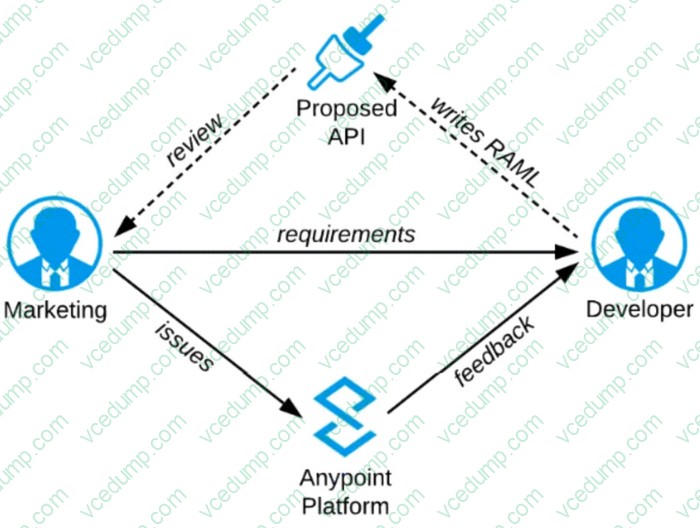
A RAML definition has been proposed for a new Promotions Process API, and has been published to Anypoint Exchange.
The Marketing Department, who will be an important consumer of the Promotions API, has important requirements and expectations that must be met.
What is the most effective way to use Anypoint Platform features to involve the Marketing Department in this early API design phase?
A. Option A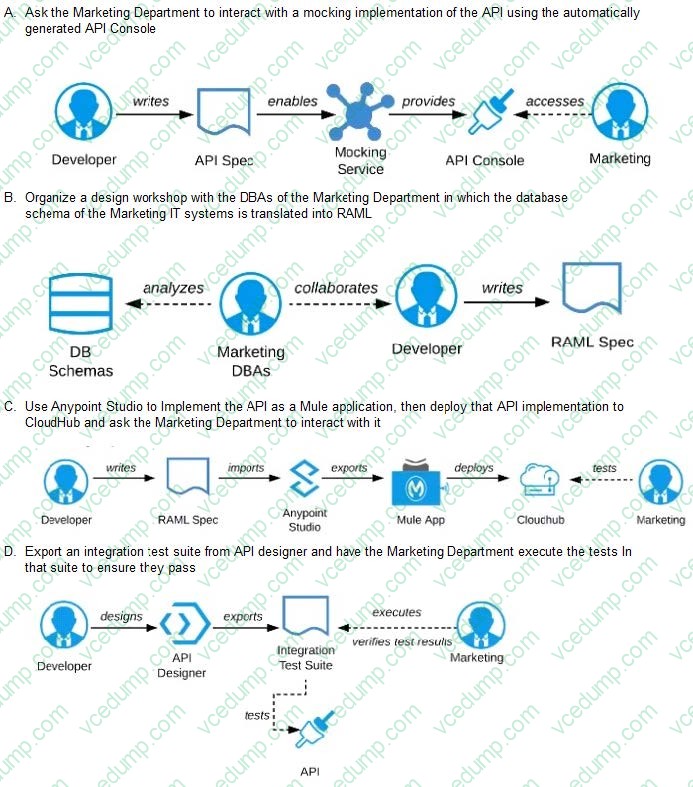
B. Option B
C. Option C
D. Option D -
Question 83:
What best explains the use of auto-discovery in API implementations?
A. It makes API Manager aware of API implementations and hence enables it to enforce policies
B. It enables Anypoint Studio to discover API definitions configured in Anypoint Platform
C. It enables Anypoint Exchange to discover assets and makes them available for reuse
D. It enables Anypoint Analytics to gain insight into the usage of APIs -
Question 84:
Which statement is true about Spike Control policy and Rate Limiting policy?
A. All requests are rejected after the limit is reached in Rate Limiting policy, whereas the requests are queued in Spike Control policy after the limit is reached
B. In a clustered environment, the Rate Limiting.and Spike Control policies are applied to each node in the cluster
C. To protect Experience APIs by limiting resource consumption, Rate Limiting policy must be applied D. In order to apply Rate Limiting and Spike Control policies, a contract to bind client application and API is needed for both -
Question 85:
Which component monitors APIs and endpoints at scheduled intervals, receives reports about whether tests pass or fail, and displays statistics about API and endpoint performance?
A. API Analytics
B. Anypoint Monitoring dashboards
C. APT Functional Monitoring
D. Anypoint Runtime Manager alerts -
Question 86:
A system API has a guaranteed SLA of 100 ms per request. The system API is deployed to a primary environment as well as to a disaster recovery (DR) environment, with different DNS names in each environment. An upstream process API invokes the system API and the main goal of this process API is to respond to client requests in the least possible time. In what order should the system APIs be invoked, and what changes should be made in order to speed up the response time for requests from the process API?
A. In parallel, invoke the system API deployed to the primary environment and the system API deployed to the DR environment, and ONLY use the first response
B. In parallel, invoke the system API deployed to the primary environment and the system API deployed to the DR environment using a scatter-gather configured with a timeout, and then merge the responses
C. Invoke the system API deployed to the primary environment, and if it fails, invoke the system API deployed to the DR environment
D. Invoke ONLY the system API deployed to the primary environment, and add timeout and retry logic to avoid intermittent failures -
Question 87:
A system API is deployed to a primary environment as well as to a disaster recovery (DR) environment, with different DNS names in each environment. A process API is a client to the system API and is being rate limited by the system API, with different limits in each of the environments. The system API's DR environment provides only 20% of the rate limiting offered by the primary environment. What is the best API fault-tolerant invocation strategy to reduce overall errors in the process API, given these conditions and constraints?
A. Invoke the system API deployed to the primary environment; add timeout and retry logic to the process API to avoid intermittent failures; if it still fails, invoke the system API deployed to the DR environment
B. Invoke the system API deployed to the primary environment; add retry logic to the process API to handle intermittent failures by invoking the system API deployed to the DR environment
C. In parallel, invoke the system API deployed to the primary environment and the system API deployed to the DR environment; add timeout and retry logic to the process API to avoid intermittent failures; add logic to the process API to combine the results
D. Invoke the system API deployed to the primary environment; add timeout and retry logic to the process API to avoid intermittent failures; if it still fails, invoke a copy of the process API deployed to the DR environment -
Question 88:
An organization is implementing a Quote of the Day API that caches today's quote.
What scenario can use the GoudHub Object Store via the Object Store connector to persist the cache's state?
A. When there are three CloudHub deployments of the API implementation to three separate CloudHub regions that must share the cache state
B. When there are two CloudHub deployments of the API implementation by two Anypoint Platform business groups to the same CloudHub region that must share the cache state
C. When there is one deployment of the API implementation to CloudHub and anottV deployment to a customer-hosted Mule runtime that must share the cache state
D. When there is one CloudHub deployment of the API implementation to three CloudHub workers that must share the cache state -
Question 89:
An organization wants to create a Center for Enablement (C4E). The IT director schedules a series of meetings with IT senior managers.
What should be on the agenda of the first meeting?
A. Define C4E objectives, mission statement, guiding principles, a
B. Explore API monetization options based on identified use cases through MuleSoft
C. A walk through of common-services best practices for logging, auditing, exception handling, caching, security via policy, and rate limiting/throttling via policy
D. Specify operating model for the MuleSoft Integrations division -
Question 90:
An organization makes a strategic decision to move towards an IT operating model that emphasizes consumption of reusable IT assets using modern APIs (as defined by MuleSoft). What best describes each modern API in relation to this new IT operating model?
A. Each modern API has its own software development lifecycle, which reduces the need for documentation and automation
B. Each modem API must be treated like a product and designed for a particular target audience (for instance, mobile app developers)
C. Each modern API must be easy to consume, so should avoid complex authentication mechanisms such as SAML or JWT D
D. Each modern API must be REST and HTTP based
Related Exams:
-
201-COMMERCIAL-BANKING-FUNCTIONAL
Salesforce enCino 201 Commercial Banking Functional -
ADM-201
Salesforce Certified Platform Administrator (Plat-Admn-201) -
ADM-211
Administration Essentials for Experienced Admin (ADM-211) -
ADM-261
Service Cloud Administration (SU24) -
ADVANCED-ADMINISTRATOR
Salesforce Certified Advanced Administrator -
ADVANCED-CROSS-CHANNEL
Marketing Cloud Advanced Cross Channel Accredited Professional -
ADX-201
Administrative Essentials for New Admins in Lightning Experience -
ADX-271
Salesforce Certified Community Cloud Consultant (ADX-271) -
AGENTFORCE-SPECIALIST
Salesforce Certified Agentforce Specialist (AI-201) -
ALS-CON-201
Salesforce Certified Agentforce Life Sciences Consultant
Tips on How to Prepare for the Exams
Nowadays, the certification exams become more and more important and required by more and more enterprises when applying for a job. But how to prepare for the exam effectively? How to prepare for the exam in a short time with less efforts? How to get a ideal result and how to find the most reliable resources? Here on Vcedump.com, you will find all the answers. Vcedump.com provide not only Salesforce exam questions, answers and explanations but also complete assistance on your exam preparation and certification application. If you are confused on your MULESOFT-PLATFORM-ARCHITECT-I exam preparations and Salesforce certification application, do not hesitate to visit our Vcedump.com to find your solutions here.