MULESOFT-PLATFORM-ARCHITECT-I Exam Details
-
Exam Code
:MULESOFT-PLATFORM-ARCHITECT-I -
Exam Name
:Salesforce Certified MuleSoft Platform Architect (Mule-Arch-201) -
Certification
:Salesforce Certifications -
Vendor
:Salesforce -
Total Questions
:154 Q&As -
Last Updated
:Jul 10, 2026
Salesforce MULESOFT-PLATFORM-ARCHITECT-I Online Questions & Answers
-
Question 71:
A business process is being implemented within an organization's application network. The architecture group proposes using a more coarse-grained application network design with relatively fewer APIs deployed to the application network compared to a more fine-grained design.
Overall, which factor typically increases with a more coarse-grained design for this business process implementation and deployment compared with using a more fine-grained design?
A. The complexity of each API implementation
B. The number of discoverable assets related to APIs deployed in the application network
C. The number of possible connections between API implementations in the application network
D. The usage of network infrastructure resources by the application network -
Question 72:
The Line of Business (LoB) of an eCommerce company is requesting a process that sends automated notifications via email every time a new order is processed through the customer's mobile application or through the internal company's web application. In the future, multiple notification channels may be added: for example, text messages and push notifications.
What is the most effective API-led connectivity approach for the scenario described above?
A. Create one Experience API for the web application and one for the mobile application. Create a Process API to orchestrate and retrieve the email template from = database. Create a System API that sends the email using the Anypoint Connector for Email.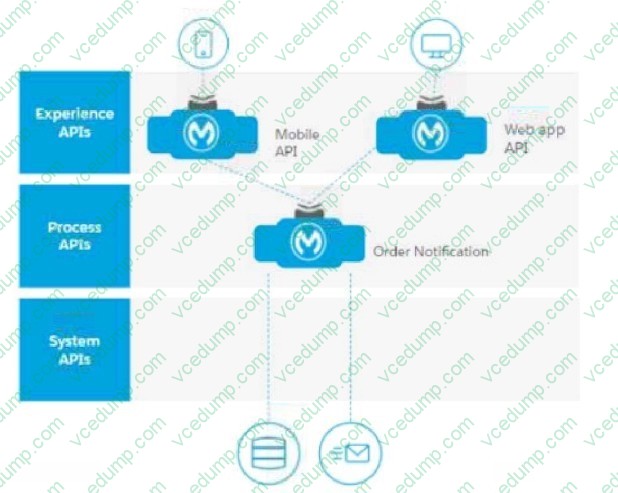
B. Create one Experience API for the web application and one for the mobile application. Create a Process API to orchestrate, retrieve the email template from a database, and send the email using the Anypoint Connector for Email.
C. Create Experience APIs for both the web application and mobile application. Create a Process API ta orchestrate, retrieve the email template from e database, and send the email using the Anypoint Connector for Email.
D. Create Experience APIs for both the web application and mobile application. (Create 3 Process API to orchestrate and retrieve the email template from 2 databese. Create a System API that sends the email using the Anypoint Connector for Email. -
Question 73:
An organization uses various cloud-based SaaS systems and multiple on-premises systems. The on-premises systems are an important part of the organization's application network and can only be accessed from within the organization's intranet.
What is the best way to configure and use Anypoint Platform to support integrations with both the cloud-based SaaS systems and on-premises systems?
A. Option A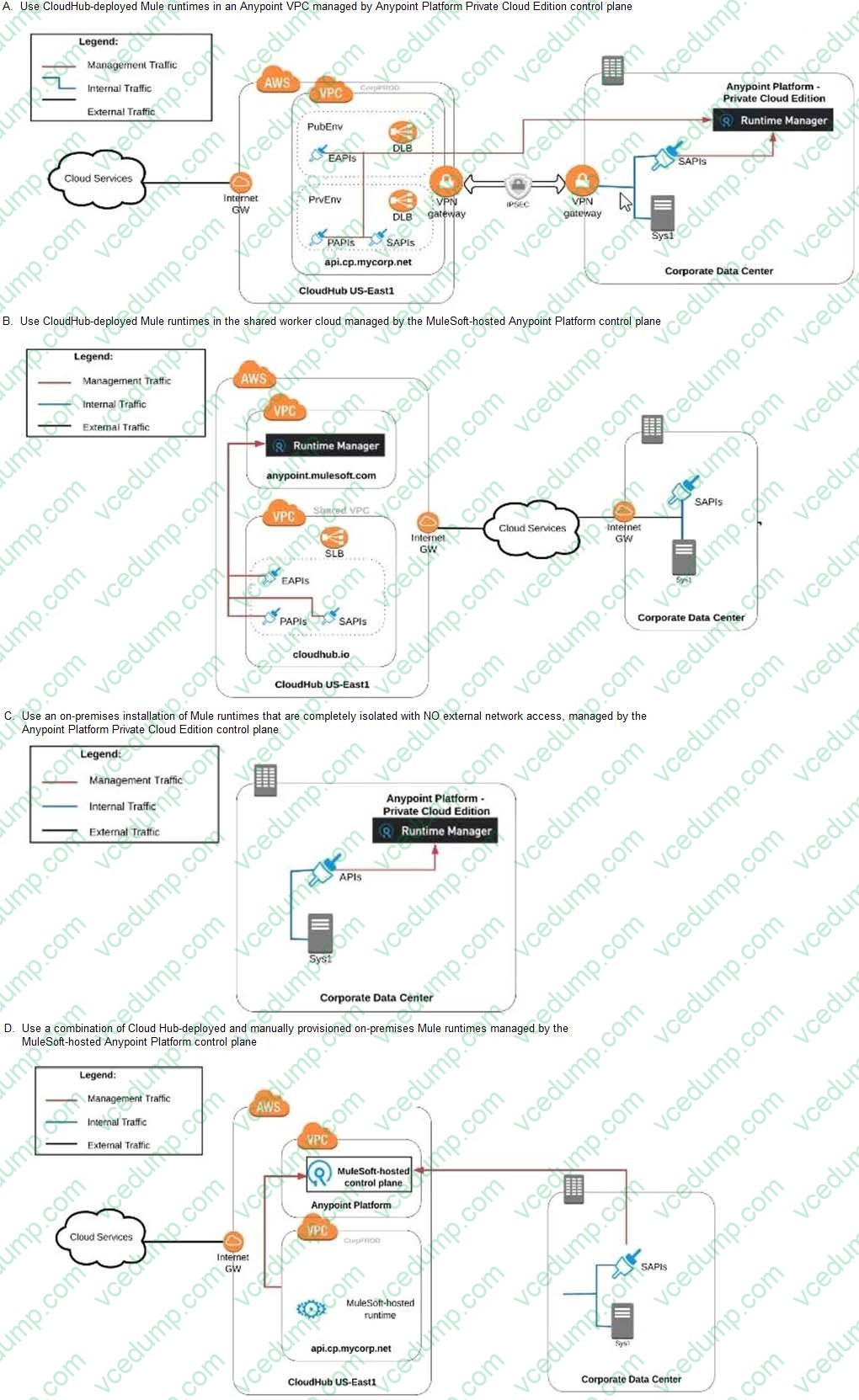
B. Option B
C. Option C
D. Option D -
Question 74:
A TemperatureSensors API instance is defined in API Manager in the PROD environment of the CAR_FACTORY business group. An AcmelemperatureSensors Mule application implements this API instance and is deployed from Runtime
Manager to the PROD environment of the CAR_FACTORY business group.
A policy that requires a valid client ID and client secret is applied in API Manager to the API instance.
Where can an API consumer obtain a valid client ID and client secret to call the AcmeTemperatureSensors Mule application?
A. In secrets manager, request access to the Shared Secret static username/password
B. In API Manager, from the PROD environment of the CAR_FACTORY business group
C. In access management, from the PROD environment of the CAR_FACTORY business group
D. In Anypoint Exchange, from an API client application that has been approved for the TemperatureSensors API instance -
Question 75:
When can CloudHub Object Store v2 be used?
A. To store an unlimited number of key-value pairs
B. To store payloads with an average size greater than 15MB
C. To store information in Mule 4 Object Store v1
D. To store key-value pairs with keys up to 300 characters -
Question 76:
An API implementation is deployed on a single worker on CloudHub and invoked by external API clients (outside of CloudHub). How can an alert be set up that is guaranteed to trigger AS SOON AS that API implementation stops responding to API invocations?
A. Implement a heartbeat/health check within the API and invoke it from outside the Anypoint Platform and alert when the heartbeat does not respond
B. Configure a "worker not responding" alert in Anypoint Runtime Manager
C. Handle API invocation exceptions within the calling API client and raise an alert from that API client when the API Is unavailable
D. Create an alert for when the API receives no requests within a specified time period -
Question 77:
How are an API implementation, API client, and API consumer combined to invoke and process an API?
A. The API consumer creates an API implementation, which receives API invocations from an API such that they are processed for an API client
B. The API client creates an API consumer, which receives API invocations from an API such that they are processed for an API implementation
C. The ApI consumer creates an API client, which sends API invocations to an API such that they are processed by an API implementation
D. The ApI client creates an API consumer, which sends API invocations to an API such that they are processed by an API implementation -
Question 78:
True or False. We should always make sure that the APIs being designed and developed are self-servable even if it needs more man-day effort and resources.
A. FALSE
B. TRUE -
Question 79:
When could the API data model of a System API reasonably mimic the data model exposed by the corresponding backend system, with minimal improvements over the backend system's data model?
A. When there is an existing Enterprise Data Model widely used across the organization
B. When the System API can be assigned to a bounded context with a corresponding data model
C. When a pragmatic approach with only limited isolation from the backend system is deemed appropriate
D. When the corresponding backend system is expected to be replaced in the near future -
Question 80:
A code-centric API documentation environment should allow API consumers to investigate and execute API client source code that demonstrates invoking one or more APIs as part of representative scenarios. What is the most effective way to provide this type of code-centric API documentation environment using Anypoint Platform?
A. Enable mocking services for each of the relevant APIs and expose them via their Anypoint Exchange entry
B. Ensure the APIs are well documented through their Anypoint Exchange entries and API Consoles and share these pages with all API consumers
C. Create API Notebooks and include them in the relevant Anypoint Exchange entries
D. Make relevant APIs discoverable via an Anypoint Exchange entry
Related Exams:
-
201-COMMERCIAL-BANKING-FUNCTIONAL
Salesforce enCino 201 Commercial Banking Functional -
ADM-201
Salesforce Certified Platform Administrator (Plat-Admn-201) -
ADM-211
Administration Essentials for Experienced Admin (ADM-211) -
ADM-261
Service Cloud Administration (SU24) -
ADVANCED-ADMINISTRATOR
Salesforce Certified Advanced Administrator -
ADVANCED-CROSS-CHANNEL
Marketing Cloud Advanced Cross Channel Accredited Professional -
ADX-201
Administrative Essentials for New Admins in Lightning Experience -
ADX-271
Salesforce Certified Community Cloud Consultant (ADX-271) -
AGENTFORCE-SPECIALIST
Salesforce Certified Agentforce Specialist (AI-201) -
ALS-CON-201
Salesforce Certified Agentforce Life Sciences Consultant
Tips on How to Prepare for the Exams
Nowadays, the certification exams become more and more important and required by more and more enterprises when applying for a job. But how to prepare for the exam effectively? How to prepare for the exam in a short time with less efforts? How to get a ideal result and how to find the most reliable resources? Here on Vcedump.com, you will find all the answers. Vcedump.com provide not only Salesforce exam questions, answers and explanations but also complete assistance on your exam preparation and certification application. If you are confused on your MULESOFT-PLATFORM-ARCHITECT-I exam preparations and Salesforce certification application, do not hesitate to visit our Vcedump.com to find your solutions here.