MULESOFT-INTEGRATION-ARCHITECT-I Exam Details
-
Exam Code
:MULESOFT-INTEGRATION-ARCHITECT-I -
Exam Name
:Salesforce Certified MuleSoft Platform Integration Architect (Mule-Arch-202) -
Certification
:Salesforce Certifications -
Vendor
:Salesforce -
Total Questions
:273 Q&As -
Last Updated
:May 29, 2026
Salesforce MULESOFT-INTEGRATION-ARCHITECT-I Online Questions & Answers
-
Question 161:
A trading company handles millions of requests a day. Due to nature of its business, it requires excellent performance and reliability within its application.
For this purpose, company uses a number of event-based API's hosted on various mule clusters that communicate across a shared message queue sitting within its network.
Which method should be used to meet the company's requirement for its system?
A. XA transactions and XA connected components
B. JMS transactions
C. JMS manual acknowledgements with a reliability pattern
D. VM queues with reliability pattern -
Question 162:
An organization's governance process requires project teams to get formal approval from all key stakeholders for all new Integration design specifications. An integration Mule application Is being designed that interacts with various backend systems. The Mule application will be created using Anypoint Design Center or Anypoint Studio and will then be deployed to a customer-hosted runtime.
What key elements should be included in the integration design specification when requesting approval for this Mule application?
A. SLAs and non-functional requirements to access the backend systems
B. Snapshots of the Mule application's flows, including their error handling
C. A list of current and future consumers of the Mule application and their contact details
D. The credentials to access the backend systems and contact details for the administrator of each system -
Question 163:
An integration architect is designing an API that must accept requests from API clients for both XML and JSON content over HTTP/1.1 by default.
Which API architectural style, when used for its intended and typical purposes, should the architect choose to meet these requirements?
A. SOAP
B. GraphQL
C. REST
D. grRPC -
Question 164:
What Mule application can have API policies applied by Anypoint Platform to the endpoint exposed by that Mule application?
A. A Mule application that accepts requests over HTTP/1x
B. A Mule application that accepts JSON requests over TCP but is NOT required to provide a response.
C. A Mule application that accepts JSON requests over WebSocket
D. A Mule application that accepts gRPC requests over HTTP/2 -
Question 165:
What is true about automating interactions with Anypoint Platform using tools such as Anypoint Platform REST API's, Anypoint CLI or the Mule Maven plugin?
A. By default, the Anypoint CLI and Mule Maven plugin are not included in the Mule runtime
B. Access to Anypoint Platform API;s and Anypoint CLI can be controlled separately thruough the roles and permissions in Anypoint platform, so that specific users can get access to Anypoint CLI while others get access to the platform API's
C. Anypoint Platform API's can only automate interactions with CloudHub while the Mule maven plugin is required for deployment to customer hosted Mule runtimes
D. API policies can be applied to the Anypoint platform API's so that only certain LOS's has access to specific functions -
Question 166:
What requirement prevents using Anypoint MQ as the messaging broker for a Mule application?
A. When the payload sent through the message broker must use XML format
B. When the payload sent through the message broker must be encrypted
C. When the messaging broker must support point-to-point messaging
D. When the messaging broker must be deployed on-premises -
Question 167:
Refer to the exhibit.
A Mule application is being designed to expose a SOAP web service to its clients.
What language is typically used inside the web service's interface definition to define the data structures that the web service Is expected to exchange with its clients?
A. WSDL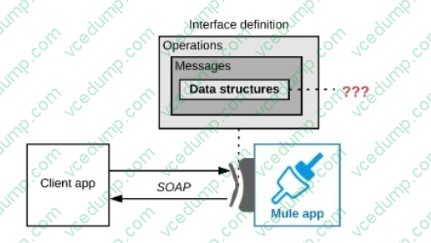
B. XSD
C. JSON Schema
D. RAMI -
Question 168:
An organization is building out a test suite for their application using MUnit.
The Integration Architect has recommended using Test Recorder in Anypoint Studio to record the processing flows and then configure unit tests based on the captured events.
What Is a core consideration that must be kept In mind while using Test Recorder?
A. The Recorder supports loops where the structure of the data being tested changes inside the Iteration
B. Mocking values resulting from parallel processes are possible and will not affect theexecution of the processors that follow in the test
C. The Recorder supports mocking a message before or inside a Foreach processor
D. Tests for flows cannot be created if Mule errors are raised Inside the flows, even if the errors are handled by On-Error Continue error handlers -
Question 169:
A leading e-commerce giant will use Mulesoft API's on runtime fabric (RTF) to process customer orders. Some customer's sensitive information such as credit card information is also there as a part of a API payload.
What approach minimizes the risk of matching sensitive data to the original and can convert back to the original value whenever and wherever required?
A. Apply masking to hide the sensitive information and then use API
B. manager to detokenize the masking format to return the original value
C. create a tokenization format and apply a tokenization policy to the API Gateway
D. Used both masking and tokenization
E. Apply a field level encryption policy in the API Gateway -
Question 170:
A company is planning to extend its Mule APIs to the Europe region. Currently all new applications are deployed to Cloudhub in the US region following this naming convention {API name}-{environment}. for example, Orders-SAPI-dev, Orders-SAPI-prod etc.
Considering there is no network restriction to block communications between API's, what strategy should be implemented in order to apply the same new API's running in the EU region of CloudHub as well to minimize latency between API's and target users and systems in Europe?
A. Set region property to Europe (eu-de) in API manager for all the mule application No need to change the naming convention
B. Set region property to Europe (eu-de) in API manager for all the mule application Change the naming convention to {API name}-{environment}-{region} and communicate this change to the consuming applications and users
C. Set region property to Europe (eu-de) in runtime manager for all the mule application No need to change the naming convention
D. Set region property to Europe (eu-de) in runtime manager for all the mule application Change the naming convention to {API name}-{environment}-{region} and communicate this change to the consuming applications and users
Related Exams:
-
201-COMMERCIAL-BANKING-FUNCTIONAL
Salesforce enCino 201 Commercial Banking Functional -
ADM-201
Salesforce Certified Platform Administrator (Plat-Admn-201) -
ADM-211
Administration Essentials for Experienced Admin (ADM-211) -
ADM-261
Service Cloud Administration (SU24) -
ADVANCED-ADMINISTRATOR
Salesforce Certified Advanced Administrator -
ADVANCED-CROSS-CHANNEL
Marketing Cloud Advanced Cross Channel Accredited Professional -
ADX-201
Administrative Essentials for New Admins in Lightning Experience -
ADX-271
Salesforce Certified Community Cloud Consultant (ADX-271) -
AGENTFORCE-SPECIALIST
Salesforce Certified Agentforce Specialist (AI-201) -
ALS-CON-201
Salesforce Certified Agentforce Life Sciences Consultant
Tips on How to Prepare for the Exams
Nowadays, the certification exams become more and more important and required by more and more enterprises when applying for a job. But how to prepare for the exam effectively? How to prepare for the exam in a short time with less efforts? How to get a ideal result and how to find the most reliable resources? Here on Vcedump.com, you will find all the answers. Vcedump.com provide not only Salesforce exam questions, answers and explanations but also complete assistance on your exam preparation and certification application. If you are confused on your MULESOFT-INTEGRATION-ARCHITECT-I exam preparations and Salesforce certification application, do not hesitate to visit our Vcedump.com to find your solutions here.