MD-102 Exam Details
-
Exam Code
:MD-102 -
Exam Name
:Endpoint Administrator -
Certification
:Microsoft Certifications -
Vendor
:Microsoft -
Total Questions
:431 Q&As -
Last Updated
:May 25, 2026
Microsoft MD-102 Online Questions & Answers
-
Question 301:
You have a Microsoft 365 subscription that uses Microsoft Intune Suite.
You use Microsoft Intune to manage devices.
You plan to deploy two apps named App1 and App2 to all Windows devices. App1 must be installed before App2.
From the Intune admin center, you create and deploy two Windows app (Win32) apps.
You need to ensure that App1 is installed before App2 on every device.
What should you configure?
A. the App1 deployment configurations
B. a dynamic device group
C. a detection rule
D. the App2 deployment configurations -
Question 302:
HOTSPOT
You have a Microsoft 365 E5 subscription.
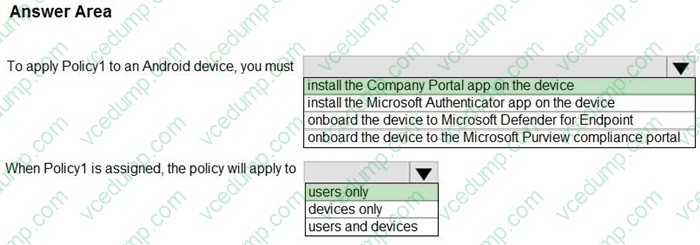
You create an app protection policy for Android device named Policy1 as shown in the following exhibit.
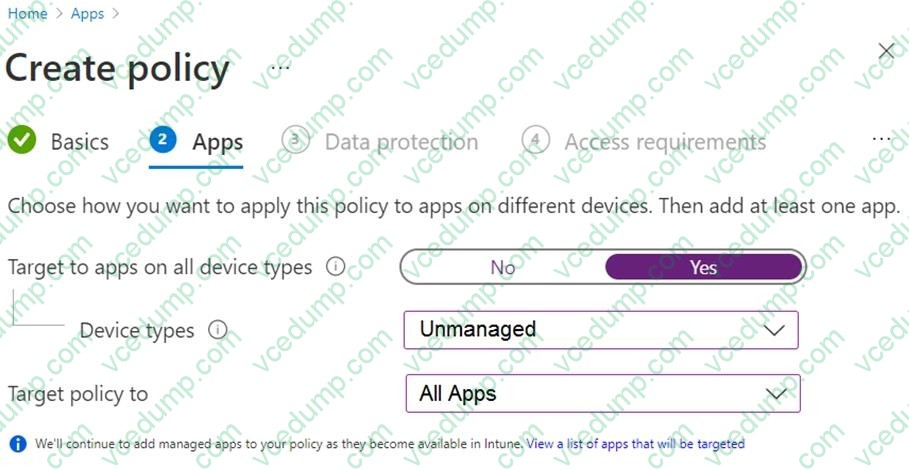
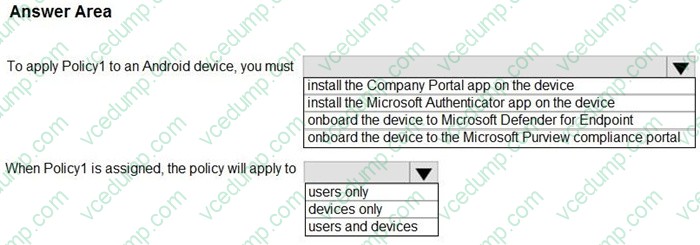
Use the drop-down menus to select the answer choice that completes each statement based on the information presented in the graphic.
NOTE: Each correct selection is worth one point.
-
Question 303:
Note: This section contains one or more sets of questions with the same scenario and problem. Each question presents a unique solution to the problem. You must determine whether the solution meets the stated goals. More than one solution in the set might solve the problem. It is also possible that none of the solutions in the set solve the problem.
After you answer a question in this section, you will NOT be able to return. As a result, these questions do not appear on the Review Screen.
You have a Microsoft Entra tenant named contoso.com.
You purchase an Android device named Device1.
You need to register Device1 in contoso.com.
Solution: You use the Microsoft Authenticator app.
Does this meet the goal?
A. Yes
B. No -
Question 304:
DRAG DROP
You have a Microsoft 365 subscription that contains the devices shown in the following table.
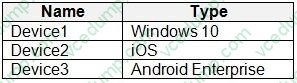
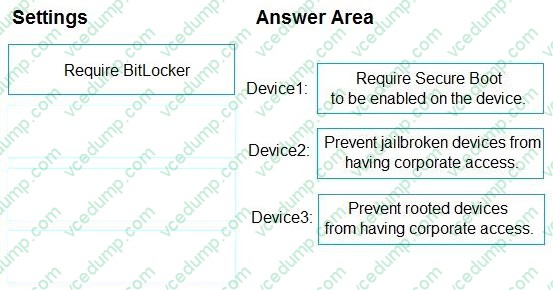
You need to ensure that only devices running trusted firmware or operating system builds can access network resources.
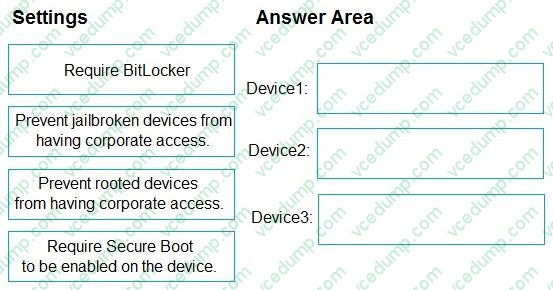
Which compliance policy setting should you configure for each device? To answer, drag the appropriate settings to the correct devices. Each setting may be used once, more than once, or not at all. You may need to drag the split bar between panes or scroll to view content.
NOTE: Each correct selection is worth one point.
Select and Place:
-
Question 305:
You have a Microsoft 365 subscription and use Microsoft Intune Suite.
The subscription contains devices enrolled in Intune as shown in the following table.
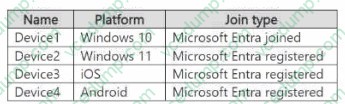
Which devices support Device query?
A. Device1 only
B. Device2 only
C. Device1 and Device2 only
D. Device1, Device2, Device3, and Device4 -
Question 306:
You have a Microsoft Deployment Toolkit (MDT) deployment share.
You plan to deploy Windows 11 by using the Standard Client Task Sequence template.
You need to modify the task sequence to perform the following actions:
1. Format disks to support Unified Extensible Firmware Interface (UEFI).
2. Create a recovery partition.
Which phase of the task sequence should you modify?
A. Preinstall
B. PostInstall
C. Install
D. Initialization -
Question 307:
HOTSPOT
You have an Azure AD tenant named contoso.com that contains the devices shown in the following table.
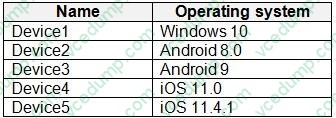
All devices contain an app named App1 and are enrolled in Microsoft Intune.
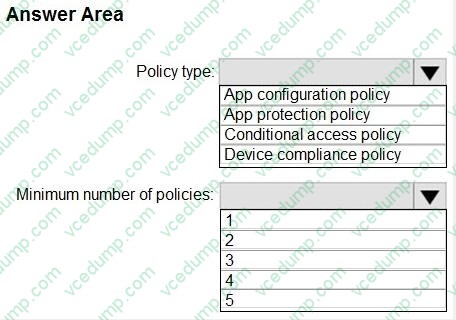
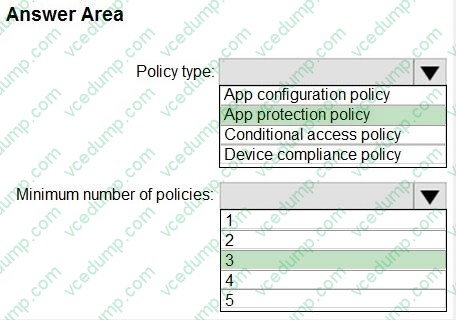
You need to prevent users from copying data from App1 and pasting the data into other apps.
Which type of policy and how many policies should you create in Intune? To answer, select the appropriate options in the answer area.
NOTE: Each correct selection is worth one point.
-
Question 308:
You have an Azure AD tenant named contoso.com.
You plan to purchase 25 computers that run Windows 11. You plan to deliver the computers directly to users.
You need to ensure that during the out-of-box experience (OBE), users are prompted to sign in, and then the computers are configured to use Microsoft Intune.
Which two components should you configure? Each correct answer presents part of the solution.
NOTE: Each correct selection is worth one point.
A. a provisioning package
B. automatic enrollment
C. an unattend.xml answer file
D. a Windows Autopilot deployment profile for self-deploying mode
E. a Windows Autopilot deployment profile for user-driven mode -
Question 309:
HOTSPOT
You have a Microsoft Deployment Toolkit (MDT) solution that is used to manage Windows 11 deployment tasks.
MDT contains the operating system images shown in the following table.
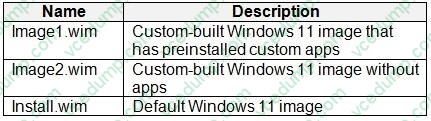
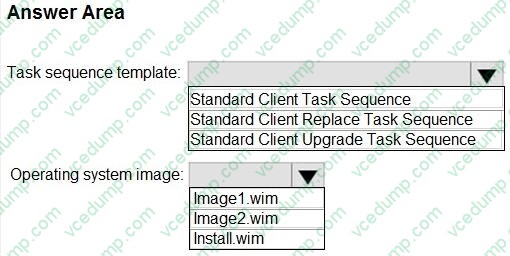
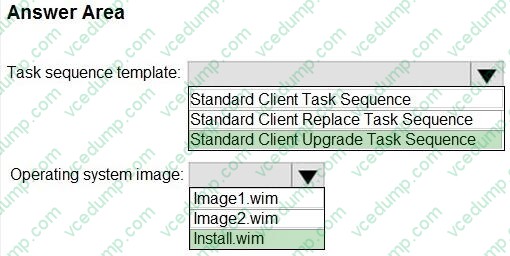
You need to perform a Windows 11-place upgrade on several computers that run Windows 10.
From the Deployment Workbench, you open the New Task Sequence Wizard.
You need to identify which task sequence template and which operating system image to use for the task sequence. The solution must minimize administrative effort.
What should you identify? To answer, select the appropriate options in the answer area.
NOTE: Each correct selection is worth one point.
-
Question 310:
You have a Microsoft 365 subscription that uses Microsoft Intune.
You have five new Windows 11 Pro devices.
You need to prepare the devices for corporate use. The solution must meet the following requirements:
1. Install Windows 11 Enterprise on each device.
2. Install a Windows Installer (MSI) package named App1 on each device.
3. Add a certificate named Certificate1 that is required by App1.
4. Join each device to Azure AD.
Which three provisioning options can you use? Each correct answer presents a complete solution.
NOTE: Each correct selection is worth one point.
A. subscription activation
B. a custom Windows image
C. an in-place upgrade
D. Windows Autopilot
E. provisioning packages
Related Exams:
-
62-193
Technology Literacy for Educators -
70-243
Administering and Deploying System Center 2012 Configuration Manager -
70-355
Universal Windows Platform – App Data, Services, and Coding Patterns -
77-420
Excel 2013 -
77-427
Excel 2013 Expert Part One -
77-725
Word 2016 Core Document Creation, Collaboration and Communication -
77-726
Word 2016 Expert Creating Documents for Effective Communication -
77-727
Excel 2016 Core Data Analysis, Manipulation, and Presentation -
77-728
Excel 2016 Expert: Interpreting Data for Insights -
77-731
Outlook 2016 Core Communication, Collaboration and Email Skills
Tips on How to Prepare for the Exams
Nowadays, the certification exams become more and more important and required by more and more enterprises when applying for a job. But how to prepare for the exam effectively? How to prepare for the exam in a short time with less efforts? How to get a ideal result and how to find the most reliable resources? Here on Vcedump.com, you will find all the answers. Vcedump.com provide not only Microsoft exam questions, answers and explanations but also complete assistance on your exam preparation and certification application. If you are confused on your MD-102 exam preparations and Microsoft certification application, do not hesitate to visit our Vcedump.com to find your solutions here.