MCIA-LEVEL1 Exam Details
-
Exam Code
:MCIA-LEVEL1 -
Exam Name
:MuleSoft Certified Integration Architect - Level 1 -
Certification
:Mulesoft Certifications -
Vendor
:Mulesoft -
Total Questions
:290 Q&As -
Last Updated
:Jul 08, 2026
Mulesoft MCIA-LEVEL1 Online Questions & Answers
-
Question 41:
A manufacturing company is developing a new set of APIs for its retail business. One of the APIs is a Master Look Up API, which is a System API,
The API uses a persistent object-store. This API will be used by almost all other APIs to provide master lookup data.
The Master Look Up API is deployed on two CloudHub workers of 0.1 vCore each because there is a lot of master data to be cached. Most of the master
lookup data is stored as a key-value pair. The cache gets refreshed if the key is not found in the cache.
During performance testing, it was determined that the Master Look Up API has a high response time due to the latency of database queries executed to fetch the master lookup data.
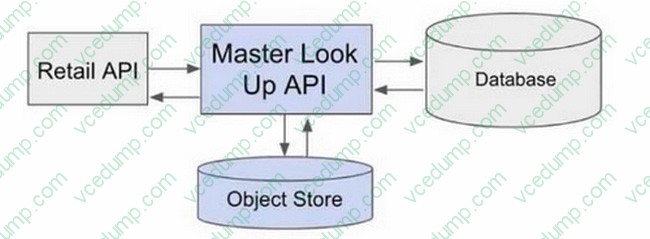
What two methods can be used to resolve these performance issues? Choose 2 answers
A. Implement the HTTP caching policy for all GET endpoints for the Master Look Up API
B. Implement an HTTP caching policy for all GET endpoints in the Master Look Up API
C. Implement locking to synchronize access to the Object Store
D. Upgrade the vCore size from 0.1 vCore to 0.2 vCore -
Question 42:
A travel company wants to publish a well-defined booking service API to be shared with its business partners. These business partners have agreed to ONLY consume SOAP services and they want to get the service contracts in an easily consumable way before they start any development. The travel company will publish the initial design documents to Anypoint Exchange, then share those documents with the business partners. When using an API-led approach, what is the first design document the travel company should deliver to its business partners?
A. Create a WSDL specification using any XML editor
B. Create a RAML API specification using any text editor
C. Create an OAS API specification in Design Center
D. Create a SOAP API specification in Design Center -
Question 43:
Refer to the exhibit.
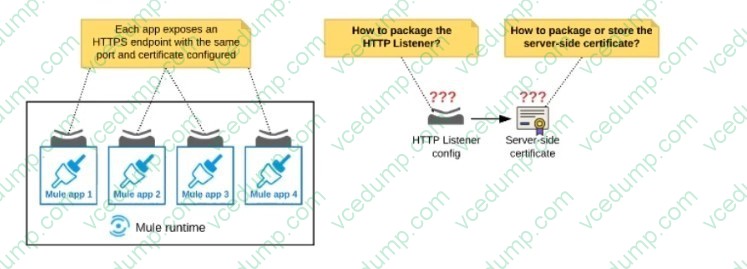
An organization deploys multiple Mule applications to the same customer -hosted Mule runtime. Many of these Mule applications must expose an HTTPS endpoint on the same port using a server-side certificate that rotates often.
What is the most effective way to package the HTTP Listener and package or store the server-side certificate when deploying these Mule applications, so the disruption caused by certificate rotation is minimized?
A. Package the HTTPS Listener configuration in a Mule DOMAIN project, referencing it from all Mule applications that need to expose an HTTPS endpoint Package the server- side certificate in ALL Mule APPLICATIONS that need to expose an HTTPS endpoint
B. Package the HTTPS Listener configuration in a Mule DOMAIN project, referencing it from all Mule applications that need to expose an HTTPS endpoint. Store the server-side certificate in a shared filesystem location in the Mule runtime's classpath, OUTSIDE the Mule DOMAIN or any Mule APPLICATION
C. Package an HTTPS Listener configuration In all Mule APPLICATIONS that need to expose an HTTPS endpoint Package the server-side certificate in a NEW Mule DOMAIN project
D. Package the HTTPS Listener configuration in a Mule DOMAIN project, referencing It from all Mule applications that need to expose an HTTPS endpoint. Package the server- side certificate in the SAME Mule DOMAIN project Go to Set -
Question 44:
When a Mule application using VM queues is deployed to a customer-hosted cluster or multiple CloudHub v1.0 workers/replicas, how are messages consumed across the nodes?
A. Sequentially, from a dedicated Anypoint MQ queue
B. Sequentially, only from the primary node
C. In a non-deterministic way
D. Round-robin, within an XA transaction -
Question 45:
An organization plans to use the Anypoint Platform audit logging service to log Anypoint MQ actions. What consideration must be kept in mind when leveraging Anypoint MQ Audit Logs?
A. Anypoint MQ Audit Logs include logs for sending, receiving, or browsing messages
B. Anypoint MQ Audit Logs include fogs for failed Anypoint MQ operations
C. Anypoint MQ Audit Logs include logs for queue create, delete, modify, and purge operations -
Question 46:
What is the primary benefit of decoupling Experience APIs from System APIs?
A. Reduced latency
B. Independent evolution of consumer and backend layers
C. Elimination of API governance
D. Simplified deployment pipelines -
Question 47:
According to MuleSoft, what is a major distinguishing characteristic of an application network in relation to the integration of systems, data, and devices?
A. It uses a well-organized monolithic approach with standards
B. It is built for change and self-service
C. It leverages well-accepted internet standards like HTTP and JSON
D. It uses CI/CD automation for real-time project delivery -
Question 48:
A marketing organization is designing a Mule application to process campaign data. The Mule application will periodically check for a file in a SFTP location and process the records in the file. The size of the file can vary from 10MB to 5GB. Due to the limited availabiltty of vCores, the Mule application is deployed to a single CloudHub worker configured with vCore size 0.2.
The application must transform and send different formats of this file to three different downstream SFTP locations.
What is the most idiomatic (used for its intended purpose) and performant way to configure the SFTP operations or event sources to process the large files to support these deployment requirements?
A. Use an in-memory repeatable stream
B. Use a file-stored non-repeatable stream
C. Use an in-memory non-repeatable stream
D. Use a file-stored repeatable stream -
Question 49:
According to MuleSoft, which major benefit does a Center for Enablement (C4E) provide for an enterprise and its lines of business?
A. Enabling Edge security between the lines of business and public devices
B. Centralizing project management across the lines of business
C. Centrally managing return on investment (ROI) reporting from lines of business to leadership
D. Accelerating self-service by the lines of business -
Question 50:
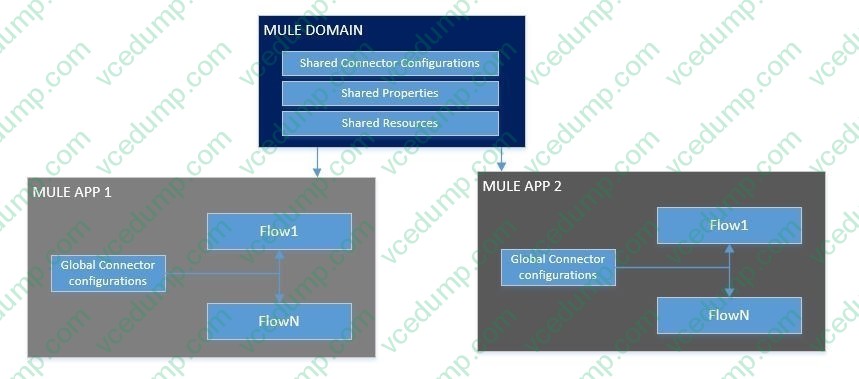
What is not true about Mule Domain Project?
A. This allows Mule applications to share resources
B. Expose multiple services within the Mule domain on the same port
C. Only available Anypoint Runtime Fabric
D. Send events (messages) to other Mule applications using VM queues
Related Exams:
-
MCD-ASSOC
MuleSoft Certified Developer - Integration and API Associate (Mule 3) -
MCD-LEVEL1
MuleSoft Certified Developer - Level 1 (Mule 4) -
MCD-LEVEL1-DELTA
MuleSoft Certified Developer - Level 1 (Mule 4) DELTA -
MCD-LEVEL2
MuleSoft Certified Developer - Level 2 (Mule 4) -
MCIA-LEVEL1
MuleSoft Certified Integration Architect - Level 1 -
MCIA-LEVEL1-MAINTENANCE
MuleSoft Certified Integration Architect - Level 1 MAINTENANCE -
MCPA-LEVEL1
MuleSoft Certified Platform Architect - Level 1 -
MCPA-LEVEL1-MAINTENANCE
MuleSoft Certified Platform Architect - Level 1 MAINTENANCE
Tips on How to Prepare for the Exams
Nowadays, the certification exams become more and more important and required by more and more enterprises when applying for a job. But how to prepare for the exam effectively? How to prepare for the exam in a short time with less efforts? How to get a ideal result and how to find the most reliable resources? Here on Vcedump.com, you will find all the answers. Vcedump.com provide not only Mulesoft exam questions, answers and explanations but also complete assistance on your exam preparation and certification application. If you are confused on your MCIA-LEVEL1 exam preparations and Mulesoft certification application, do not hesitate to visit our Vcedump.com to find your solutions here.