MCIA-LEVEL1 Exam Details
-
Exam Code
:MCIA-LEVEL1 -
Exam Name
:MuleSoft Certified Integration Architect - Level 1 -
Certification
:Mulesoft Certifications -
Vendor
:Mulesoft -
Total Questions
:290 Q&As -
Last Updated
:Jul 08, 2026
Mulesoft MCIA-LEVEL1 Online Questions & Answers
-
Question 31:
What is a defining characteristic of an integration-Platform-as-a-Service (iPaaS)?
A. A Cloud-based
B. No-code
C. Code-first
D. On-premises -
Question 32:
According to MuleSoft, which system integration term describes the method, format, and protocol used for communication between two system?
A. Component
B. interaction
C. Message
D. Interface -
Question 33:
A Mule application is synchronizing customer data between two different database systems.
What is the main benefit of using XA transaction over local transactions to synchronize these two database system?
A. Reduce latency
B. Increase throughput
C. Simplifies communincation
D. Ensure consistency -
Question 34:
Mule application muleA deployed in cloudhub uses Object Store v2 to share data across instances. As a part of new requirement , application muleB which is deployed in same region wants to access this Object Store. Which of the following option you would suggest which will have minimum latency in this scenario?
A. Object Store REST API
B. Object Store connector
C. Both of the above option will have same latency
D. Object Store of one mule application cannot be accessed by other mule application. -
Question 35:
To implement predictive maintenance on its machinery equipment, ACME Tractors has installed thousands of IoT sensors that will send data for each machinery asset as sequences of JMS messages, in near real-time, to a JMS queue named SENSOR_DATA on a JMS server. The Mule application contains a JMS Listener operation configured to receive incoming messages from the JMS servers SENSOR_DATA JMS queue. The Mule application persists each received JMS message, then sends a
transformed version of the corresponding Mule event to the machinery equipment back-end systems.
The Mule application will be deployed to a multi-node, customer-hosted Mule runtime cluster. Under normal conditions, each JMS message should be processed exactly once.
How should the JMS Listener be configured to maximize performance and concurrent message processing of the JMS queue?
A. Set numberOfConsumers = 1 Set primaryNodeOnly = false
B. Set numberOfConsumers = 1 Set primaryNodeOnly = true
C. Set numberOfConsumers to a value greater than one Set primaryNodeOnly = true
D. Set numberOfConsumers to a value greater than one Set primaryNodeOnly = false -
Question 36:
A platform architect includes both an API gateway and a service mesh in the architect of a distributed application for communication management. Which type of communication management does a service mesh typically perform in this architecture?
A. Between application services and the firewall
B. Between the application and external API clients
C. Between services within the application
D. Between the application and external API implementations. -
Question 37:
A new upstream API Is being designed to offer an SLA of 500 ms median and 800 ms maximum (99th percentile) response time. The corresponding API implementation needs to sequentially invoke 3 downstream APIs of very similar complexity. The first of these downstream APIs offers the following SLA for its response time: median: 100 ms, 80th percentile: 500 ms, 95th percentile: 1000 ms. If possible, how can a timeout be set in the upstream API for the invocation of the first downstream API to meet the new upstream API's desired SLA?
A. Set a timeout of 100 ms; that leaves 400 ms for the other two downstream APIs to complete
B. Do not set a timeout; the Invocation of this API Is mandatory and so we must wait until it responds
C. Set a timeout of 50 ms; this times out more invocations of that API but gives additional room for retries
D. No timeout is possible to meet the upstream API's desired SLA; a different SLA must be negotiated with the first downstream API or invoke an alternative API -
Question 38:
An Integration Mule application is being designed to synchronize customer data between two systems. One system is an IBM Mainframe and the other system is a Salesforce Marketing Cloud (CRM) instance. Both systems have been deployed in their typical configurations, and are to be invoked using the native protocols provided by Salesforce and IBM.
What interface technologies are the most straightforward and appropriate to use in this Mute application to interact with these systems, assuming that Anypoint Connectors exist that implement these interface technologies?
A. IBM: DB access CRM: gRPC
B. IBM: REST CRM:REST
C. IBM: Active MQ CRM: REST
D. IBM: CICS CRM: SOAP -
Question 39:
A banking company is developing a new set of APIs for its online business. One of the critical API's is a master lookup API which is a system API. This master lookup API uses persistent object store. This API will be used by all other APIs to provide master lookup data.
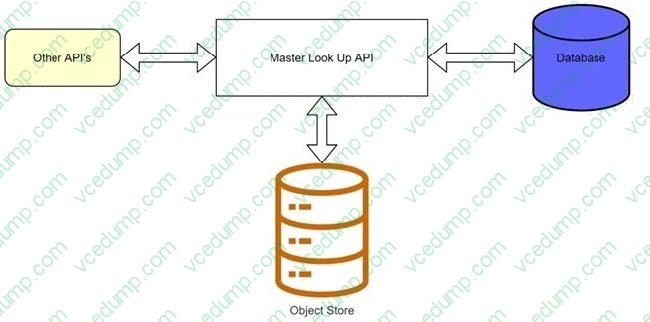
Master lookup API is deployed on two cloudhub workers of 0.1 vCore each because there is a lot of master data to be cached. Master lookup data is stored as a key value pair. The cache gets refreshed if they key is not found in the cache.
Doing performance testing it was observed that the Master lookup API has a higher response time due to database queries execution to fetch the master lookup data.
Due to this performance issue, go-live of the online business is on hold which could cause potential financial loss to Bank.
As an integration architect, which of the below option you would suggest to resolve performance issue?
A. Implement HTTP caching policy for all GET endpoints for the master lookup API and implement locking to synchronize access to object store
B. Upgrade vCore size from 0.1 vCore to 0,2 vCore
C. Implement HTTP caching policy for all GET endpoints for master lookup API
D. Add an additional Cloudhub worker to provide additional capacity -
Question 40:
In one of the critical payment related mule application, transaction is being used . As an enhancement to implementation , scatter gather route is introduced which is also the part of transaction group. Scatter gather route has 4 routes. What will be the behavior of the Mule application in case of error occurs in 4th route of the scatter-gather router and transaction needs to be rolled back?
A. Only errored route will be rolled back
B. All routes will be rolled back
C. Scatter Gather router cannot be part of transaction
Related Exams:
-
MCD-ASSOC
MuleSoft Certified Developer - Integration and API Associate (Mule 3) -
MCD-LEVEL1
MuleSoft Certified Developer - Level 1 (Mule 4) -
MCD-LEVEL1-DELTA
MuleSoft Certified Developer - Level 1 (Mule 4) DELTA -
MCD-LEVEL2
MuleSoft Certified Developer - Level 2 (Mule 4) -
MCIA-LEVEL1
MuleSoft Certified Integration Architect - Level 1 -
MCIA-LEVEL1-MAINTENANCE
MuleSoft Certified Integration Architect - Level 1 MAINTENANCE -
MCPA-LEVEL1
MuleSoft Certified Platform Architect - Level 1 -
MCPA-LEVEL1-MAINTENANCE
MuleSoft Certified Platform Architect - Level 1 MAINTENANCE
Tips on How to Prepare for the Exams
Nowadays, the certification exams become more and more important and required by more and more enterprises when applying for a job. But how to prepare for the exam effectively? How to prepare for the exam in a short time with less efforts? How to get a ideal result and how to find the most reliable resources? Here on Vcedump.com, you will find all the answers. Vcedump.com provide not only Mulesoft exam questions, answers and explanations but also complete assistance on your exam preparation and certification application. If you are confused on your MCIA-LEVEL1 exam preparations and Mulesoft certification application, do not hesitate to visit our Vcedump.com to find your solutions here.