MCIA-LEVEL1 Exam Details
-
Exam Code
:MCIA-LEVEL1 -
Exam Name
:MuleSoft Certified Integration Architect - Level 1 -
Certification
:Mulesoft Certifications -
Vendor
:Mulesoft -
Total Questions
:290 Q&As -
Last Updated
:May 28, 2026
Mulesoft MCIA-LEVEL1 Online Questions & Answers
-
Question 201:
An organization's IT team must secure all of the internal APIs within an integration solution by using an API proxy to apply required authentication and authorization policies. Which integration technology, when used for its intended purpose, should the team choose to meet these requirements if all other relevant factors are equal?
A. API Management (APIM)
B. Robotic Process Automation (RPA)
C. Electronic Data Interchange (EDI)
D. Integration Platform-as-a-service (PaaS) -
Question 202:
Mule application A receives a request Anypoint MQ message REQU with a payload containing a variable-length list of request objects. Application A uses the For Each scope to split the list into individual objects and sends each object as a message to an Anypoint MQ queue.
Service S listens on that queue, processes each message independently of all other messages, and sends a response message to a response queue.
Application A listens on that response queue and must in turn create and publish a response Anypoint MQ message RESP with a payload containing the list of responses sent by service S in the same order as the request objects originally sent in REQU.
Assume successful response messages are returned by service S for all request messages.
What is required so that application A can ensure that the length and order of the list of objects in RESP and REQU match, while at the same time maximizing message throughput?
A. Use a Scatter-Gather within the For Each scope to ensure response message order Configure the Scatter-Gather with a persistent object store
B. Perform all communication involving service S synchronously from within the For Each scope, so objects in RESP are in the exact same order as request objects in REQU
C. Use an Async scope within the For Each scope and collect response messages in a second For Each scope in the order In which they arrive, then send RESP using this list of responses
D. Keep track of the list length and all object indices in REQU, both in the For Each scope and in all communication involving service Use persistent storage when creating RESP -
Question 203:
An organization has deployed runtime fabric on an eight note cluster with performance profile. An API uses and non persistent object store for maintaining some of its state data. What will be the impact to the stale data if server crashes?
A. State data is preserved
B. State data is rolled back to a previously saved version
C. State data is lost
D. State data is preserved as long as more than one more is unaffected by the crash -
Question 204:
A project uses Jenkins to implement CI/CD process. It was observed that each Mule package contains some of the Jenkins files and folders for configurations of CI/CD jobs.
As these files and folders are not part of the actual package, expectation is that these should not be part of deployed archive.
Which file can be used to exclude these files and folders from the deployed archive?
A. muleignore
B. _unTrackMule
C. mulelnclude
D. _muleExclude -
Question 205:
A MuteSoft developer must implement an API as a Mule application, run the application locally, and execute unit tests against the Running application. Which Anypoint Platform component can the developer use to full all of these requirements?
A. API Manager
B. API Designer
C. Anypoint CLI
D. Anypoint Studio -
Question 206:
Refer to the exhibit.
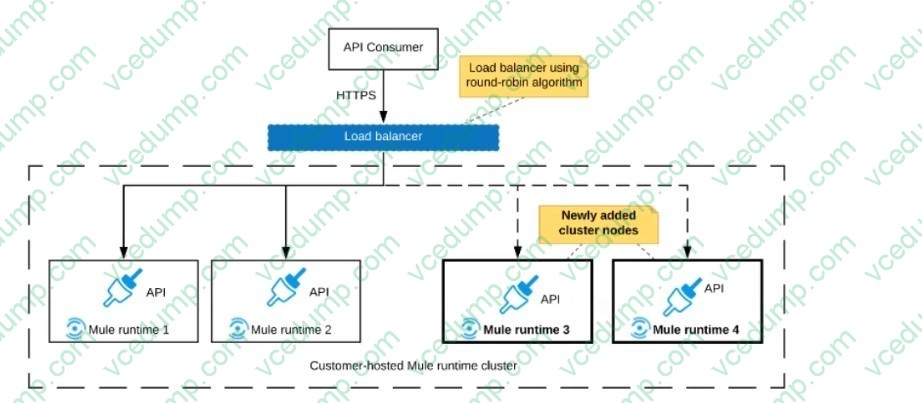
An organization uses a 2-node Mute runtime cluster to host one stateless API implementation. The API is accessed over HTTPS through a load balancer that uses round-robin for load distribution.
Two additional nodes have been added to the cluster and the load balancer has been configured to recognize the new nodes with no other change to the load balancer.
What average performance change is guaranteed to happen, assuming all cluster nodes are fully operational?
A. 50% reduction in the response time of the API
B. 100% increase in the throughput of the API
C. 50% reduction In the JVM heap memory consumed by each node
D. 50% reduction In the number of requests being received by each node -
Question 207:
An organization is building out a test suite for their application using MUnit. The Integration Architect has recommended using Test Recorder in Anypoint Studio to record the processing flows and then configure unit tests based on the captured events. What Is a core consideration that must be kept In mind while using Test Recorder?
A. The Recorder supports loops where the structure of the data being tested changes inside the Iteration
B. Mocking values resulting from parallel processes are possible and will not affect theexecution of the processors that follow in the test
C. The Recorder supports mocking a message before or inside a Foreach processor
D. Tests for flows cannot be created if Mule errors are raised Inside the flows, even if the errors are handled by On-Error Continue error handlers -
Question 208:
A Mule application is built to support a local transaction for a series of operations on a single database. The Mule application has a Scatter-Gather that participates in the local transaction. What is the behavior of the Scatter-Gather when running within this local transaction?
A. Execution of each route within the Scatter-Gather occurs sequentially Any error that occurs inside the Scatter-Gather will result in a rollback of all the database operations
B. Execution of all routes within the Scatter-Gather occurs in parallel Any error that occurs inside the Scatter-Gather will result in a rollback of all the database operations
C. Execution of each route within the Scatter-Gather occurs sequentially Any error that occurs inside the Scatter-Gather will NOT result in a rollback of any of the database operations
D. Execution of each route within the Scatter-Gather occurs in parallel Any error that occurs inside the Scatter-Gather will NOT result in a rollback of any of the database operations -
Question 209:
An API client is implemented as a Mule application that includes an HTTP Request operation using a default configuration. The HTTP Request operation invokes an external API that follows standard HTTP status code conventions, which causes the HTTP Request operation to return a 4xx status code. What is a possible cause of this status code response?
A. An error occurred inside the external API implementation when processing the HTTP request that was received from the outbound HTTP Request operation of the Mule application
B. The external API reported that the API implementation has moved to a different external endpoint
C. The HTTP response cannot be interpreted by the HTTP Request operation of the Mule application after it was received from the external API
D. The external API reported an error with the HTTP request that was received from the outbound HTTP Request operation of the Mule application -
Question 210:
An integration Mute application is being designed to process orders by submitting them to a backend system for offline processing. Each order will be received by the Mute application through an HTTPS POST and must be acknowledged immediately. Once acknowledged, the order will be submitted to a backend system. Orders that cannot be successfully submitted due to rejections from the backend system will need to be processed manually (outside the backend system).
The Mule application will be deployed to a customer-hosted runtime and is able to use an existing ActiveMQ broker if needed.
The backend system has a track record of unreliability both due to minor network connectivity issues and longer outages.
What idiomatic (used for their intended purposes) combination of Mule application components and ActiveMQ queues are required to ensure automatic submission of orders to the backend system, while minimizing manual order processing?
A. An On Error scope Non-persistent VM ActiveMQ Dead Letter Queue for manual processing
B. An On Error scope MuleSoft Object Store ActiveMQ Dead Letter Queue for manual processing
C. Until Successful component MuleSoft Object Store ActiveMQ is NOT needed or used
D. Until Successful component ActiveMQ long retry Queue ActiveMQ Dead Letter Queue for manual processing
Related Exams:
-
MCD-ASSOC
MuleSoft Certified Developer - Integration and API Associate (Mule 3) -
MCD-LEVEL1
MuleSoft Certified Developer - Level 1 (Mule 4) -
MCD-LEVEL1-DELTA
MuleSoft Certified Developer - Level 1 (Mule 4) DELTA -
MCD-LEVEL2
MuleSoft Certified Developer - Level 2 (Mule 4) -
MCIA-LEVEL1
MuleSoft Certified Integration Architect - Level 1 -
MCIA-LEVEL1-MAINTENANCE
MuleSoft Certified Integration Architect - Level 1 MAINTENANCE -
MCPA-LEVEL1
MuleSoft Certified Platform Architect - Level 1 -
MCPA-LEVEL1-MAINTENANCE
MuleSoft Certified Platform Architect - Level 1 MAINTENANCE
Tips on How to Prepare for the Exams
Nowadays, the certification exams become more and more important and required by more and more enterprises when applying for a job. But how to prepare for the exam effectively? How to prepare for the exam in a short time with less efforts? How to get a ideal result and how to find the most reliable resources? Here on Vcedump.com, you will find all the answers. Vcedump.com provide not only Mulesoft exam questions, answers and explanations but also complete assistance on your exam preparation and certification application. If you are confused on your MCIA-LEVEL1 exam preparations and Mulesoft certification application, do not hesitate to visit our Vcedump.com to find your solutions here.