MCIA-LEVEL1 Exam Details
-
Exam Code
:MCIA-LEVEL1 -
Exam Name
:MuleSoft Certified Integration Architect - Level 1 -
Certification
:Mulesoft Certifications -
Vendor
:Mulesoft -
Total Questions
:290 Q&As -
Last Updated
:May 28, 2026
Mulesoft MCIA-LEVEL1 Online Questions & Answers
-
Question 191:
Refer to the exhibit.
A Mule application is being designed to expose a SOAP web service to its clients.
What language is typically used inside the web service's interface definition to define the data structures that the web service Is expected to exchange with its clients?
A. WSDL
B. XSD
C. JSON Schema
D. RAMI -
Question 192:
Which role is primarily responsible for building API implementation as part of a typical MuleSoft integration project?
A. API Developer
B. API Designer
C. Integration Architect
D. Operations -
Question 193:
During a planning session with the executive leadership, the development team director presents plans for a new API to expose the data in the company's order database. An earlier effort to build an API on top of this data failed, so the director is recommending a design-first approach. Which characteristics of a design-first approach will help make this API successful?
A. Building MUnit tests so administrators can confirm code coverage percentage during deployment
B. Publishing the fully implemented API to Exchange so all developers can reuse the API
C. Adding global policies to the API so all developers automatically secure the implementation before coding anything
D. Developing a specification so consumers can test before the implementation is built -
Question 194:
An auto mobile company want to share inventory updates with dealers Dl and D2 asynchronously and concurrently via queues Q1 and Q2. Dealer Dl must consume the message from the queue Q1 and dealer D2 to must consume a message from the queue Q2.
Dealer D1 has implemented a retry mechanism to reprocess the transaction in case of any errors while processing the inventers updates. Dealer D2 has not implemented any retry mechanism.
How should the dealers acknowledge the message to avoid message loss and minimize impact on the current implementation?
A. Dealer D1 must use auto acknowledgement and dealer D2 can use manual acknowledgement and acknowledge the message after successful processing
B. Dealer D1 can use auto acknowledgement and dealer D2 can use IMMEDIATE acknowledgement and acknowledge the message of successful processing
C. Dealer D1 and dealer D2 must use AUTO acknowledgement and acknowledge the message after successful processing
D. Dealer D1 can use AUTO acknowledgement and dealer D2 must use manual acknowledgement and acknowledge the message after successful processing -
Question 195:
As an enterprise architect, what are the two reasons for which you would use a canonical data model in the new integration project using Mulesoft Anypoint platform ( choose two answers )
A. To have consistent data structure aligned in processes
B. To isolate areas within a bounded context
C. To incorporate industry standard data formats
D. There are multiple canonical definitions of each data type
E. Because the model isolates the back and systems and support mule applications from change -
Question 196:
Which Anypoint Platform component helps integration developers discovers and share reusable APIs, connectors, and templates?
A. Anypoint Exchange
B. API Manager
C. Anypoint Studio
D. Design Center -
Question 197:
An external REST client periodically sends an array of records in a single POST request to a Mule application API endpoint.
The Mule application must validate each record of the request against a JSON schema before sending it to a downstream system in the same order that it was received in the array
Record processing will take place inside a router or scope that calls a child flow. The child flow has its own error handling defined. Any validation or communication failures should not prevent further processing of the remaining records.
To best address these requirements what is the most idiomatic(used for it intended purpose) router or scope to used in the parent flow, and what type of error handler should be used in the child flow?
A. First Successful router in the parent flow On Error Continue error handler in the child flow
B. For Each scope in the parent flow On Error Continue error handler in the child flow
C. Parallel For Each scope in the parent flow On Error Propagate error handler in the child flow
D. Until Successful router in the parent flow On Error Propagate error handler in the child flow -
Question 198:
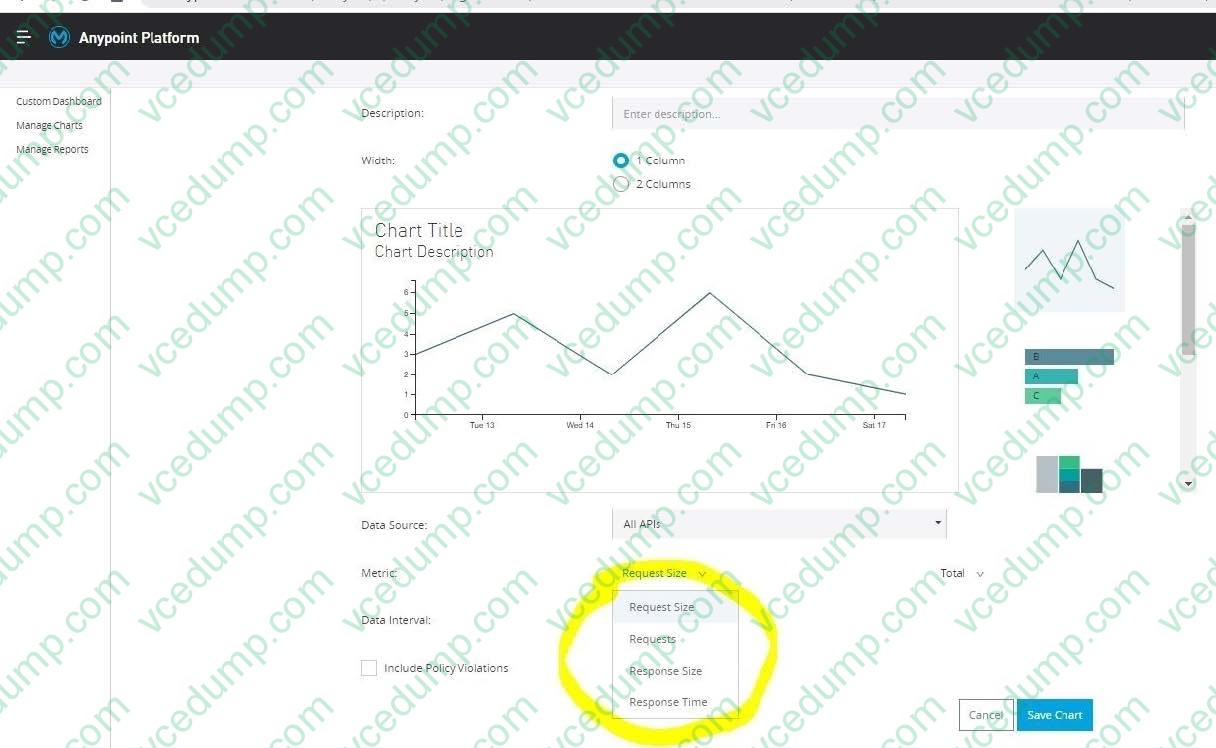
What metrics about API invocations are available for visualization in custom charts using Anypoint Analytics?
A. Request size, request HTTP verbs, response time
B. Request size, number of requests, JDBC Select operation result set size
C. Request size, number of requests, response size, response time
D. Request size, number of requests, JDBC Select operation response time -
Question 199:
A Mule application is built to support a local transaction for a series of operations on a single database. The mule application has a Scatter-Gather scope that participates in the local transaction.
What is the behavior of the Scatter-Gather when running within this local transaction?
A. Execution of all routes within Scatter-Gather occurs in parallel Any error that occurs inside Scatter-Gather will result in a roll back of all the database operations
B. Execution of all routes within Scatter-Gather occurs sequentially Any error that occurs inside Scatter-Gather will be handled by error handler and will not result in roll back
C. Execution of all routes within Scatter-Gather occurs sequentially Any error that occurs inside Scatter-Gather will result in a roll back of all the database operations
D. Execution of all routes within Scatter-Gather occurs in parallel Any error that occurs inside Scatter-Gather will be handled by error handler and will not result in roll back -
Question 200:
What is required before an API implemented using the components of Anypoint Platform can be managed and governed (by applying API policies) on Anypoint Platform?
A. The API must be published to Anypoint Exchange and a corresponding API instance ID must be obtained from API Manager to be used in the API implementation
B. The API implementation source code must be committed to a source control management system (such as GitHub)
C. A RAML definition of the API must be created in API designer so it can then be published to Anypoint Exchange
D. The API must be shared with the potential developers through an API portal so API consumers can interact with the API
Related Exams:
-
MCD-ASSOC
MuleSoft Certified Developer - Integration and API Associate (Mule 3) -
MCD-LEVEL1
MuleSoft Certified Developer - Level 1 (Mule 4) -
MCD-LEVEL1-DELTA
MuleSoft Certified Developer - Level 1 (Mule 4) DELTA -
MCD-LEVEL2
MuleSoft Certified Developer - Level 2 (Mule 4) -
MCIA-LEVEL1
MuleSoft Certified Integration Architect - Level 1 -
MCIA-LEVEL1-MAINTENANCE
MuleSoft Certified Integration Architect - Level 1 MAINTENANCE -
MCPA-LEVEL1
MuleSoft Certified Platform Architect - Level 1 -
MCPA-LEVEL1-MAINTENANCE
MuleSoft Certified Platform Architect - Level 1 MAINTENANCE
Tips on How to Prepare for the Exams
Nowadays, the certification exams become more and more important and required by more and more enterprises when applying for a job. But how to prepare for the exam effectively? How to prepare for the exam in a short time with less efforts? How to get a ideal result and how to find the most reliable resources? Here on Vcedump.com, you will find all the answers. Vcedump.com provide not only Mulesoft exam questions, answers and explanations but also complete assistance on your exam preparation and certification application. If you are confused on your MCIA-LEVEL1 exam preparations and Mulesoft certification application, do not hesitate to visit our Vcedump.com to find your solutions here.