MCIA-LEVEL1 Exam Details
-
Exam Code
:MCIA-LEVEL1 -
Exam Name
:MuleSoft Certified Integration Architect - Level 1 -
Certification
:Mulesoft Certifications -
Vendor
:Mulesoft -
Total Questions
:290 Q&As -
Last Updated
:May 28, 2026
Mulesoft MCIA-LEVEL1 Online Questions & Answers
-
Question 121:
Which feature allows automation of Anypoint Platform operations without directly calling REST APIs?
A. Runtime Manager agent
B. Anypoint CLI
C. API Gateway
D. Exchange Mocking Service -
Question 122:
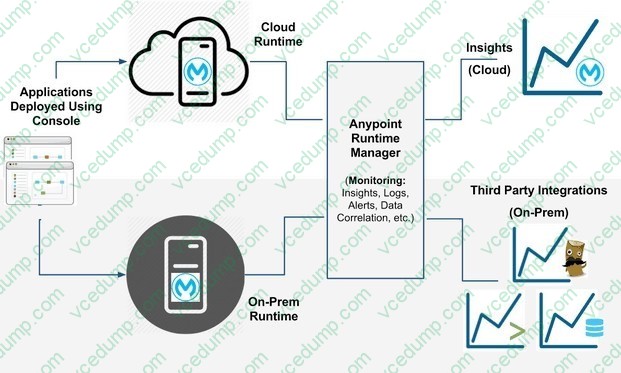
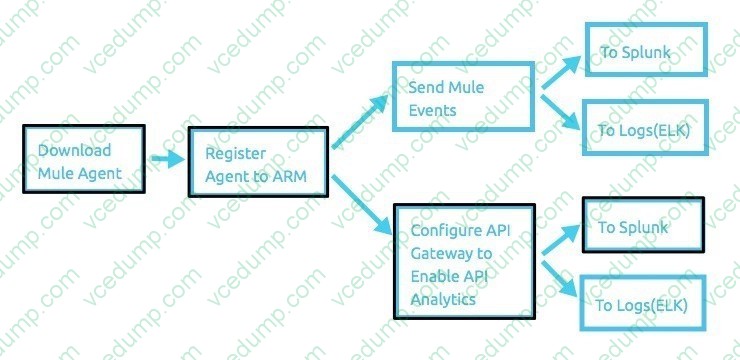
An organization uses Mule runtimes which are managed by Anypoint Platform - Private Cloud Edition. What MuleSoft component is responsible for feeding analytics data to non- MuleSoft analytics platforms?
A. Anypoint Exchange
B. The Mule runtimes
C. Anypoint API Manager
D. Anypoint Runtime Manager -
Question 123:
What is a core pillar of the MuleSoft Catalyst delivery approach?
A. Business outcomes
B. Technology centralization
C. Process thinking
D. Scope reduction -
Question 124:
In which order are the API Client, API Implementation, and API interface components called in a typical REST request?
A. API Client > API implementation > API Interface
B. API interface > API Client > API Implementation
C. API Client > API Interface > API implementation
D. API Implementation > API Interface > API Client -
Question 125:
What is the primary purpose of a Process API in API-led connectivity?
A. Directly expose backend systems
B. Aggregate and orchestrate multiple System APIs
C. Serve consumer-specific data formats
D. Enforce transport-level security -
Question 126:
A REST API is being designed to implement a Mule application.
What standard interface definition language can be used to define REST APIs?
A. Web Service Definition Language(WSDL)
B. OpenAPI Specification (OAS)
C. YAML
D. AsyncAPI Specification -
Question 127:
As a part of project requirement, Java Invoke static connector in a mule 4 application needs to invoke a static method in a dependency jar file. What are two ways to add the dependency to be visible by the connectors class loader? (Choose two answers)
A. In the Java Invoke static connector configuration, configure a path and name of the dependency jar file
B. Add the dependency jar file to the java classpath by setting the JVM parameters
C. Use Maven command to include the dependency jar file when packaging the application
D. Configure the dependency as a shared library in the project POM
E. Update mule-artefact.json to export the Java package -
Question 128:
A mule application must periodically process a large dataset which varies from 6 GB lo 8 GB from a back-end database and write transform data lo an FTPS server using a properly configured bad job scope.
The performance requirements of an application are approved to run in the cloud hub 0.2 vCore with 8 GB storage capacity and currency requirements are met.
How can the high rate of records be effectively managed in this application?
A. Use streaming with a file storage repeatable strategy for reading records from the database and batch aggregator with streaming to write to FTPS
B. Use streaming with an in-memory reputable store strategy for reading records from the database and batch aggregator with streaming to write to FTPS
C. Use streaming with a file store repeatable strategy for reading records from the database and batch aggregator with an optimal size
D. Use streaming with a file store repeatable strategy reading records from the database and batch aggregator without any required configuration -
Question 129:
Refer to the exhibit.

An organization is sizing an Anypoint VPC for the non-production deployments of those Mule applications that connect to the organization's on-premises systems. This applies to approx. 60 Mule applications. Each application is deployed to two CloudHub i workers. The organization currently has three non-production environments (DEV, SIT and UAT) that share this VPC. The AWS region of the VPC has two AZs. The organization has a very mature DevOps approach which automatically progresses each application through all non-production environments before automatically deploying to production. This process results in several Mule application deployments per hour, using CloudHub's normal zero-downtime deployment feature.
What is a CIDR block for this VPC that results in the smallest usable private IP address range?
A. 10.0.0.0/26 (64 IPS)
B. 10.0.0.0/25 (128 IPs)
C. 10.0.0.0/24 (256 IPs)
D. 10.0.0.0/22 (1024 IPs) -
Question 130:
According to MuleSoft's recommended REST conventions, which HTTP method should an API use to specify how AP\ clients can request data from a specified resource?
A. POST
B. PUT
C. PATCH
D. GET
Related Exams:
-
MCD-ASSOC
MuleSoft Certified Developer - Integration and API Associate (Mule 3) -
MCD-LEVEL1
MuleSoft Certified Developer - Level 1 (Mule 4) -
MCD-LEVEL1-DELTA
MuleSoft Certified Developer - Level 1 (Mule 4) DELTA -
MCD-LEVEL2
MuleSoft Certified Developer - Level 2 (Mule 4) -
MCIA-LEVEL1
MuleSoft Certified Integration Architect - Level 1 -
MCIA-LEVEL1-MAINTENANCE
MuleSoft Certified Integration Architect - Level 1 MAINTENANCE -
MCPA-LEVEL1
MuleSoft Certified Platform Architect - Level 1 -
MCPA-LEVEL1-MAINTENANCE
MuleSoft Certified Platform Architect - Level 1 MAINTENANCE
Tips on How to Prepare for the Exams
Nowadays, the certification exams become more and more important and required by more and more enterprises when applying for a job. But how to prepare for the exam effectively? How to prepare for the exam in a short time with less efforts? How to get a ideal result and how to find the most reliable resources? Here on Vcedump.com, you will find all the answers. Vcedump.com provide not only Mulesoft exam questions, answers and explanations but also complete assistance on your exam preparation and certification application. If you are confused on your MCIA-LEVEL1 exam preparations and Mulesoft certification application, do not hesitate to visit our Vcedump.com to find your solutions here.