MCIA-LEVEL1 Exam Details
-
Exam Code
:MCIA-LEVEL1 -
Exam Name
:MuleSoft Certified Integration Architect - Level 1 -
Certification
:Mulesoft Certifications -
Vendor
:Mulesoft -
Total Questions
:290 Q&As -
Last Updated
:May 28, 2026
Mulesoft MCIA-LEVEL1 Online Questions & Answers
-
Question 141:
Refer to the exhibit.
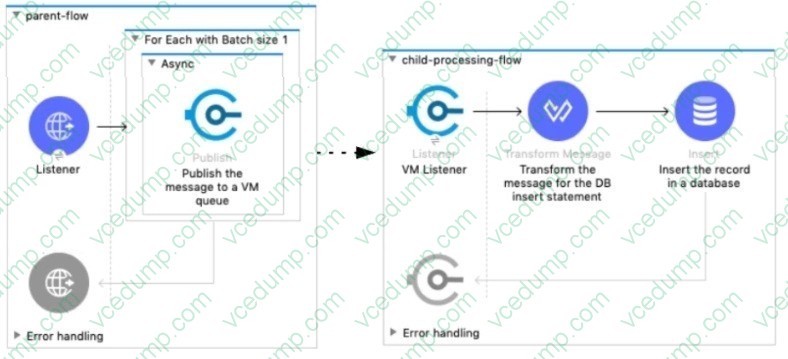
A Mule 4 application has a parent flow that breaks up a JSON array payload into 200 separate items, then sends each item one at a time inside an Async scope to a VM queue.
A second flow to process orders has a VM Listener on the same VM queue. The rest of this flow processes each received item by writing the item to a database.
This Mule application is deployed to four CloudHub workers with persistent queues enabled.
What message processing guarantees are provided by the VM queue and the CloudHub workers, and how are VM messages routed among the CloudHub workers for each invocation of the parent flow under normal operating conditions where all the CloudHub workers remain online?
A. EACH item VM message is processed AT MOST ONCE by ONE CloudHub worker, with workers chosen in a deterministic round-robin fashion Each of the four CloudHub workers can be expected to process 1/4 of the Item VM messages (about 50 items)
B. EACH item VM message is processed AT LEAST ONCE by ONE ARBITRARY CloudHub worker Each of the four CloudHub workers can be expected to process some item VM messages
C. ALL Item VM messages are processed AT LEAST ONCE by the SAME CloudHub worker where the parent flow was invoked This one CloudHub worker processes ALL 200 item VM messages
D. ALL item VM messages are processed AT MOST ONCE by ONE ARBITRARY CloudHub worker This one CloudHub worker processes ALL 200 item VM messages -
Question 142:
Mule applications need to be deployed to CloudHub so they can access on-premises database systems. These systems store sensitive and hence tightly protected data, so are not accessible over the internet.
What network architecture supports this requirement?
A. An Anypoint VPC connected to the on-premises network using an IPsec tunnel or AWS DirectConnect, plus matching firewall rules in the VPC and on-premises network
B. Static IP addresses for the Mule applications deployed to the CloudHub Shared Worker Cloud, plus matching firewall rules and IP whitelisting in the on-premises network
C. An Anypoint VPC with one Dedicated Load Balancer fronting each on-premises database system, plus matching IP whitelisting in the load balancer and firewall rules in the VPC and on-premises network
D. Relocation of the database systems to a DMZ in the on-premises network, with Mule applications deployed to the CloudHub Shared Worker Cloud connecting only to the DMZ -
Question 143:
An organization is using Mulesoft cloudhub and develops API's in the latest version. As a part of requirements for one of the API's, third party API needs to be called. The security team has made it clear that calling any external API needs to have include listing As an integration architect please suggest the best way to accomplish the design plan to support these requirements?
A. Implement includelist IP on the cloudhub VPC firewall to allow the traffic
B. Implement the validation of includelisted IP operation
C. Implement the Any point filter processor to implement the include list IP
D. Implement a proxy for the third party API and enforce the IPinclude list policy and call this proxy from the flow of the API -
Question 144:
An organization is choosing between API-led connectivity and other integration approaches.
According to MuleSoft, which business benefits is associated with an API-led connectivity approach using Anypoint Platform?
A. improved security through adoption of monolithic architectures
B. Increased developer productivity through sell-service of API assets
C. Greater project predictability through tight coupling of systems
D. Higher outcome repeatability through centralized development -
Question 145:
A set of integration Mule applications, some of which expose APIs, are being created to enable a new business process. Various stakeholders may be impacted by this. These stakeholders are a combination of semi-technical users (who understand basic integration terminology and concepts such as JSON and XML) and technically skilled potential consumers of the Mule applications and APIs.
What Is an effective way for the project team responsible for the Mule applications and APIs being built to communicate with these stakeholders using Anypoint Platform and its supplied toolset?
A. Use Anypoint Design Center to implement the Mule applications and APIs and give the various stakeholders access to these Design Center projects, so they can collaborate and provide feedback
B. Create Anypoint Exchange entries with pages elaborating the integration design, including API notebooks (where applicable) to help the stakeholders understand and interact with the Mule applications and APIs at various levels of technical depth
C. Use Anypoint Exchange to register the various Mule applications and APIs and share the RAML definitions with the stakeholders, so they can be discovered
D. Capture documentation about the Mule applications and APIs inline within the Mule integration flows and use Anypoint Studio's Export Documentation feature to provide an HTML version of this documentation to the stakeholders -
Question 146:
A Mule application is synchronizing customer data between two different database systems.
What is the main benefit of using eXtended Architecture (XA) transactions over local transactions to synchronize these two different database systems?
A. An XA transaction synchronizes the database systems with the least amount of Mule configuration or coding
B. An XA transaction handles the largest number of requests in the shortest time
C. An XA transaction automatically rolls back operations against both database systems if any operation falls
D. An XA transaction writes to both database systems as fast as possible -
Question 147:
An organization has several APIs that accept JSON data over HTTP POST. The APIs are all publicly available and are associated with several mobile applications and web applications. The organization does NOT want to use any authentication or compliance policies for these APIs, but at the same time, is worried that some bad actor could send payloads that could somehow compromise the applications or servers running the API implementations. What out-of-the-box Anypoint Platform policy can address exposure to this threat?
A. Apply a Header injection and removal policy that detects the malicious data before it is used
B. Apply an IP blacklist policy to all APIs; the blacklist will Include all bad actors
C. Shut out bad actors by using HTTPS mutual authentication for all API invocations
D. Apply a JSON threat protection policy to all APIs to detect potential threat vectors -
Question 148:
As a part of business requirement , old CRM system needs to be integrated using Mule application. CRM system is capable of exchanging data only via SOAP/HTTP protocol. As an integration architect who follows API led approach , what is the the below step you will perform so that you can share document with CRM team?
A. Create RAML specification using Design Center
B. Create SOAP API specification using Design Center
C. Create WSDL specification using text editor
D. Create WSDL specification using Design Center -
Question 149:
Which type of communication is managed by a service mesh in a microservices architecture?
A. Communication between microservices runtime administrators
B. Communication between microservices developers
C. Communication between microservices
D. Communication between trading partner services -
Question 150:
An application load balancer routes requests to a RESTful web API secured by Anypoint Flex Gateway.
Which protocol is involved in the communication between the load balancer and the Gateway?
A. SFTP
B. HTTPS
C. LDAP
D. SMTP
Related Exams:
-
MCD-ASSOC
MuleSoft Certified Developer - Integration and API Associate (Mule 3) -
MCD-LEVEL1
MuleSoft Certified Developer - Level 1 (Mule 4) -
MCD-LEVEL1-DELTA
MuleSoft Certified Developer - Level 1 (Mule 4) DELTA -
MCD-LEVEL2
MuleSoft Certified Developer - Level 2 (Mule 4) -
MCIA-LEVEL1
MuleSoft Certified Integration Architect - Level 1 -
MCIA-LEVEL1-MAINTENANCE
MuleSoft Certified Integration Architect - Level 1 MAINTENANCE -
MCPA-LEVEL1
MuleSoft Certified Platform Architect - Level 1 -
MCPA-LEVEL1-MAINTENANCE
MuleSoft Certified Platform Architect - Level 1 MAINTENANCE
Tips on How to Prepare for the Exams
Nowadays, the certification exams become more and more important and required by more and more enterprises when applying for a job. But how to prepare for the exam effectively? How to prepare for the exam in a short time with less efforts? How to get a ideal result and how to find the most reliable resources? Here on Vcedump.com, you will find all the answers. Vcedump.com provide not only Mulesoft exam questions, answers and explanations but also complete assistance on your exam preparation and certification application. If you are confused on your MCIA-LEVEL1 exam preparations and Mulesoft certification application, do not hesitate to visit our Vcedump.com to find your solutions here.