MCAT-TEST Exam Details
-
Exam Code
:MCAT-TEST -
Exam Name
:Medical College Admission Test: Verbal Reasoning, Biological Sciences, Physical Sciences, Writing Sample -
Certification
:Medical Tests Certifications -
Vendor
:Medical Tests -
Total Questions
:812 Q&As -
Last Updated
:Jul 08, 2026
Medical Tests MCAT-TEST Online Questions & Answers
-
Question 71:
How many electrons does gold (Au) possess that have a quantum number l = 2?
B. 23
C. 29
D. 79 -
Question 72:
...Squeaking sand produces sounds with very high frequencies -- between 500 and 2,500 hertz, lasting less than a quarter of a second. The peals are musically pure, often containing four or five harmonic overtones. Booming sand makes louder, low-frequency sounds of 50 to 300 hertz, which may last as long as 15 minutes in larger dunes (although typically they last for seconds or less). In addition, they are rather noisy, containing a multitude of nearby frequencies. Booms have never been observed to contain more than one harmonic of the fundamental tone. These dramatic differences once led to a consensus that although both types of sand produce acoustic emissions, the ways in which they do so must be substantially different.... In the late 1970s, however, Peter K. Haff, then at the California Institute of Technology, produced squeaks in booming sand, suggesting a closer connection between the two. Both kinds of sand must be displaced to make sounds. Walking on some sand, for example, forces the sand underfoot to move down and out, producing squeaks. In the case of booming sand, displacement occurs during avalanches. It is within the avalanche that sound begins and where the answers must be hiding. Before an avalanche can occur, winds must build a dune up to a certain angle, usually about 35 degrees for dry desert sand. Once an angle is achieved, the sand on the leeward side of the dune begins to slump. Intact layers of sand slip over the layers below, like a sheared deck of cards. At the same time, the individual grains in the upper layers tumble over the grains underneath, momentarily falling into the spaces between them and bouncing out again to continue their downward journey. Their concerted up-and-down motion is believed to be the secret source of sound. Fully developed avalanches, in which sliding plates of sand remain intact for most of their motion, have the greatest acoustic output. In some places, where large amounts of sand are involved, booming can be heard up to 10 kilometers away. Because it is caused by large volumes of shearing sand, the roaring is also loud. In fact, sounds made by booming sand can be nearly deafening, and the vibrations causing them can be so intense that standing in their midst is nearly impossible. A good place to start in exploring the vibrational properties of sand is with the grains themselves. The mean diameter of most sand grains, whether acoustically active or not, is about 300 microns. Usually the grains in a booming dune are very similar in size, especially near the leeward crest, where the sound most often originates; such uniformity allows for more efficient shearing. Otherwise, the smaller grains impede the smooth motion of the larger ones. Similar sizes do not alone allow sand to boom. On the contrary, the booming sands of Korizo and Gelf Kebib, also in Libya, feature an uncharacteristically broad range of particle sizes. Moreover, silent dune sand often contains grains somewhat similar to nearby booming sand. Grains of booming sand also tend to have uncommonly smooth surfaces, with protrusions on the scale of mere microns. Booming dunes are often found at the downwind end of large sand sources; having bounced and rolled across the desert for long distances, the sand grains in these dunes are usually highly polished. Over time a grain can also be polished by repeated shifts within a moving dune. And squeaking sand as well tends to be exceptionally smooth.... ...Another important factor is humidity, because moisture can modify the friction between grains or cause sand to clump together, thus precluding shearing. Sounds occur in those parts of the dune that dry the fastest. Precipitation may be rare in the desert, but dunes retain water with remarkable efficiency. Sand near the surface dries quickly, however, and sand around a dune's crest tends to dry the fastest.
Which of the following characteristics is most helpful in differentiating booming sand from squeaking sand?
A. duration of the sound
B. frequency of the sound
C. size of the sand grains
D. smoothness of the sand grains -
Question 73:
The information coded on the mRNA is decoded into:
A. fats.
B. proteins.
C. amino acids.
D. carbohydrates. -
Question 74:
A helium-neon gas discharge laser as shown in Figure 1 below generates a coherent beam of monochromatic light at a wavelength of 632.8 nm.
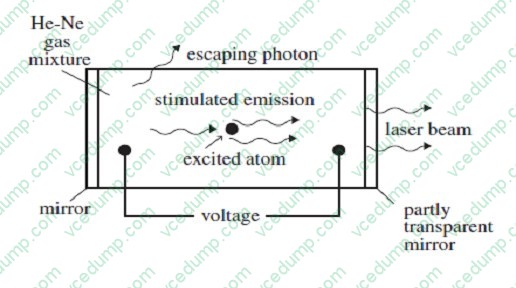
Figure 1
A discharge current of electrons is created in the tube by an applied voltage. When these electrons collide with the helium atoms, they can excite ground-state helium electrons to an energy level of 20.61 eV. The excited electrons cannot decay back to the ground state by emitting a photon because such a transition does not conserve angular momentum. Instead, if the excited helium atom collides with a neon atom, a ground-state electron in the neon atom can be excited to an energy level of 20.66 eV, and the helium electron can return to its ground state. The above process occurs quite often in the tube until the percentage of neon atoms with electrons in the 20.66-eV energy level is greater than the percentage of neon atoms with electrons in lower levels. This condition is called a population inversion. An excited electron in one of the neon atoms can then spontaneously decay by emitting a photon of wavelength 632.8 nm in a random direction. The photon will stimulate the same transition in another excited electron in a neon atom. The photon radiated by this stimulated emission process travels in the same direction as the original photon. The resulting light is then reflected back and forth inside the tube until it escapes through the partially transparent mirror. (Note: A photon's energy in eV is given by E = 1240/, where is the photon's wavelength in nm. The helium and neon ground-state energies are both 0 eV.)
Why is stimulated emission of photons necessary in order to produce a coherent beam of light instead of spontaneous emission alone?
A. Stimulated emission produces photons of higher energy than those produced by spontaneous emission.
B. Stimulated emission produces photons that travel in the same direction as the photon that induces their emission.
C. Stimulated emission produces photons with longer wavelengths than those produced by spontaneous emission.
D. Either spontaneous or stimulated emission alone would be sufficient to produce laser light. -
Question 75:
Aerobic respiration is the major process used by oxygen- requiring organisms to generate energy. During respiration, glucose is metabolized to generate chemical energy in the form of ATP:

The biochemical machinery necessary for cellular respiration is found in the mitochondria, small organelles scattered throughout the cytoplasm of most eukaryotic cells. The number of mitochondria per cell varies by tissue type and cell function.
Mitochondria are unusual in that they have their own genetic systems that are entirely separate from the cell's genetic material. However, mitochondrial replication is still dependent upon the cell's nuclear DNA to encode essential proteins required for replication. Despite this fact, mitochondria seem to replicate randomly, out of phase with both the cell cycle and other mitochondria.
The nature of the mitochondrial genome and protein synthesizing machinery has led many researchers to postulate that mitochondria may have arisen as the result of the ingestion of a bacterium by a primitive cell millions of years ago. It is postulated that the two may have entered into a symbiotic relationship and eventually became dependent on each another; the cell sustained the bacterium, while the bacterium provided energy for the cell. Gradually, the two evolved into the present-day eukaryotic cell, with the mitochondrion retaining some of its own DNA. This is known as the endosymbiotic hypothesis. Because mitochondrial DNA is inherited in a non-Mendelian fashion (mitochondria are inherited from the maternal parent, who supplies most of the cytoplasm to the fertilized egg), it has been used to look at evolutionary relationships among different organisms.
In which of the following phases of the cell cycle could mitochondrial DNA replicate?
I. G1
II. S
III. G2
IV.
M
A. IV only
B. I and III only
C. II and IV only
D. I, II, III, and IV
I. G1 II. S III. G2 IV. M -
Question 76:
Synthetic dyes constitute a commercially significant area of organic chemistry. The color producing properties of these compounds are the result of highly delocalized electron systems giving rise to electronic transitions whose absorptions occur in the visible region. Most commercially useful dyes can be classified as one of three types -- anthraquinones, azo dyes, or triarylmethyl salts. Examples of each type are illustrated in Figure 1.
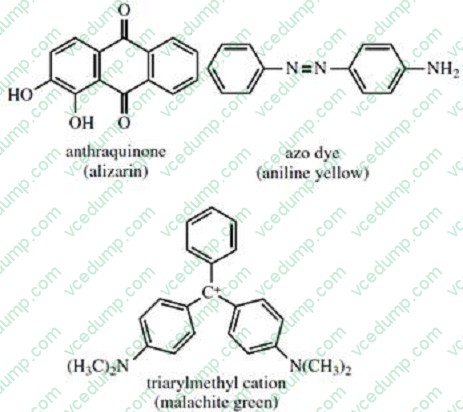
Figure 1
In order for a dye to be useful in the fabric industry, it must have sufficient affinity for the polymeric fibers of which the material is composed; the dye must not only impart a color to the fabric, but must also do so in a relatively permanent manner (color fastness). Proper design of synthetic polymers requires the placement of acidic or basic side chains along the polymer backbone such that binding sites are available for dying. Similarly, dyes must be produced not only with the appropriate color-producing structure, but also with an affinity for the fabric in question. The structural units of several common synthetic fibers are shown in Figure 2.
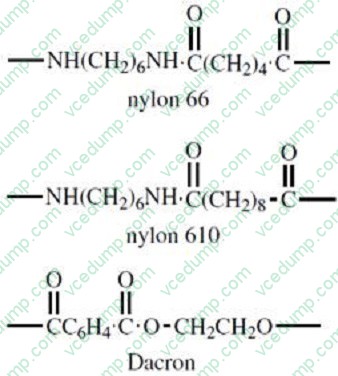
Figure 2
Hydrogenation of alizarin over a specific rhodium catalyst results in the complete saturation of all the carbon-carbon bonds, but does not affect any other functional groups. Which of the following effects should also be expected?
A. The hydrogenated product will no longer have any affinity for Dacron fibers.
B. The hydrogenated product will no longer be soluble in aqueous base.
C. The hydrogenated product will no longer appear colored.
D. The hydrogenated product will have a greatly increased affinity for nylon 610. -
Question 77:
Neutrons penetrate matter easily because they:
A. occupy no more than one-tenth of the volume of the electrons.
B. are electrically neutral.
C. occupy no more than one-tenths of the volume of the protons.
D. have smaller mass than protons. -
Question 78:
Four major blood types exist in the human ABO blood system: types A, B, AB, and O; and there are three alleles that code for them. The A and B alleles are codominant, and the O allele is recessive. Blood types are derived from the presence of specific polysaccharide antigens that lie on the outer surface of the red blood cell membrane. The A allele codes for the production of the A antigen; the B allele codes for the production of the B antigen; the O allele does not code for any antigen. While there are many other antigens found on red blood cell membranes, the second most important antigen is the Rh antigen. Rh is an autosomally dominant trait coded for by 2 alleles. If this antigen is present, an individual is Rh+; if it is absent, an individual is Rh-. For example, a person with type AB blood with the Rh antigen is said to be AB+.
These antigens become most important when an individual comes into contact with foreign blood. Because of the presence of naturally occurring substances that closely mimic the A and B antigens, individuals who do not have these antigens on their red blood cells will form antibodies against them. This is inconsequential until situations such as blood transfusion, organ transplant, or pregnancy occur.
Erythroblastosis fetalis is a condition in which the red blood cells of an Rh+ fetus are attached by antibodies produced by its Rh- mother. Unlike ABO incompatibility, in which there are naturally occurring antibodies to foreign antigens, the Rh system requires prior sensitization to the Rh antigen before antibodies are produced. This sensitization usually occurs during the delivery of an Rh+ baby. So while the first baby will not be harmed, any further Rh+ fetuses are at risk. The Coombs tests provide a method for determining whether a mother has mounted an immune response again her baby's blood. The tests are based on whether or not agglutination occurs when Coombs reagent is added to a sample. Coombs reagent contains antibodies against the anti-Rh antibodies produced by the mother. The indirect Coombs test takes the mother's serum, which contains her antibodies but no red blood cells, and mixes it with Rh+ red blood cells. Coombs reagent is then added. If agglutination occurs, the test is positive, and the mother must be producing anti-Rh antibodies. The direct Coombs test mixes the baby's red blood cells with Coombs reagent. If agglutination occurs, the test is positive, and the baby's red blood cells must have been attacked by its mother's anti-Rh antibodies.
A medical student suggested giving Rh- mothers of Rh+ fetuses a specific exogenous substance prior to delivery to prevent an immune response. Which of the following substances would likely be the safest and most effective?
A. Rh antigen
B. An immunosuppressive drug
C. Anti-Rh antibody
D. Iron pills -
Question 79:
Hypoxia refers to a physiological condition in which the body lacks sufficient oxygen for normal cellular functioning. Prolonged hypoxia generally leads to an inhibition of mental capacity and a reduction in the work capacity of muscle. Severe cases of hypoxia can lead to coma or even death. Depending on the cause, hypoxia can be classified into four general types:
Hypoxic hypoxia is a type of hypoxia that occurs when the partial pressure of oxygen in the blood is too low. For example, climbers at high altitude, where the air contains less oxygen, might experience hypoxic hypoxia because the partial pressure of oxygen in the air inhaled is very low, leading to insufficient partial pressure of oxygen in the blood.
Anemic hypoxia describes a diminished ability of the blood to transport oxygen. Several factors can influence the oxygen-carrying capacity of the blood. Primary causes of anemic hypoxia include a lower than normal number of functional erythrocytes or an insufficient quantity of hemoglobin, the oxygen- carrying molecules of the blood. Abnormal hemoglobin can also decrease the blood's capacity to carry oxygen and lead to anemic hypoxia.
Ischemic hypoxia is caused by a decreased delivery of blood to the tissues. Localized circulatory deficiencies, such as blood clots, and global circulatory deficiencies, such as heart failure, decrease the delivery of blood to the tissues, and can therefore cause ischemic hypoxia.
Histotoxic hypoxia results from the inability of cells to utilize the oxygen available in the blood. Causes of histotoxic hypoxia include the poisoning of cellular enzymes involved in aerobic respiration, as well as the decreased metabolic capacity of the oxidative enzymes due to vitamin deficiency. Cyanide poisoning causes histotoxic hypoxia by blocking the action of cytochrome oxidase in the electron transport chain so that tissues cannot use oxygen even though it is available.
Cigarette smoking causes emphysema, a condition in which the net surface area of the lungs is greatly decreased leading to a decrease in the diffusing capacity of the lungs.
Emphysema leads to which type of hypoxia?
A. Hypoxic hypoxia
B. Anemic hypoxia
C. Ischemic hypoxia
D. Histotoxic hypoxia -
Question 80:
Which of following is mostly likely the result of large scale destruction of forests?
A. Increase in air humidity
B. Decrease in floods
C. Increase in soil erosion
D. Decrease in carbon dioxide
Related Exams:
Tips on How to Prepare for the Exams
Nowadays, the certification exams become more and more important and required by more and more enterprises when applying for a job. But how to prepare for the exam effectively? How to prepare for the exam in a short time with less efforts? How to get a ideal result and how to find the most reliable resources? Here on Vcedump.com, you will find all the answers. Vcedump.com provide not only Medical Tests exam questions, answers and explanations but also complete assistance on your exam preparation and certification application. If you are confused on your MCAT-TEST exam preparations and Medical Tests certification application, do not hesitate to visit our Vcedump.com to find your solutions here.