JN0-360 Exam Details
-
Exam Code
:JN0-360 -
Exam Name
:Service Provider Routing and Switching, Specialist (JNCIS-SP) -
Certification
:Juniper Certifications -
Vendor
:Juniper -
Total Questions
:542 Q&As -
Last Updated
:Jan 17, 2024
Juniper JN0-360 Online Questions & Answers
-
Question 331:
Click the Exhibit.
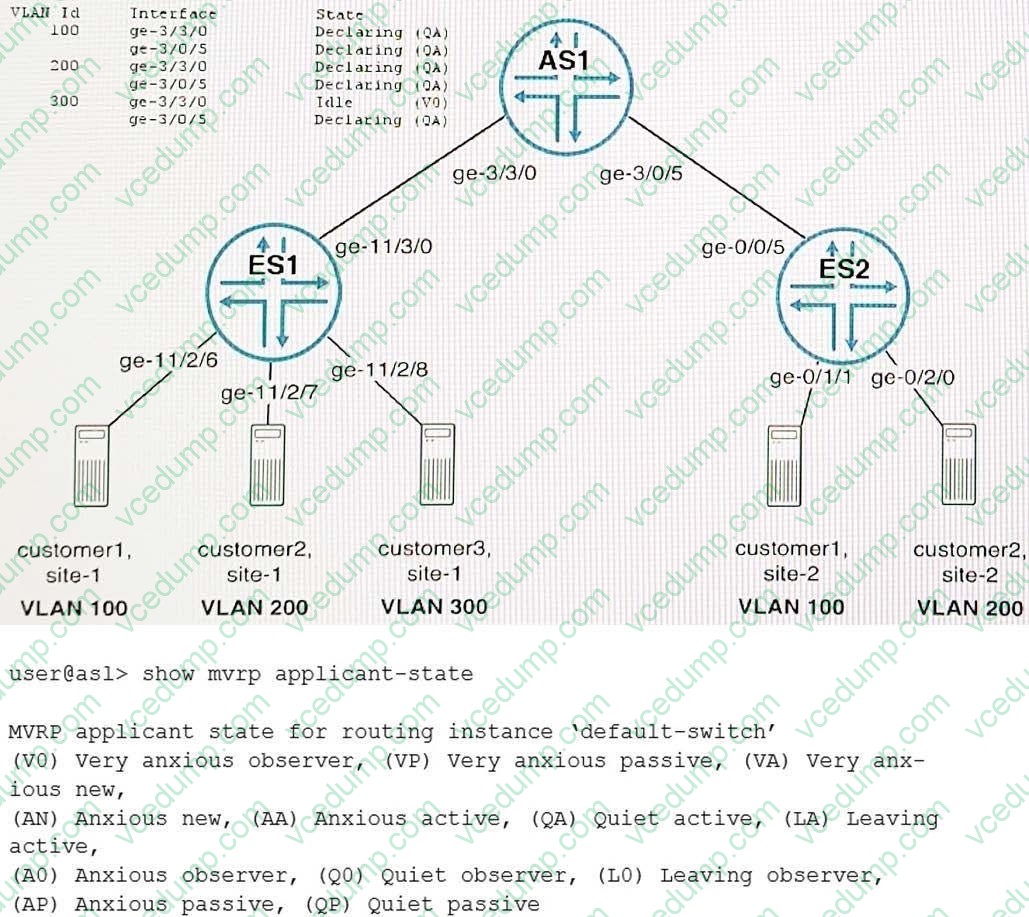
Referring to the exhibit, which statement is correct about MVRP?
A. AS1's VLAN ID list is missing an entry for VLAN 300.
B. ES2 is not interested in VLAN 300.
C. AS1 is not allowing ES2 access to VLAN 300.
D. ES1 is not advertising VLAN 300 to AS1. -
Question 332:
You are logged in to an MX80 and issue the command "show route protocol bgp" You see that you have received the route 10.0.4/24 from two different peers. One peer is an external peer and the other is an internal peer. The route received from the internal peer is active.
By the rules of BGP preference, what would cause the internal path for this prefix to be preferred over the external one?
A. Internally learned prefix is preferred over an externally learned prefix
B. The local-preference value of the internally learned prefix is higher than the externally learned peer
C. The peer ID of the internally learned prefix is lower than that of the externally learned peer
D. The internally learned prefix has a shorted cluster length -
Question 333:
What are three well-known mandatory BGP attributes? (Choose three.)
A. origin
B. MED
C. AS path
D. next hop
E. local preference -
Question 334:
You have configured MPLS and RSVP in your network using all of the Junos defaults. You have established an LSP in your network, which is reporting a status of "Up", but no traffic is using it. Which two statements reflect potential causes for this issue? (Choose two)
A. The LSP egress address is a physical interface address
B. family MPLS was omitted from the router configurations
C. No BGP routes are being advertised from the remote neighbor
D. The LSP egress address does not match the BGP next-hop address -
Question 335:
Click the exhibit.
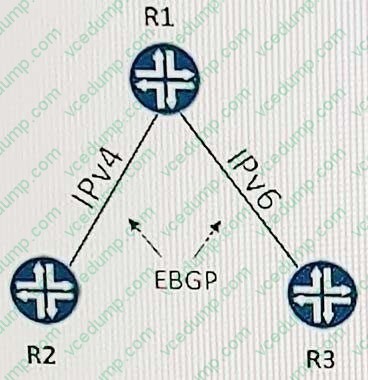
You are asked to enable a new BGP connection on R1, which has an existing IPv4 peering with R2. The new peering with R3 will use IPv6. Referring to the exhibit, which two steps are required to enable the new IPv6 peering? (Choose two.)
A. Configure an IPv6 address on the appropriate interface.
B. Configure the rib inet6.0 statement under the BGP group.
C. Configure an IPv6 neighbor address under the BGP group.
D. Configure an IPv6 local address under the BGP group. -
Question 336:
In your network, you have two LDP routers connected across four physical interfaces. You also have enabled LDP to separate on all four of those interfaces. What is the resulting outcome of your configuration between those two devices?
A. One session is built across one neighbor relationship
B. One session is built across four neighbor relationships
C. Four sessions are built across one neighbor relationship
D. Four sessions are built across four neighbor relationships -
Question 337:
Click the Exhibit button
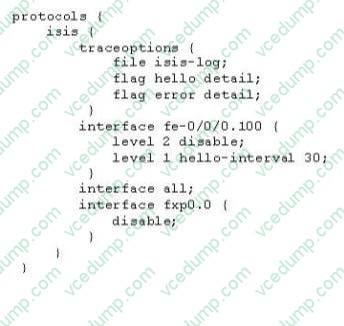
Based on the configuration shown in the exhibit, which command would you use to display real-time hellos and errors for IS-IS?
A. monitor file isis-log
B. monitor start isis-log
C. monitor log isis-log
D. monitor syslog isis-log -
Question 338:
-- Exhibit -user@router# show interfaces
xe-0/0/0 {
unit 0 {
family inet {
address 192.168.12.1/24;
}
family mpls;
}
}
xe-0/0/1 {
encapsulation ethernet-ccc;
unit 0 {
family ccc;
}
}
lo0 {
unit 0 {
family inet {
address 1.1.1.1/32;
}
}
}
[edit]
user@router# show protocols
mpls {
interface all;
}
ospf {
traffic-engineering;
area 0.0.0.0 {
interface all;
}
}
ldp {
interface all;
}
l2circuit {
neighbor 2.2.2.2 {
interface xe-0/0/1.0 {
}
}
}
-- Exhibit -
Click the Exhibit button.
In the exhibit, which configuration element is missing to bring up the Layer 2 circuit?
A. the route target
B. the virtual circuit ID
C. a targeted LDP session
D. an MPLS LSP -
Question 339:
-- Exhibit -user@R1> show
interfaces {
ge-1/1/0 {
unit 0 {
family inet {
address 10.100.1.1/30;
}
family iso;
}
}
lo0 {
unit 0 {
family inet {
address 10.100.10.1/32;
}
family iso {
address 49.1001.0010.0100.00;
}
}
}
}
protocols {
isis {
interface ge-1/1/0.0 {
level 2 disable;
}
interface lo0.0;
}
}
user@R2> show
interfaces {
ge-1/1/0 {
unit 0 {
family inet {
address 10.100.1.2/30;
}
}
}
lo0 {
unit 0 {
family inet {
address 10.100.10.2/32;
}
family iso {
address 49.1001.0010.0200.00;
}
}
}
}
protocols {
isis {
interface ge-1/1/0.0;
interface lo0.0;
}
}
-- Exhibit -
Click the Exhibit button.
Referring to the exhibit, R1 and R2 are directly connected using interface ge-1/1/0.
What happens as a result of the configurations?
A. No adjacency forms
B. Level 2 adjacency forms
C. Level 1 adjacency forms
D. Level 1 and Level 2 adjacencies form -
Question 340:
Click the Exhibit button
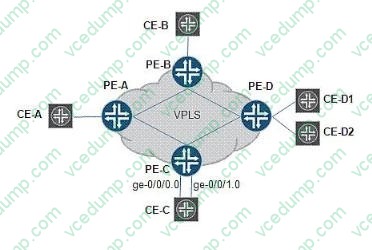
Based on the illustration of the VPLS topology shown in the exhibit, which statement is true?
A. PE-C must have a spanning-tree protocol enabled
B. CE-C must have BGP enabled
C. Traffic forwarded from PE-C to PE-A is forwarded on to PE-B
D. Traffic forwarded from PE-C to PE-A is not forwarded on to PE-B
Related Exams:
-
JN0-102
Internet Associate, Junos(JNCIA-Junos) -
JN0-104
Junos, Associate (JNCIA-Junos) -
JN0-105
Junos, Associate (JNCIA-Junos) -
JN0-106
Junos - Associate (JNCIA-Junos) Junos OS 21.2 -
JN0-1101
Juniper Networks Certified Design Associate (JNCDA) -
JN0-1103
Design, Associate (JNCIA-Design) -
JN0-130
Juniper networks Certified internet specialist.e(jncis-e) -
JN0-1301
Data Center Design, Specialist (JNCDS-DC) -
JN0-1302
Data Center Design Specialist (JNCDS-DC) -
JN0-1331
Security Design, Specialist (JNCDS-SEC)
Tips on How to Prepare for the Exams
Nowadays, the certification exams become more and more important and required by more and more enterprises when applying for a job. But how to prepare for the exam effectively? How to prepare for the exam in a short time with less efforts? How to get a ideal result and how to find the most reliable resources? Here on Vcedump.com, you will find all the answers. Vcedump.com provide not only Juniper exam questions, answers and explanations but also complete assistance on your exam preparation and certification application. If you are confused on your JN0-360 exam preparations and Juniper certification application, do not hesitate to visit our Vcedump.com to find your solutions here.