JN0-360 Exam Details
-
Exam Code
:JN0-360 -
Exam Name
:Service Provider Routing and Switching, Specialist (JNCIS-SP) -
Certification
:Juniper Certifications -
Vendor
:Juniper -
Total Questions
:542 Q&As -
Last Updated
:Jan 17, 2024
Juniper JN0-360 Online Questions & Answers
-
Question 221:
Your RSVP network is being designed to support end-to-end class of service (CoS) using best practices. Which MPLS label should be advertised by the egress router in this situation?
B. 1
C. 2
D. 3 -
Question 222:
You own a home network connecting through an always-on connection and need to assign IPv6 addresses to your routers because you want to follow the guidelines spelled out in RFC 3177. You want to design your network with the correct prefixes.
Which prefix would your ISP likely allocate to your network?
A. 47-bit prefix
B. 48-bit prefix
C. 64-bit prefix
D. 128-bit prefix -
Question 223:
What is required on the egress and ingress devices to transport IPv6 traffic across an IPv4 network?
A. An IP-IP interface
B. A TE tunnel interface
C. A GRE tunnel interface
D. A 6to 4 tunnel interface -
Question 224:
Click the Exhibit button
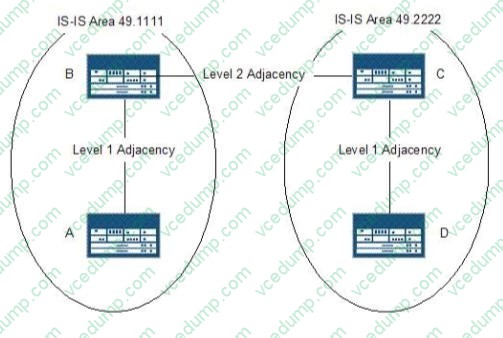
Referring to the network illustrated in the exhibit, how does router A reach destinations in area 49.2222?
A. Router A will use the routes from area 49.2222; it learns from router B
B. Router A will see the attached bit from router B and create a default route
C. Router A must have a default route manually configured
D. Router A will receive a default route in the IS-IS update from router B -
Question 225:
How can you control the selection of the designated intermediate system (DIS) on a specific link in an IS-IS network?
A. Configure the interface as passive
B. Configure a priority on the interface
C. Configure the hello interval on the interface
D. DIS selection is random in the Junos OS -
Question 226:
Router A is an OSPF router connected to both Area 0 and Area 1 Area 1 has been configured as a stub area Which two LSA types does Router A suppress from Area 1?
A. Router LSA
B. External LSA
C. Summary LSA
D. ASBR Summary LSA -
Question 227:
Which two statements are correct regarding LDP-signaled VPLS instances? (Choose two.)
A. You must enable the Layer 2 VPN signaling NLRI.
B. You must configure the same VPLS identifier on all peers.
C. You must define a the same site-identifier value on all peers.
D. You must define all neighbors using their tunnel end-point IP addresses. -
Question 228:
Click the Exhibit.
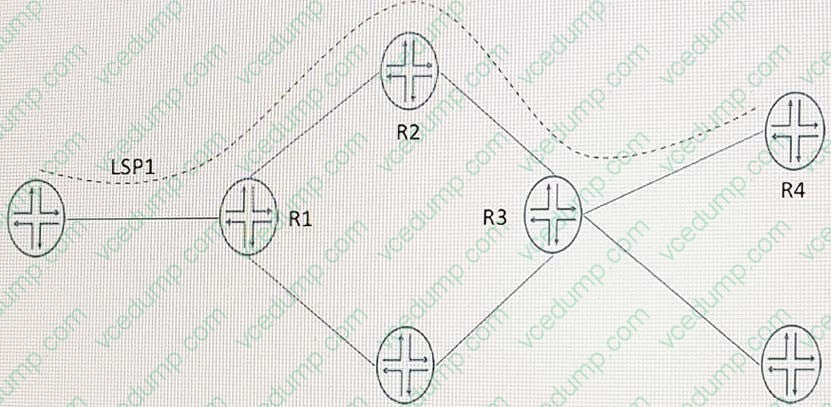
By default, at which router will the implicit null (Label3) action take place for LSP shown in the exhibit?
A. R4
B. R2
C. R1
D. R3 -
Question 229:
You are configuring a default static route using the default preference value. You want to ensure that any static route that you configure in the future will be less preferred than the OSPF routes that are configured on the network. Which command will accomplish this task?
A. set protocols ospf preference 6
B. set routing-options static route preference 9
C. set routing-options static defaults preference 20
D. set routing-options static defaults passive -
Question 230:
-- Exhibit -user@R1> show route protocol bgp
inet.0: 6 destinations, 6 routes (6 active, 0 holddown, 0 hidden)
+ = Active Route, - = Last Active, * = Both
200.200.0.0/24 *[BGP/170] 00:00:47, localpref 100 AS path: 65001 I > to 192.168.100.1 via ge-1/1/5.435 200.200.1.0/24 *[BGP/170] 00:00:47, localpref 100 AS path: 65001 I > to 192.168.100.1 via ge-1/1/5.435 200.200.2.0/24 *[BGP/170] 00:00:47, localpref 100 AS path: 65001 I > to 192.168.100.1 via ge-1/1/5.435 200.200.3.0/24 *[BGP/170] 00:00:47, localpref 100 AS path: 65001 I > to 192.168.100.1 via ge-1/1/5.435
user@R2> show route 200.200/16
inet.0: 36 destinations, 36 routes (36 active, 0 holddown, 0 hidden) Restart Complete
+ = Active Route, - = Last Active, * = Both
200.200.0.0/24 *[Static/5] 00:09:12
Reject
200.200.1.0/24 *[Static/5] 00:09:12
Reject
200.200.2.0/24 *[Static/5] 00:09:12
Reject
200.200.3.0/24 *[Static/5] 00:09:12
Reject
200.200.4.0/24 *[Static/5] 00:09:12
Reject
user@R2> show configuration protocols bgp
export export-200;
group c5 {
neighbor 192.168.100.2 {
export export-200.200;
peer-as 65002;
}
}
user@R2> show configuration policy-options policy-statement export-200.200
term 1 {
from {
route-filter 200.200.0.0/22 longer;
}
then accept;
}
user@R2> show configuration policy-options policy-statement export-200
term 1 {
from {
route-filter 200.200.0.0/21 longer;
}
then accept;
}
-- Exhibit -
Click the Exhibit button.
R2 is exporting static routes to R1 using BGP. R1 is not receiving one of the five static routes that is configured on R2.
Referring to the exhibit, what should be changed under the BGP configuration to resolve this issue?
A. Delete the global export policy.
B. Delete the neighbor export policy.
C. Move policy export-200 to the group level.
D. Move policy export-200.200 to the group level.
Related Exams:
-
JN0-102
Internet Associate, Junos(JNCIA-Junos) -
JN0-104
Junos, Associate (JNCIA-Junos) -
JN0-105
Junos, Associate (JNCIA-Junos) -
JN0-106
Junos - Associate (JNCIA-Junos) Junos OS 21.2 -
JN0-1101
Juniper Networks Certified Design Associate (JNCDA) -
JN0-1103
Design, Associate (JNCIA-Design) -
JN0-130
Juniper networks Certified internet specialist.e(jncis-e) -
JN0-1301
Data Center Design, Specialist (JNCDS-DC) -
JN0-1302
Data Center Design Specialist (JNCDS-DC) -
JN0-1331
Security Design, Specialist (JNCDS-SEC)
Tips on How to Prepare for the Exams
Nowadays, the certification exams become more and more important and required by more and more enterprises when applying for a job. But how to prepare for the exam effectively? How to prepare for the exam in a short time with less efforts? How to get a ideal result and how to find the most reliable resources? Here on Vcedump.com, you will find all the answers. Vcedump.com provide not only Juniper exam questions, answers and explanations but also complete assistance on your exam preparation and certification application. If you are confused on your JN0-360 exam preparations and Juniper certification application, do not hesitate to visit our Vcedump.com to find your solutions here.