ISO-IEC-27001-LEAD-AUDITOR Exam Details
-
Exam Code
:ISO-IEC-27001-LEAD-AUDITOR -
Exam Name
:PECB Certified ISO/IEC 27001 Lead Auditor exam -
Certification
:PECB Certifications -
Vendor
:PECB -
Total Questions
:289 Q&As -
Last Updated
:May 25, 2026
PECB ISO-IEC-27001-LEAD-AUDITOR Online Questions & Answers
-
Question 141:
You are performing an ISMS audit at a residential nursing home (ABC) that provides healthcare services. The next step in your audit plan is to verify the information security of ABC's healthcare mobile app development, support, and lifecycle process. During the audit, you learned the organization outsourced the mobile app development to a professional software development company with CMMI Level 5, ITSM (ISO/IEC 20000-1), BCMS (ISO 22301) and ISMS (ISO/IEC 27001) certified.
The IT Manager presented the software security management procedure and summarised the process as following:
The mobile app development shall adopt "security-by-design" and "security-by-default" principles, as a minimum. The following security functions for personal data protection shall be available:
Access control.
Personal data encryption, i.e., Advanced Encryption Standard (AES) algorithm, key lengths: 256 bits; and Personal data pseudonymization.
Vulnerability checked and no security backdoor
You sample the latest Mobile App Test report, details as follows:
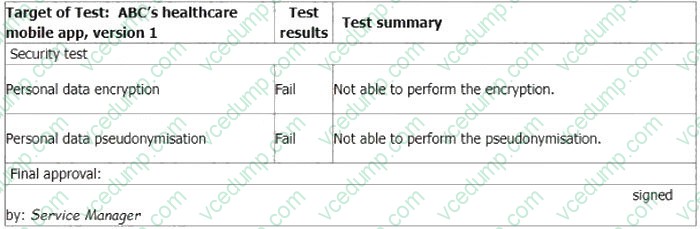
You ask the IT Manager why the organisation still uses the mobile app while personal data encryption and pseudonymization tests failed. Also, whether the Service Manager is authorised to approve the test.
The IT Manager explains the test results should be approved by him according to the software security management procedure.
The reason why the encryption and pseudonymisation functions failed is that these functions heavily slowed down the system and service performance. An extra 150% of resources are needed to cover this. The Service Manager agreed that
access control is good enough and acceptable. That's why the Service Manager signed the approval.
You are preparing the audit findings. Select the correct option.
A. There is NO nonconformity (NC). The Service Manager makes a good decision to continue the service.(Relevant to clause 8.1, control A.8.30)
B. There is a nonconformity (NC). The organisation and developer do not perform acceptance tests.(Relevant to clause 8.1, control A.8.29)
C. There is a nonconformity (NC). The organisation and developer perform security tests that fail.(Relevant to clause 8.1, control A.8.29)
D. There is a nonconformity (NC). The Service Manager does not comply with the software security management procedure. (Relevant to clause 8.1, control A.8.30) -
Question 142:
You are an experienced ISMS audit team leader conducting a third-party surveillance visit.
You notice that although the auditee is claiming conformity with ISO/IEC 27001:2022 they are still referring to Improvement as clause 10.2 (as it was in the 2013 edition) when this is now clause 10.1 in the 2022 edition. You have confirmed they are meeting all of the 2022 requirements set out in the standard.
Select one option of the action you should take.
A. Note the issue in the audit report
B. Raise a nonconformity against clause 7.5.3 - Control of documented information
C. Raise it as an opportunity for improvement
D. Bring the matter up at the closing meeting -
Question 143:
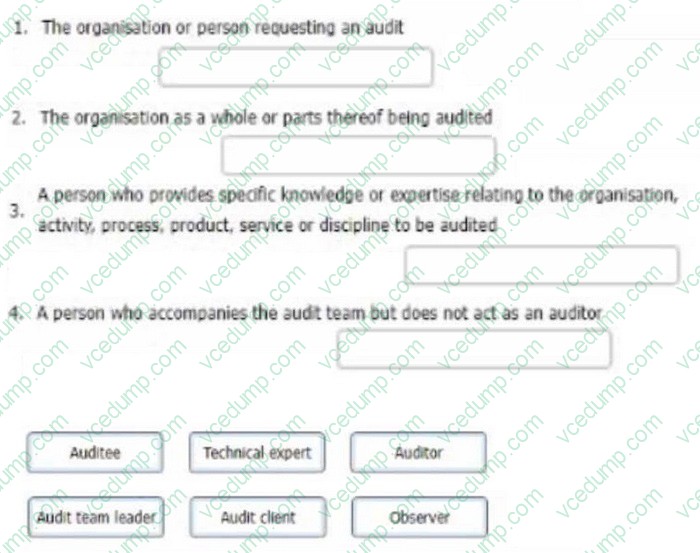
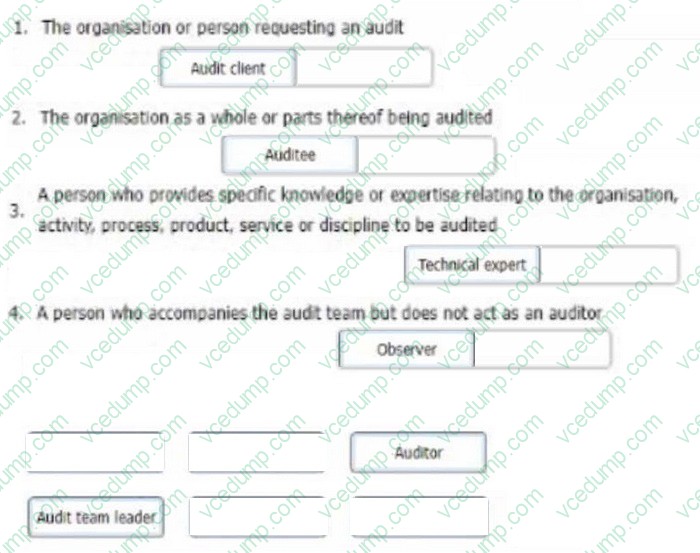
DRAG DROP Please match the roles to the following descriptions: To complete the table click on the blank section you want to complete so that it is highlighted in red, and then click on the applicable test from the options below. Alternatively, you may drag and drop each option to the appropriate blank
section.
Select and Place:
-
Question 144:
Scenario 6: Sinvestment is an insurance company that offers home, commercial, and life insurance. The company was founded in North Carolina, but have recently expanded in other locations, including Europe and Africa.
Sinvestment is committed to complying with laws and regulations applicable to their industry and preventing any information security incident. They have implemented an ISMS based on ISO/IEC 27001 and have applied for ISO/IEC 27001 certification.
Two auditors were assigned by the certification body to conduct the audit. After signing a confidentiality agreement with Sinvestment. they started the audit activities. First, they reviewed the documentation required by the standard, including the declaration of the ISMS scope, information security policies, and internal audits reports. The review process was not easy because, although Sinvestment stated that they had a documentation procedure in place, not all documents had the same format.
Then, the audit team conducted several interviews with Sinvestment's top management to understand their role in the ISMS implementation. All activities of the stage 1 audit were performed remotely, except the review of documented information, which took place on-site, as requested by Sinvestment.
During this stage, the auditors found out that there was no documentation related to information security training and awareness program. When asked, Sinvestment's representatives stated that the company has provided information security training sessions to all employees. Stage 1 audit gave the audit team a general understanding of Sinvestment's operations and ISMS.
The stage 2 audit was conducted three weeks after stage 1 audit. The audit team observed that the marketing department (which was not included in the audit scope) had no procedures in place to control employees' access rights. Since controlling employees' access rights is one of the ISO/IEC 27001 requirements and was included in the information security policy of the company, the issue was included in the audit report. In addition, during stage 2 audit, the audit team observed that Sinvestment did not record logs of user activities. The procedures of the company stated that "Logs recording user activities should be retained and regularly reviewed," yet the company did not present any evidence of the implementation of such procedure.
During all audit activities, the auditors used observation, interviews, documented information review, analysis, and technical verification to collect information and evidence. All the audit findings during stages 1 and 2 were analyzed and the audit team decided to issue a positive recommendation for certification.
Based on the scenario above, answer the following question:
The audit team reviewed Sinvestment's documented information on-site, as requested by the company. Is this acceptable?
A. Yes, Sinvestment has the right to require that no document is carried off-site during the documented information review
B. No, Sinvestment cannot decide where the documentation review take place, since a confidentiality agreement was signed prior to stage 1 audit
C. No, the combination of on-site and off-site activities can impact the audit negatively -
Question 145:
You are an experienced audit team leader conducting a third-party surveillance audit of an organisation that designs websites for its clients. You are currently reviewing the organisation's Statement of Applicability.
Based on the requirements of ISO/IEC 27001, which two of the following observations about the Statement of Applicability are true?
A. Justification for both the inclusion and exclusion of Annex A controls in the Statement of Applicability is required
B. The Statement of Applicability is owned and amended by the organisation's top management
C. The Statement of Applicability must be reviewed at least annually
D. A Statement of Applicability must be produced by organisations seeking ISO/IEC 27001 conformity
E. Justification is only required for any controls that the organisations choses to exclude
F. The Statement of Applicability must be reviewed at Management Review -
Question 146:
Implement plan on a test basis - this comes under which section of PDCA
A. Plan
B. Do
C. Act
D. Check -
Question 147:
Which two of the following are valid audit conclusions?
A. ISMS induction training does not provide guidance on malware prevention
B. The risk register had not been updated since June 202X
C. Corrective action was outstanding for two internal audits
D. The ISMS policy has been effectively communicated to the organisation
E. The organisation's ISMS objectives meet the requirements of ISO/IEC 27001:2022
F. The schedule of applicability was based on the 2013 edition of ISO/IEC 27001, not the 2022 edition -
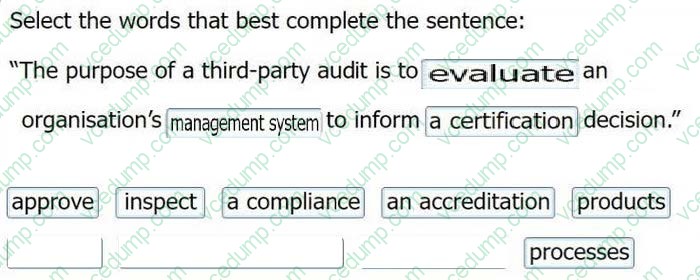
Question 148:
DRAG DROP
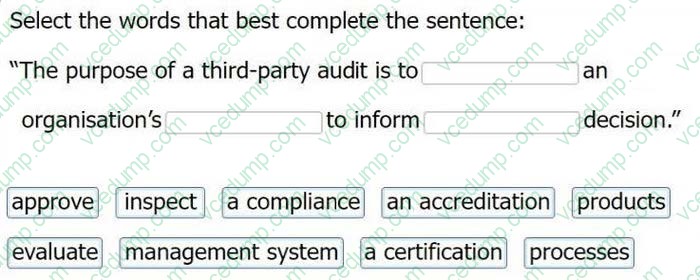
Select the words that best complete the sentence:
Select and Place:
-
Question 149:
Phishing is what type of Information Security Incident?
A. Private Incidents
B. Cracker/Hacker Attacks
C. Technical Vulnerabilities
D. Legal Incidents -
Question 150:
Audit methods can be either with or without interaction with individuals representing the auditee. Which two of the following methods are with interaction?
A. Sampling (e.g. products)
B. Observing work performed via live video streaming
C. Reviewing checklists with auditee
D. Checking legal compliance with local authorities
E. Conducting interviews
F. Analysing documents provided in advance of the audit
Related Exams:
-
ISO-20000-FND
ISO/IEC 20000 Foundation -
ISO-22301-BCMS-CLA
ISO 22301 BCMS - Certified Lead Auditor -
ISO-22301-LA
ISO 22301 Lead Auditor -
ISO-22301-LEAD-AUDITOR
PECB Certified ISO 22301 Lead Auditor Exam -
ISO-22301-LI
ISO 22301 Lead Implementer -
ISO-27001-ISMS-FND
ISO 27001:2013 ISMS - Foundation -
ISO-27001-LA
ISO/IEC 27001:2022 Lead Auditor -
ISO-27001-LI
ISO/IEC 27001:2022 Lead Implementer -
ISO-27002-LI
ISO/IEC 27002 - Lead Implementer -
ISO-27005-RM
ISO/IEC 27005 Risk Manager
Tips on How to Prepare for the Exams
Nowadays, the certification exams become more and more important and required by more and more enterprises when applying for a job. But how to prepare for the exam effectively? How to prepare for the exam in a short time with less efforts? How to get a ideal result and how to find the most reliable resources? Here on Vcedump.com, you will find all the answers. Vcedump.com provide not only PECB exam questions, answers and explanations but also complete assistance on your exam preparation and certification application. If you are confused on your ISO-IEC-27001-LEAD-AUDITOR exam preparations and PECB certification application, do not hesitate to visit our Vcedump.com to find your solutions here.