ISO-IEC-27001-LEAD-AUDITOR Exam Details
-
Exam Code
:ISO-IEC-27001-LEAD-AUDITOR -
Exam Name
:PECB Certified ISO/IEC 27001 Lead Auditor exam -
Certification
:PECB Certifications -
Vendor
:PECB -
Total Questions
:289 Q&As -
Last Updated
:May 25, 2026
PECB ISO-IEC-27001-LEAD-AUDITOR Online Questions & Answers
-
Question 131:
Scenario 4: SendPay is a financial company that provides its services through a network of agents and financial institutions. One of their main services is transferring money worldwide. SendPay, as a new company, seeks to offer top quality services to its clients. Since the company offers international transactions, it requires from their clients to provide personal information, such as their identity, the reason for the transactions, and other details that might be needed to complete the transaction. Therefore, SendPay has implemented security measures to protect their clients' information, including detecting, investigating, and responding to any information security threats that may emerge. Their commitment to offering secure services was also reflected during the ISMS implementation where the company invested a lot of time and resources.
Last year, SendPay unveiled their digital platform that allows money transactions through electronic devices, such as smartphones or laptops, without requiring an additional fee. Through this platform, SendPay's clients can send and receive money from anywhere and at any time. The digital platform helped SendPay to simplify the company's operations and further expand its business. At the time, SendPay was outsourcing its software operations, hence the project was completed by the software development team of the outsourced company. The same team was also responsible for maintaining the technology infrastructure of SendPay.
Recently, the company applied for ISO/IEC 27001 certification after having an ISMS in place for almost a year. They contracted a certification body that fit their criteria. Soon after, the certification body appointed a team of four auditors to audit SendPay's ISMS.
During the audit, among others, the following situations were observed:
1.The outsourced software company had terminated the contract with SendPay without prior notice. As a result, SendPay was unable to immediately bring the services back in-house and its operations were disrupted for five days. The auditors requested from SendPay's representatives to provide evidence that they have a plan to follow in cases of contract terminations. The representatives did not provide any documentary evidence but during an interview, they told the auditors that the top management of SendPay had identified two other software development companies that could provide services immediately if similar situations happen again.
2.There was no evidence available regarding the monitoring of the activities that were outsourced to the software development company. Once again, the representatives of SendPay told the auditors that they regularly communicate with the software development company and that they are appropriately informed for any possible change that might occur.
3.There was no nonconformity found during the firewall testing. The auditors tested the firewall configuration in order to determine the level of security provided by these services. They used a packet analyzer to test the firewall policies which enabled them to check the packets sent or received in real-time.
Based on this scenario, answer the following question:
How do you evaluate the evidence obtained related to the monitoring process of outsourced operations? Refer to scenario 4.
A. Irrelevant, monitoring the outsourced operations is not a requirement of the standard
B. Not reliable. SendPay provided only verbal evidence regarding the monitoring of its outsourced operations
C. Appropriate and sufficient, verbal confirmation from the SendPay's representatives indicates that the they were aware that outsourced operations must be monitored -
Question 132:
Scenario 3: NightCore is a multinational technology company based in the United States that focuses on e- commerce, cloud computing, digital streaming, and artificial intelligence. After having an information security management system (ISMS) implemented for over 8 months, they contracted a certification body to conduct a third party audit in order to get certified against ISO/IEC 27001. The certification body set up a team of seven auditors. Jack, the most experienced auditor, was assigned as the audit team leader. Over the years, he received many well known certifications, such as the ISO/IEC 27001 Lead Auditor, CISA, CISSP, and CISM.
Jack conducted thorough analyses on each phase of the ISMS audit, by studying and evaluating every information security requirement and control that was implemented by NightCore. During stage 2 audit. Jack detected several nonconformities. After comparing the number of purchased invoices for software licenses with the software inventory, Jack found out that the company has been using the illegal versions of a software for many computers. He decided to ask for an explanation from the top management about this nonconformity and see whether they were aware about this. His next step was to audit NightCore's IT Department. The top management assigned Tom, NightCore's system administrator, to act as a guide and accompany Jack and the audit team toward the inner workings of their system and their digital assets infrastructure.
While interviewing a member of the Department of Finance, the auditors discovered that the company had recently made some unusual large transactions to one of their consultants. After gathering all the necessary details regarding the transactions. Jack decided to directly interview the top management.
When discussing about the first nonconformity, the top management told Jack that they willingly decided to use a copied software over the original one since it was cheaper. Jack explained to the top management of NightCore that using illegal versions of software is against the requirements of ISO/IEC 27001 and the national laws and regulations. However, they seemed to be fine with it.
Several months after the audit, Jack sold some of NightCore's information that he collected during the audit for a huge amount of money to competitors of NightCore.
Based on this scenario, answer the following question:
Based on audit principles, should Jack contact the certification body regarding the second nonconformity? Refer to scenario 3.
A. Yes, auditors should contact the ethics committee members of the certification body to obtain advice on such situation
B. Yes, auditors should communicate such situations to the certification body; however, the top management should not be informed
C. No, situations that may indicate financial crime are not the focus of an ISMS audit -
Question 133:
As the Information Security Management System audit team leader, you are conducting a second-party audit of an international logistics company on behalf of an online retailer. During the audit, one of your team members reports a
nonconformity relating to control 5.18 (Access rights) of Appendix A of ISO/IEC 27001:
2022. She found evidence that removing the server access protocols of 20 people who left in the last 3 months took up to 1 week whereas the policy required removing access within 24 hours of their departure.
When the auditee was asked why there was a delay in removing access they replied, 'no one was available in the IT department during that period as a result of COVID-19. As soon as an IT officer became available the rights were removed.
You note that she intends to raise a minor non-conformity against Access rights control (5.18). How should you respond to this?
A. Agree with the raising of a minor non-conformity but against control 5.15, not 5.18.
B. Agree with the raising of the minor non-conformity against 5.18.
C. Disagree with the raising of a minor conformity as appropriate action was taken at the earliest opportunity Take no further action.
D. Disagree with the raising of the minor nonconformity as appropriate action was taken at the earliest opportunity. Instead raise an opportunity for improvement.
E. Disagree with the raising of the minor nonconformity, there is sufficient evidence to justify an escalation to a major non-conformity.
F. Require additional audit evidence to be obtained before determining whether a non-conformity is appropriate. -
Question 134:
Which is the glue that ties the triad together
A. Process
B. People
C. Collaboration
D. Technology -
Question 135:
You are a certification body auditor, conducting a surveillance audit to ISO/IEC 27001:2022 of a data centre operated by a client who provides hosting services for ICT facilities.
You and your guide are currently in one of the private suites that the client rents out to customers. Access to each suite is controlled using a combination lock. CCTV is also installed in every suite.
Within each suite are three data cabinets in which the client can locate mission-critical servers and other items of networking equipment such as switches and routers.
You notice that whilst two of the cabinets in your suite are locked, the third is unlocked. You ask the guide why. They reply "This is because the client is currently swapping out a hard drive unit. Their technician is currently on a lunch break".
What three actions should you undertake next?
A. Do nothing, the room appears adequately protected so it is unlikely that a security incident has taken place.
B. Raise a nonconformity against control 5.16 'identity management' as it may not be possible to identify who left the cabinet unlocked.
C. Raise a nonconformity against control 7.2 'physical entry' as the area where the client's equipment is located is not protected.
D. Raise a nonconformity against control 7.4 'physical security monitoring' as the private suite is not being continuously monitored for unauthorised physical access.
E. Raise an opportunity for improvement suggesting cabinet doors are locked whenever clients leave their suites, even if they intend to return within a short time.
F. Review the CCTV records to ensure that only the client has accessed the cabinet since it was last confirmed as locked.
G. When the technician returns from lunch, reprimand them for leaving the cabinet open.
H. With the permission of the guide, speak to the customer to confirm that they are in the process of swapping out a drive. -
Question 136:
You are performing an ISMS audit at a residential nursing home called ABC that provides healthcare services. You find all nursing home residents wear an electronic wristband for monitoring their location, heartbeat, and blood pressure always. You learned that the electronic wristband automatically uploads all data to the artificial intelligence (AI) cloud server for healthcare monitoring and analysis by healthcare staff.
To verify the scope of ISMS, you interview the management system representative (MSR) who explains that the ISMS scope covers an outsourced data center.
Select three options for the audit evidence you need to find to verify the scope of the ISMS.
A. The auditee has identified the resident's needs and expectations on the facility and environmental safety
B. The auditee has ISO 9001 certification
C. The auditee has identified the governmental authorities' needs and expectations on healthcare services and patient data handling
D. The auditee has identified the resident's needs and expectations on how they should protect the resident's personal data
E. The auditee has identified the resident's needs and expectations on the comfort facility, medical professional's competence, and clean environment
F. The auditee has identified the resident's needs and expectations on healthcare medical treatment services
G. The IT service agreement with the data center where the artificial intelligence (AI) cloud server is located
H. The auditee is considering the purchase of a healthcare monitoring app from an external software company -
Question 137:
During a follow-up audit, you notice that a nonconformity identified for completion before the follow-up audit is still outstanding.
Which four of the following actions should you take?
A. Report the failure to address the corrective action for the outstanding nonconformity to the organisation's top management
B. Immediately raise an nonconformity as the date for completion has been exceeded
C. If the delay is justified agree on a revised date for clearing the nonconformity with the auditee/audit client
D. Contact the individuals) managing the audit programme to seek their advice as to how to proceed
E. Decide whether the delay in addressing the nonconformity is justified
F. Cancel the follow-up audit and return when an assurance has been received that the nonconformity has been cleared
G. Note the nonconformity is still outstanding and follow audit trails to determine why
H. If the delay is unjustified advise the auditee /audit client and agree on remedial action -
Question 138:
You are conducting a third-party surveillance audit when another member of the audit team approaches you seeking clarification. They have been asked to assess the organisation's application of control 5.7 - Threat Intelligence. They are aware that this is one of the new controls introduced in the 2022 edition of ISO/IEC 27001, and they want to make sure they audit the control correctly.
They have prepared a checklist to assist them with their audit and want you to confirm that their planned activities are aligned with the control's requirements.
Which three of the following options represent valid audit trails?
A. I will determine whether internal and external sources of information are used in the production of threat intelligence
B. I will ensure that the task of producing threat intelligence is assigned to the organisation's internal audit team
C. I will ensure that the organisation's risk assessment process begins with effective threat intelligence
D. I will check that the organisation has a fully documented threat intelligence process
E. I will check that threat intelligence is actively used to protect the confidentiality, integrity and availability of the organisation's information assets
F. I will speak to top management to make sure all staff are aware of the importance of reporting threats
G. I will ensure that appropriate measures have been introduced to inform top management as to the effectiveness of current threat intelligence arrangements
H. I will review how information relating to information security threats is collected and evaluated to produce threat intelligence -
Question 139:
DRAG DROP
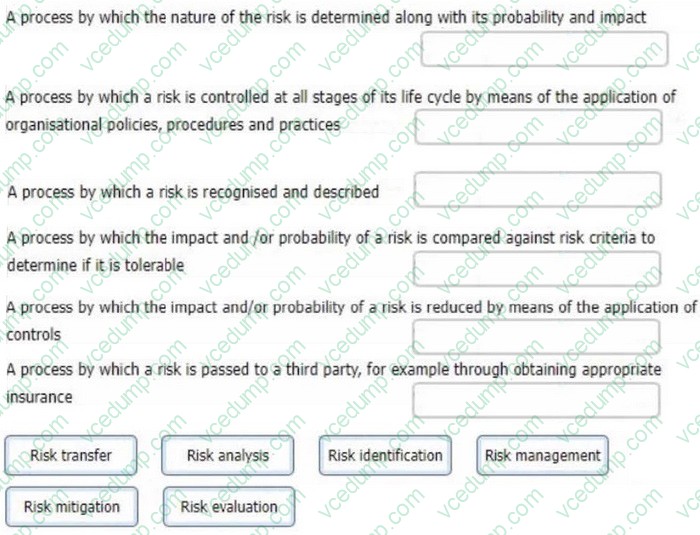
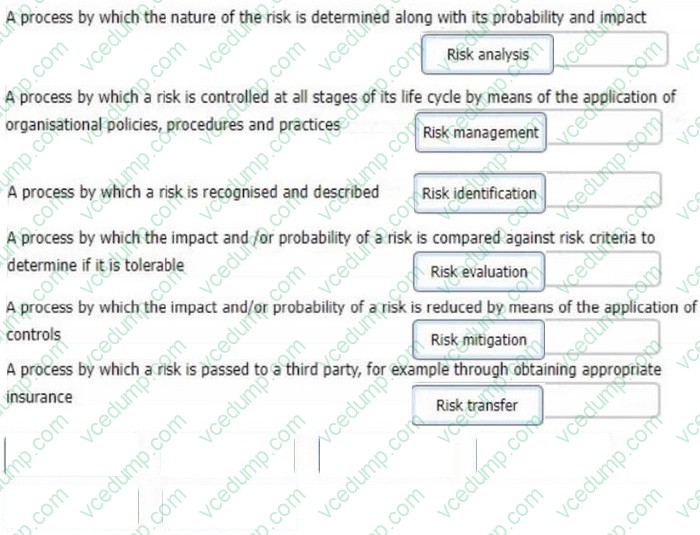
You are an experienced ISMS audit team leader providing instruction to an auditor in training. They are unclear in their understanding of risk processes and ask you to provide them with an example of each of the processes detailed below.
Match each of the descriptions provided to one of the following risk management processes.
To complete the table click on the blank section you want to complete so that it is highlighted in red, and then click on the applicable text from the options below. Alternatively, you may drag and drop each option to the appropriate blank
section.
Select and Place:
-
Question 140:
You are an experienced audit team leader guiding an auditor in training.
Your team is currently conducting a third-party surveillance audit of an organisation that stores data on behalf of external clients. The auditor in training has been tasked with reviewing the TECHNOLOGICAL controls listed in the Statement of Applicability (SoA) and implemented at the site.
Select four controls from the following that would you expect the auditor in training to review.
A. Confidentiality and nondisclosure agreements
B. How access to source code and development tools are managed
C. How power and data cables enter the building
D. How protection against malware is implemented
E. How the organisation evaluates its exposure to technical vulnerabilities
F. Information security awareness, education and training
G. The organisation's arrangements for information deletion
H. The organisation's business continuity arrangements
Related Exams:
-
ISO-20000-FND
ISO/IEC 20000 Foundation -
ISO-22301-BCMS-CLA
ISO 22301 BCMS - Certified Lead Auditor -
ISO-22301-LA
ISO 22301 Lead Auditor -
ISO-22301-LEAD-AUDITOR
PECB Certified ISO 22301 Lead Auditor Exam -
ISO-22301-LI
ISO 22301 Lead Implementer -
ISO-27001-ISMS-FND
ISO 27001:2013 ISMS - Foundation -
ISO-27001-LA
ISO/IEC 27001:2022 Lead Auditor -
ISO-27001-LI
ISO/IEC 27001:2022 Lead Implementer -
ISO-27002-LI
ISO/IEC 27002 - Lead Implementer -
ISO-27005-RM
ISO/IEC 27005 Risk Manager
Tips on How to Prepare for the Exams
Nowadays, the certification exams become more and more important and required by more and more enterprises when applying for a job. But how to prepare for the exam effectively? How to prepare for the exam in a short time with less efforts? How to get a ideal result and how to find the most reliable resources? Here on Vcedump.com, you will find all the answers. Vcedump.com provide not only PECB exam questions, answers and explanations but also complete assistance on your exam preparation and certification application. If you are confused on your ISO-IEC-27001-LEAD-AUDITOR exam preparations and PECB certification application, do not hesitate to visit our Vcedump.com to find your solutions here.