ISO-IEC-27001-LEAD-AUDITOR Exam Details
-
Exam Code
:ISO-IEC-27001-LEAD-AUDITOR -
Exam Name
:PECB Certified ISO/IEC 27001 Lead Auditor exam -
Certification
:PECB Certifications -
Vendor
:PECB -
Total Questions
:289 Q&As -
Last Updated
:May 25, 2026
PECB ISO-IEC-27001-LEAD-AUDITOR Online Questions & Answers
-
Question 151:
You are an experienced ISMS audit team leader. During the conducting of a third-party surveillance audit, you decide to test your auditee's knowledge of ISO/IEC 27001's risk management requirements. You ask her a series of questions to which the answer is either 'that is true' or 'that is false'. Which four of the following should she answer 'that is true'?
A. The results of risk assessments must be maintained
B. Risk identification is used to determine the severity of an information security risk
C. ISO/IEC 27001 provides an outline approach for the management of risk
D. The organisation must produce a risk treatment plan for every business risk identified
E. The organisation must operate a risk treatment process to eliminate it's information security risks
F. The initial phase in an organisation's risk management process should be information security risk assessment
G. Risks assessments should be undertaken at monthly intervals
H. Risk assessments should be undertaken following significant changes -
Question 152:
You are conducting a third-party surveillance audit when another member of the audit team approaches you seeking clarification. They have been asked to assess the organisation's application of control 5.7 - Threat Intelligence. They are aware that this is one of the new controls introduced in the 2022 edition of ISO/IEC 27001, and they want to make sure they audit the control correctly.
They have prepared a checklist to assist them with their audit and want you to confirm that their planned activities are aligned with the control's requirements.
Which three of the following options represent valid audit trails?
A. I will review the organisation's threat intelligence process and will ensure that this is fully documented
B. I will speak to top management to make sure all staff are aware of the importance of reporting threats
C. I will ensure that the task of producing threat intelligence is assigned to the organisation s internal audit team
D. I will check that threat intelligence is actively used to protect the confidentiality, integrity and availability of the organisation's information assets
E. I will ensure that the organisation's risk assessment process begins with effective threat intelligence
F. I will determine whether internal and external sources of information are used in the production of threat intelligence
G. I will review how information relating to information security threats is collected and evaluated to produce threat intelligence
H. I will ensure that appropriate measures have been introduced to inform top management as to the effectiveness of current threat intelligence arrangements -
Question 153:
You are the audit team leader conducting a third-party audit of an online insurance company. During Stage 1, you found that the organization took a very cautious risk approach and included all the information security controls in ISO/IEC 27001:2022 Appendix A in their Statement of Applicability.
During the Stage 2 audit, your audit team found that there was no evidence of a risk treatment plan for the implementation of the three controls (5.3 Segregation of duties, 6.1 Screening, 7.12 Cabling security). You raise a nonconformity against clause 6.1.3.e of ISO 27001:2022.
At the closing meeting, the Technical Director issues an extract from an amended Statement of Applicability (as shown) and asks for the nonconformity to be withdrawn.
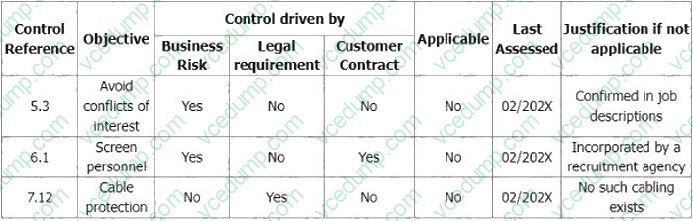
Select three options of the correct responses of an audit team leader to the request of the Technical Director.
A. Advise management that the information provided will be reviewed when the auditors have more time.
B. Advise the Technical Director that his request will be included in the audit report.
C. Advise the Technical Director that once a nonconformity is raised it cannot be withdrawn.
D. Advise the Technical Director that the nonconformity must stand since the evidence obtained for it was clear.
E. Ask the auditor who raised the issue for their opinion on how you should respond to the request.
F. Inform the Technical Director that the nonconformity will be changed to an Opportunity for Improvement.
G. Review the documentation produced and withdraw the nonconformity.
H. State that a follow up audit will be necessary to review the evidence for the updated Statement of Applicability. -
Question 154:
You ask the IT Manager why the organisation still uses the mobile app while personal data encryption and pseudonymization tests failed. Also, whether the Service Manager is authorized to approve the test.
The IT Manager explains the test results should be approved by him according to the software security management procedure. The reason why the encryption and pseudonymization functions failed is that these functions heavily slowed down the system and service performance. An extra 150% of resources are needed to cover this. The Service Manager agreed that access control is good enough and acceptable. That's why the Service Manager signed the approval.
You sample one of the medical staff's mobile and found that ABC's healthcare mobile app, version 1.01 is installed. You found that version 1.01 has no test record.
The IT Manager explains that because of frequent ransomware attacks, the outsourced mobile app development company gave a free minor update on the tested software, performed an emergency release of the updated software, and gave a verbal guarantee that there will be no impact on any security functions. Based on his 20 years of information security experience, there is no need to re-test.
You are preparing the audit findings Select two options that are correct.
A. There is NO nonconformity (NC). The IT Manager demonstrates he is fully competent. (Relevant to clause 7.2)
B. There is a nonconformity (NC). The IT Manager does not comply with the software security management procedure. (Relevant to clause 8.1, control A.8.30)
C. There is a nonconformity (NC). The organisation does not control planned changes and review the consequences of unintended changes. (Relevant to clause 8.1)
D. There is an opportunity for improvement (OI). The organisation selects an external service provider based on the extent of free services it will provide. (Relevant to clause 8.1, control A.5.21)
E. There is NO nonconformity (NC). The IT Manager demonstrates good leadership. (Relevant to clause 5.1, control 5.4)
F. There is an opportunity for improvement (OI). The IT Manager should make the decision to continue the service based on appropriate testing. (Relevant to clause 8.1, control A.8.30) -
Question 155:
You are an ISMS auditor conducting a third-party surveillance audit of a telecom's provider. You are in the equipment staging room where network switches are pre-programmed before being despatched to clients. You note that recently there has been a significant increase in the number of switches failing their initial configuration test and being returned for reprogramming.
You ask the Chief Tester why and she says, 'It's a result of the recent ISMS upgrade'. Before the upgrade each technician had their own hard copy work instructions. Now, the eight members of my team have to share two laptops to access the clients' configuration instructions online. These delays put pressure on the technicians, resulting in more mistakes being made'.
Based solely on the information above, which clause of ISO/IEC 27001:2022 would be the most appropriate to raise a nonconformity against? Select one.
A. Clause 10.2 - Nonconformity and corrective action
B. Clause 7.2 - Competence
C. Clause 7.5 - Documented information
D. Clause 8.1 - Operational planning and control -
Question 156:
How does the use of new technologies such as big data impact auditing?
A. It presents new challenges, for example, combining structured and unstructured data
B. It enhances the audit quality by enabling auditors to collect higher quality audit evidence
C. It causes significant disruptions, for example, introducing data that is too large or complex for processing by traditional database management tools -
Question 157:
Which one of the following options best describes the main purpose of a Stage 1 third-party audit?
A. To introduce the audit team to the client
B. To learn about the organisation's procurement
C. To determine redness for a stage 2 audit
D. To check for legal compliance by the organisation
E. To prepare an independent audit report
F. To get to know the organisation's customers -
Question 158:
You are performing an ISMS audit at a residential nursing home that provides healthcare services and are reviewing the Software Code Management (SCM) system. You found a total of 10 user accounts on the SCM. You confirm that one of the users, Scott, resigned 9-months ago. The SCM System Administrator confirmed Scott's last check-out of the source code was found 1 month ago. He was using one of the uthorized desktops from the local network in a secure area.
You check with the user de-registration procedure which states "Managers have to make sure of deregistration of the user account and authorisation immediately from the relevant ICT system and/or equipment after resignation approval." There was no deregistration record for user Scott.
The IT Security Manager explains that Scott still comes back to the office every month after he resigned to provide support on source code maintenance. That's why his account on SCM still exists.
You would like to investigate other areas further to collect more audit evidence. Select three options that would not be valid audit trails.
A. Collect more evidence on how access controls are periodically reviewed to maintain security (Relevant to control A.5.35)
B. Collect more evidence on how the transition of Scott from full-time to part-time employment was managed (relevant to control A.6.5)
C. Collect more evidence from Scott's background verification checks performed by the human resource department under the new employment relationship. (Relevant to control A.6.1)
D. Collect more evidence of why Scott resigned and whether his re-engagement represents a conflict of interest. (relevant to control A.5.3)
E. Collect more evidence on how Scott can access the employee's desktop and local network. (Relevant to control A.5.15)
F. Collect more evidence on how Scott can access the secure area. (Relevant to control A.8.4)
G. Collect more evidence on how the organization pays for Scott's source code maintenance support service. (Relevant to control A.6.2)
H. Collect more evidence on where Scott kept the source code that he checked out and how it was secured. (Relevant to control A.8.4) -
Question 159:
How are internal audits and external audits related?
A. Internal audits ensure that the organization regularly monitors the external audit reports and action plans
B. Internal audits ensure the implementation of the corrective actions before the organization is recommended for certification by the external auditor
C. Internal audits and external audits are included in the certification cycle, which ensures the monitoring of the management system on a regular basis -
Question 160:
After drafting the audit conclusions, the work documents of the audit team leader were reviewed by another auditor selected by the certification body. Is this acceptable?
A. Yes, the work documents of the audit team leader must be reviewed by another auditor after reaching audit conclusions
B. No, the work of the audit team leader must be reviewed before reaching an audit conclusion
C. No' it is only the audit team leader that reviews the work documents of each auditor
Related Exams:
-
ISO-20000-FND
ISO/IEC 20000 Foundation -
ISO-22301-BCMS-CLA
ISO 22301 BCMS - Certified Lead Auditor -
ISO-22301-LA
ISO 22301 Lead Auditor -
ISO-22301-LEAD-AUDITOR
PECB Certified ISO 22301 Lead Auditor Exam -
ISO-22301-LI
ISO 22301 Lead Implementer -
ISO-27001-ISMS-FND
ISO 27001:2013 ISMS - Foundation -
ISO-27001-LA
ISO/IEC 27001:2022 Lead Auditor -
ISO-27001-LI
ISO/IEC 27001:2022 Lead Implementer -
ISO-27002-LI
ISO/IEC 27002 - Lead Implementer -
ISO-27005-RM
ISO/IEC 27005 Risk Manager
Tips on How to Prepare for the Exams
Nowadays, the certification exams become more and more important and required by more and more enterprises when applying for a job. But how to prepare for the exam effectively? How to prepare for the exam in a short time with less efforts? How to get a ideal result and how to find the most reliable resources? Here on Vcedump.com, you will find all the answers. Vcedump.com provide not only PECB exam questions, answers and explanations but also complete assistance on your exam preparation and certification application. If you are confused on your ISO-IEC-27001-LEAD-AUDITOR exam preparations and PECB certification application, do not hesitate to visit our Vcedump.com to find your solutions here.