HPE6-A48 Exam Details
-
Exam Code
:HPE6-A48 -
Exam Name
:Aruba Certified Mobility Expert 8 Written -
Certification
:HP Certifications -
Vendor
:HP -
Total Questions
:61 Q&As -
Last Updated
:Jul 09, 2026
HP HPE6-A48 Online Questions & Answers
-
Question 51:
An airline wants to invest in an Aruba Mobility (MM)-Mobility Controller (MC) solution for the three hubs it has throughout the country. A single MM is located in the datacenter at one of the hubs. The MCs in the other two hubs reach the MM
through a site-to-site IPSec VPN.
The operations team does not want to lose monitoring and configuration control of the MCs if something happens to the datacenter where the MM resides.
Which solution ensures that there is management access to the MCs in case of an MM failure due to a datacenter outage?
A. Deploy another MM in a different location, and enable L2 redundancy.
B. Install AirWave Management Platform, and enable Read and Write Management access on devices.
C. Deploy another MM in a different location, and enable L3 redundancy.
D. Deploy a local MM on each hub, and synchronize the configuration between all MMs. -
Question 52:
A financial institution contacts an Aruba partner to deploy an advanced and secure Mobility Master (MM)-Mobility Controller (MC) WLAN solution in its main campus and 14 small offices/home offices (SOHOs). Key requirements are that users
at all locations, including telecommuters with VIA, should be assigned roles with policies that filter undesired traffic. Also, advanced WIPs should be enforced at the campus only.
These are additional requirements for this deployment:
RAPs should ship directly to their final destinations without any pre-setup and should come up with the right configuration as soon as they get Internet access.
Activate should be configured with devices MACs, serial numbers, and provisioning rules that redirect them to the standalone VMC at the DMZ
Users should be able to reach DNS, FTP, Web and telephone servers in the campus as well as send and receive IP telephone calls to and from the voice 10.1.50.0/24 segment.
Local Internet access should be granted.
Refer to the exhibit.
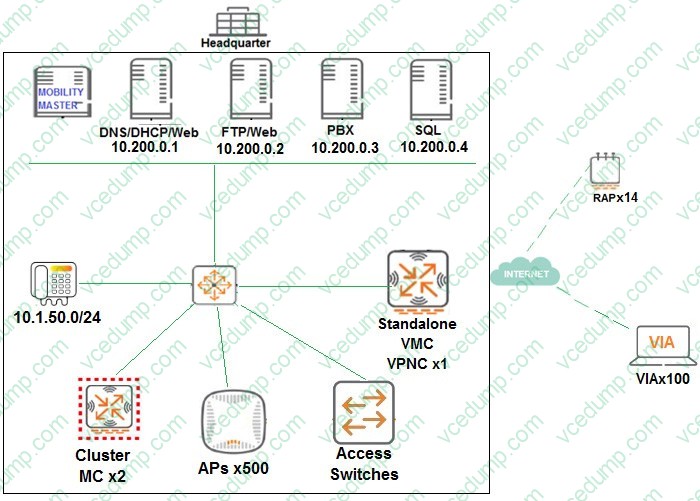
Refer to the scenario and the exhibit.
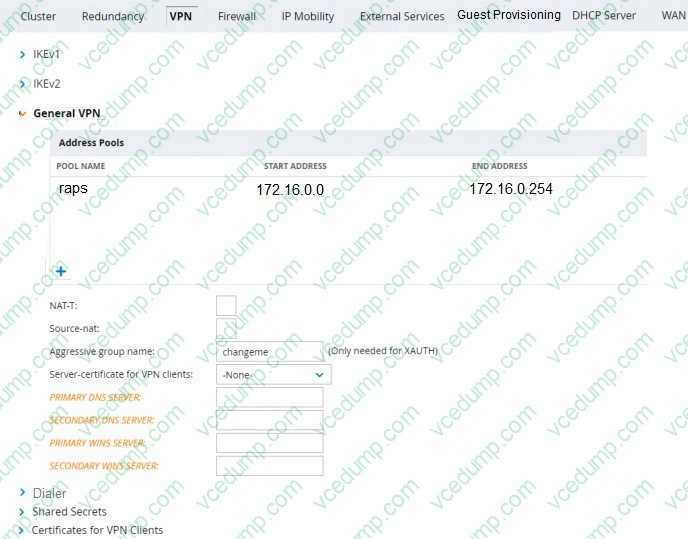
The standalone VMC will act as a VPN Concentrator of the RAPs. The network administrator configures the Standalone VMC with a pool of addresses and the SOHOs AP Group from the MM. Which additional steps must the network administrator perform to allow the RAPs to terminate their IPSec tunnels and associate to the Standalone VMC?
A. Add RAP MAC addresses into the RAP whitelist, and associate them with the SOHOs AP-Group.
B. Add RAP MAC addresses into the CPSec whitelist, and associate them with the SOHOs AP-Group.
C. Configure the same IP Pool at the MM group level, then create user accounts for the RAPs in the internal database.
D. Create user accounts with the sys-ap-role, and define shared secrets to associate to RAP IP addresses at the MM group level. -
Question 53:
A point venture between two companies results in a fully functional WLAN Aruba solution. The network administrator uses the following script to integrate the WLAN solution with two radius servers, radius1 and radius2.
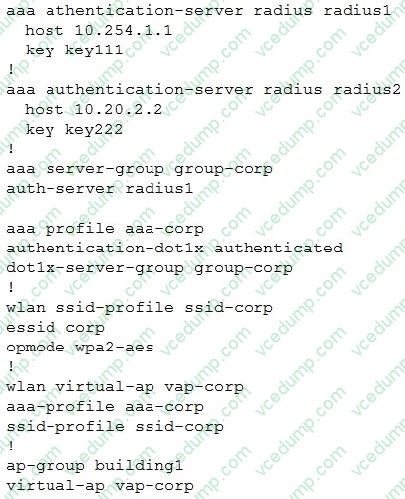
While all users authenticate with [email protected] type of credentials, radius1 has user accounts without the domain name portion.
Which additional configuration is required to authenticate corp1.com users with radius1 and corp2 users with radius2?
A. aaa authentication-server radius radius1 trim-fqdn ! aaa server-group-corp auth-server radius1 match-authstring corp1.com auth-server radius1 match-authstring corp2.com
B. aaa server-group-corp auth-server radius1 match-fqdn corp1.com auth-server radius1 trim-fqdn auth-server radius2 match-fqdn corp2.com
C. aaa authentication-server tadius radius1 ! aaa server-group-corp auth-server radius1 match-string corp1.com trim-fqdn auth-server radius1 match-string corp2.com
D. aaa authentication-server radius radius1 trim-fqdn ! aaa server-group-corp auth-server radius1 match-domain corp1.com auth-server radius1 match-domain corp2.com -
Question 54:
Refer to the exhibits. Exhibit1
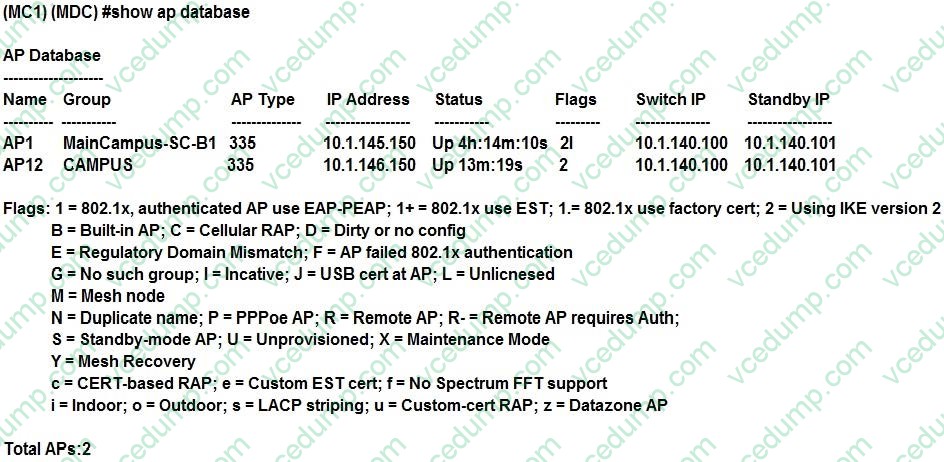
Exhibit 2
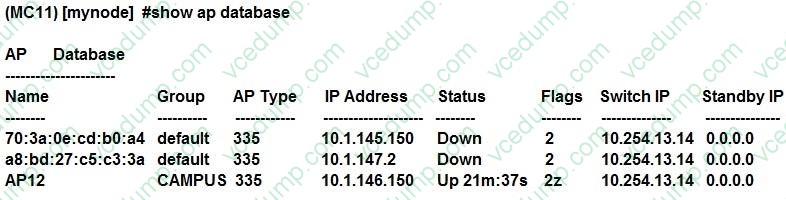
Based on outputs shown in the exhibits, what is the reason that AP12 is seen by two different controllers?
A. AP12 connects to a high availability group. MC1 is the active controller, and MC11 is the standby controller.
B. AP12 is a multizone AP. MC1 is part of the primary zone, and MC11 is part of the datazone.
C. AP12 connects to an MC cluster. MC1 is the A-AAC, and MC2 is S-AAC.
D. AP12 is in the middle of the boot process. MC1 is the master IP controller, and MC11 is the LMS IP controller. -
Question 55:
Refer to the exhibit.
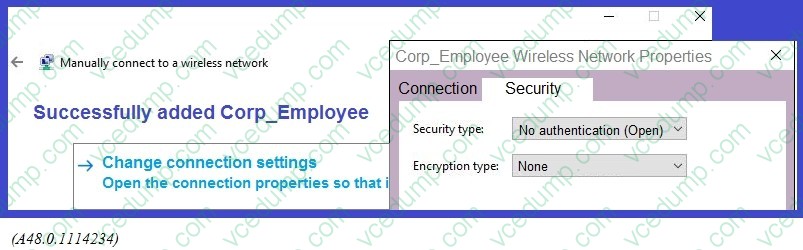
A network administrator wants to configure an 802.1x supplicamt for a wireless network that includes the following: AES encryption EAP-MSCHAP v2-based user and machine authentication Validation of server certificate in Microsoft Windows 10
The network administrator creates a WLAN profile and selects the change connection settings option. Then the network administrator changes the security type to Microsoft: Protected EAP (PEAP), and enables user and machine authentication under Additonal Settings.
What must the network administrator do next to accomplish the task?
A. Enable user authentication under Settings.
B. Change the security type to Microsoft. Smart Card or other certificate.
C. Enable server certificate validation under Settings.
D. Enable computer autentication under Settings. -
Question 56:
Refer to the exhibit.
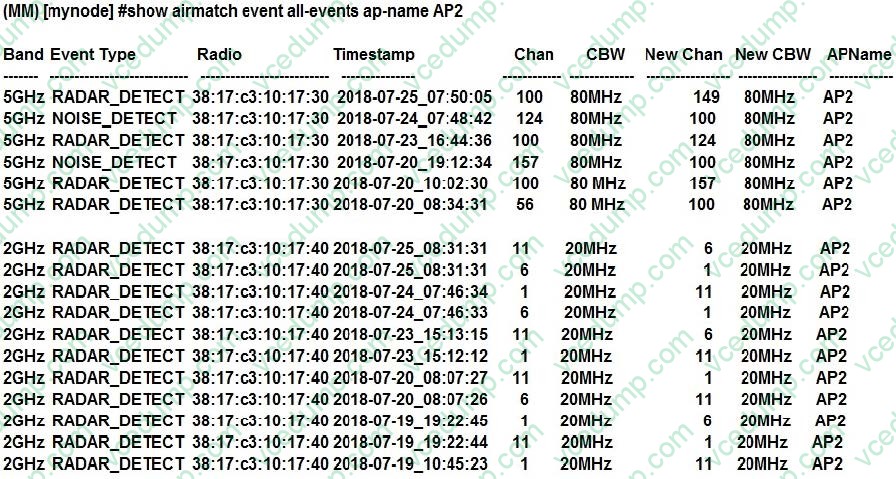
A network administrator deploys a Mobility Master (MM)-Mobility Controller (MC) network with APs in different locations. Users in one of the locations report that the WiFi network works fine for several hours, ang then they are suddenly
disconnected. The symptom may happen at any time, up to three times every day, and lasts no more than two minutes.
After some research, the network administrator logs into the MM and reviews the output shown in the exhibit.
Based on this information, the network administrator logs into the MM and reviews the output shown in the exhibit.
Based on this information, what is the most likely reason users get disconnected?
A. AirMatch is applying a scheduled optimization solution.
B. Users in the 2.4 GHz band are being affected by high interference.
C. Adpative Radio Management is reacting to RF events.
D. AirMatch is reacting to non-scheduled RF events. -
Question 57:
Refer to the exhibit.
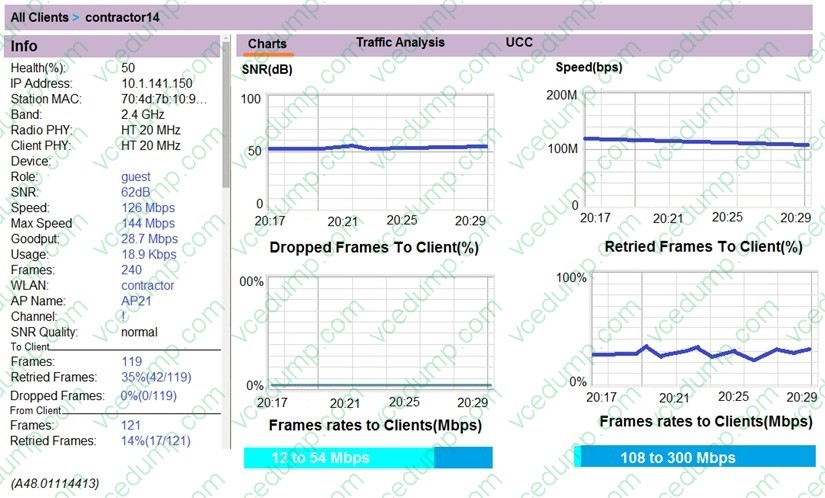
A user reports show response time to a network administrator and suggests that there might be a problem with the WLAN. The user's laptop supports 802.11n in the 2.4 GHz band only. The network administrator finds the user on the Mobility Master (MM) and reviews the output shown in the exhibit.
What can the network administrator conclude after analyzing the data?
A. Client health is low, and retried frames are high. It is possible there is high channel utilization.
B. Client health is low, but SNR is high. It is possible data in the dashboard is not accurate and needs to be updated.
C. The speed is good. Client health seems to be related to a problem with the client NIC.
D. The network is low because of low SNR. TX power must be increased in both the client and the AP. -
Question 58:
Refer to the exhibit.
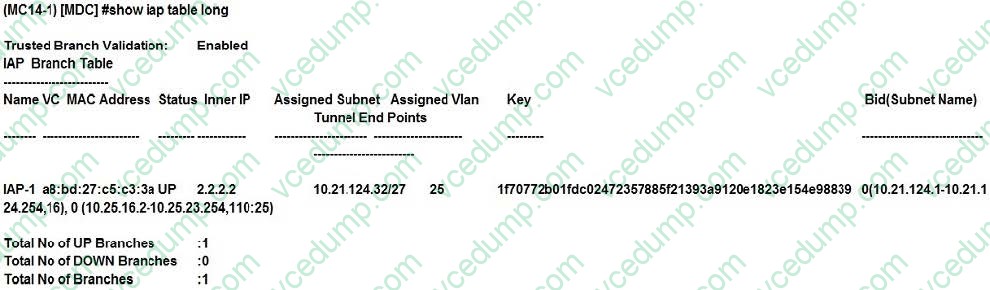
A network administrator configures an Instant AP (IAP) to establish an Aruba IPSec tunnel across the Internet, and configures two DHCP pools for wireless users. Based on the output shown in the exhibit, which device behaves as a DHCP server for the users?
A. Mobility Master
B. Mobility Controller
C. External server
D. DSL modem
E. Virtual Controller -
Question 59:
A company has headquarters based in the US and rents internation office space in Mexico City so that 10 employees can work remotely. The company must implement a remote access technology so branch office employees can access all
servers at the headquareters.
The office has both wired and wireless internet connectivity, with no restrictions on what device connects to the network. However, ports UDP 4500, 5060, and 5061 are blocked by the primeter firewall.
Which remote access technology is required to allow employees to access the servers at the headquarters?
A. BOC with CAPs
B. IAP VPN
C. RAP
D. VIA -
Question 60:
Refer to exhibit.
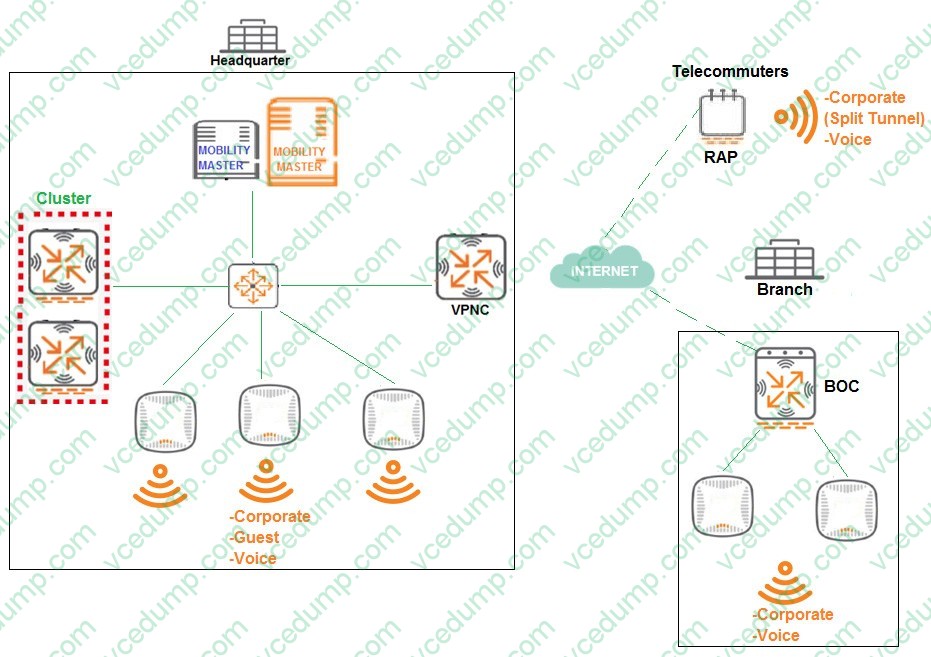
A company has a multiple Arua implementation with three different locations named Headquarter, Branch, and Telecommuters.
The network design includes the following:
Headquarter APs terminate at the Mobility Controller (MC) cluster and propagate Corporate, Guest, and Voice SSIDs
Branch APs terminate at the Branch Office Controller (BOC) and propagate Corporate and Voice SSIDs
BOC reaches the Mobility Master (MM) through a VPNC.
Telecommuter RAPs terminate at VPNC and propagate Corporate and Voice SSIDs.
The Corporate SSID on the RAPs is split-tunnel, all other SSIDs are tunnel.
The network design requires minimal AP group and VAP configuration effor, while preventing unnecessary VAP propagation to lower hierarchy levels.
Following Aruba node hierarchy desing recommendations, which group hierarchy design helps meet these requirements?
A. /md /md/Corp1/ /md/Corp1/Offices /md/Corp1/Offices/Headquarter /md/Corp1/Offices/Branch /md/Corp1/Telecommuters /mm /mm/mynode
B. /md /md/Headquarter /md/Branch /md/Telecommuters /mm /mm/mynode
C. /mm /md/Locations /md/Locations/Headquarter /md/Locations/Branch /md/Locations/Telecommuters /mm /mm/mynode
D. /md /md/Location1/ /md/Location1/Branch /mdLocation1/Offices /md/Location1/Offices/Headquarter /md/Location1/Telecommuters /mm /mm/mynode
Related Exams:
-
HP0-003
HP OpenView Service Desk 5.x -
HP0-045
Supporting the ESL E-Series Lobraries -
HP0-052
Planning and Design of HP 9000/HP Integrity Server Solutions -
HP0-053
Enterprise Integration and Management of HP ProLiant Servers -
HP0-054
Compaq/Oracle 8i I and P with Windows NT -
HP0-055
Implementing HP ProLiant Servers -
HP0-058
Configuration and Management of HP Integrity Mid-Range Servers -
HP0-063
LF PROFESSIONAL COLOR WORKFLOW MANAGEMENT -
HP0-064
HP BladeSystems C-Class Solutions 1 -
HP0-065
Planning and Designing ProLiant Solutions for the Enterprise
Tips on How to Prepare for the Exams
Nowadays, the certification exams become more and more important and required by more and more enterprises when applying for a job. But how to prepare for the exam effectively? How to prepare for the exam in a short time with less efforts? How to get a ideal result and how to find the most reliable resources? Here on Vcedump.com, you will find all the answers. Vcedump.com provide not only HP exam questions, answers and explanations but also complete assistance on your exam preparation and certification application. If you are confused on your HPE6-A48 exam preparations and HP certification application, do not hesitate to visit our Vcedump.com to find your solutions here.