HPE6-A48 Exam Details
-
Exam Code
:HPE6-A48 -
Exam Name
:Aruba Certified Mobility Expert 8 Written -
Certification
:HP Certifications -
Vendor
:HP -
Total Questions
:61 Q&As -
Last Updated
:Jul 09, 2026
HP HPE6-A48 Online Questions & Answers
-
Question 21:
A bank deploys an Aruba Mobility Master (MM)-Mobility Controller (MC) solution to provide wireless access for users that run different applications on their laptops, including SIP-based IP telephony. When users only run the IP telephony software, call quality is high. However, if users also run email, web, or mission critical applications, then voice quality drops.
Which feature would help improve the quality of voice calls over the air when users run different applications?
A. DSCP for IPv4 traffic
B. WiFi Multi Media
C. Type of Service
D. High/Low Queue -
Question 22:
Refer to the exhibits.
Exhibit 1
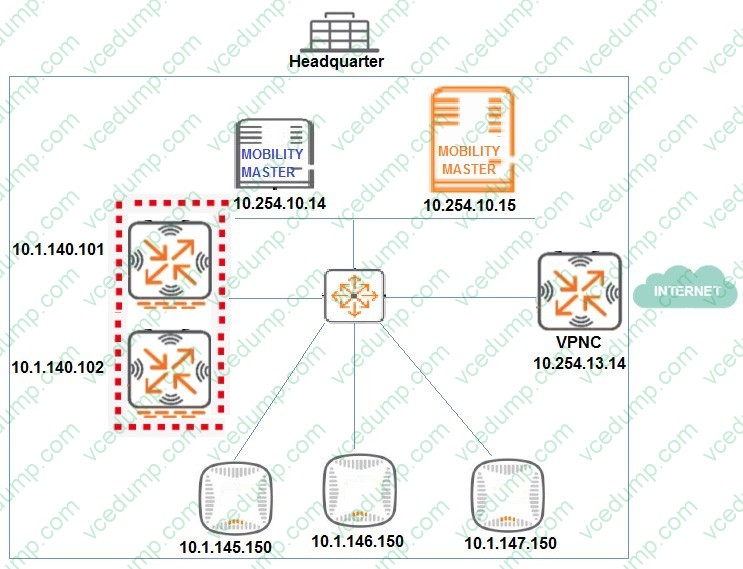
Exhibit 2
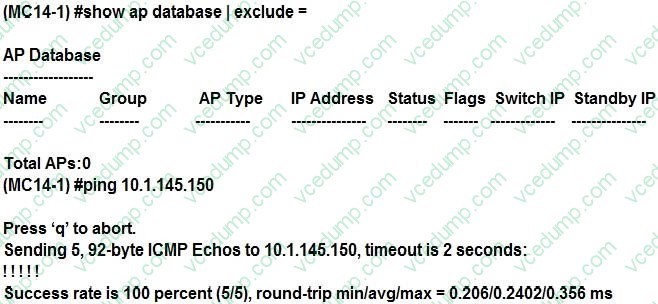
Exhibit 3
A network engineer deploys a Master Controller (MC) cluster at Headquarter to offer high levels of redundancy, and prepares the wired side of the network. This preparation includes the VLAN, DHCP Settings, and unicast routing services
that APs require to reach the cluster.
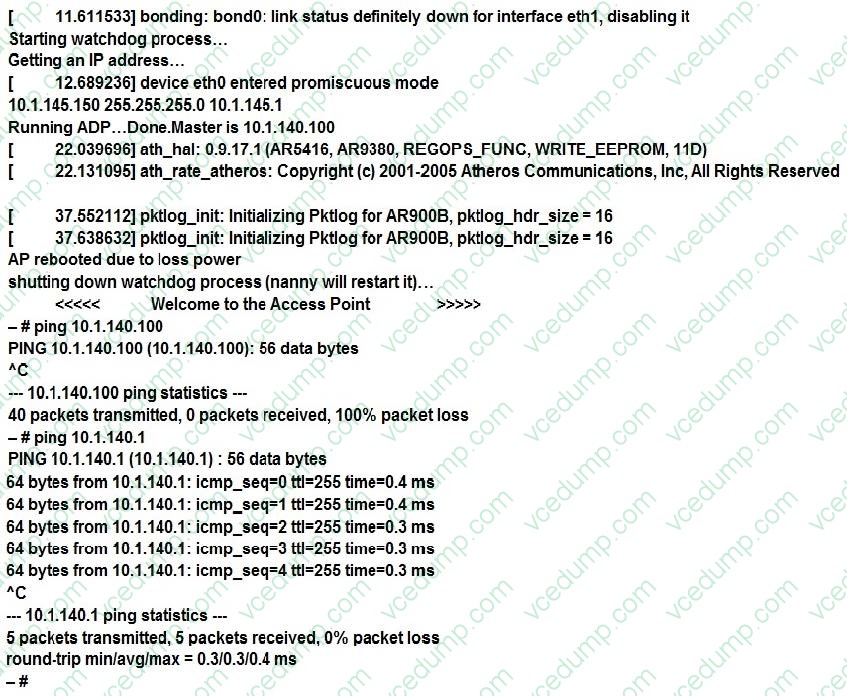
The network engineer waits for 20 minutes after connecting the APs and sees that no SSIDs are advertised. The network engineer logs into one of the MCs and one of the AP's consoles to obtain the outputs shown in the exhibits.
What can the network engineer do to fix the APs discovery process, to ensure the best scalability even if one MC fails?
A. Reprovision the APs with a different Master IP.
B. Modify the IP address in one of the MCs.
C. Modify option 43 in the DHCP pool.
D. Create a VRRP instance in the MCs. -
Question 23:
Refer to the exhibit.
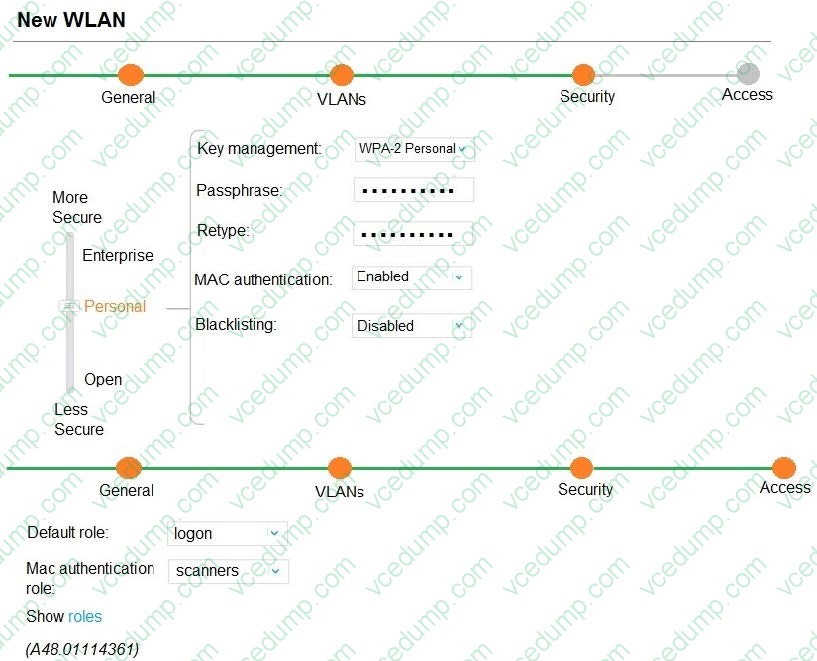
A company acquires ten barcode scanners to run inventory tasks. These Wifi devices support WPA2-PSK security only. The network administrator deploys a WLAN named scanners using the configuration shown in the exhibit. What must the network administrator do next to ensure that the scanner devices successfully connect to their SSID?
A. Add scanner MAC addresses in user derivation rules.
B. Add scanner MAC addresses in the internal database.
C. Set internal as the MAC authentication server group.
D. Enable L2 Authentication Fail Through. -
Question 24:
Refer to the exhibits.
Exhibit 1
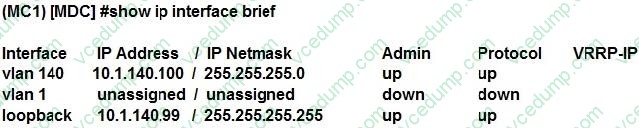
Exhibit 2
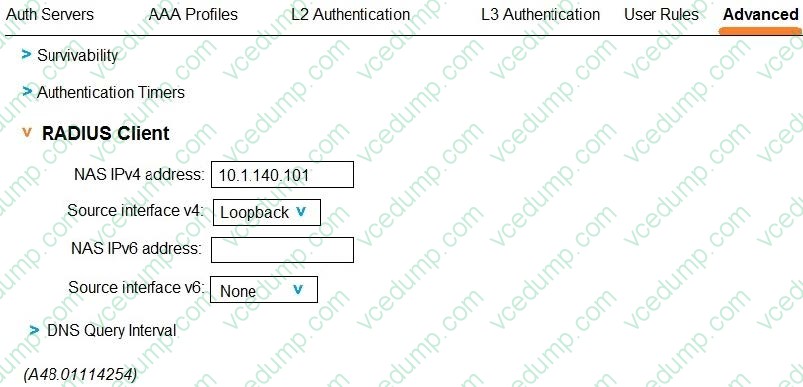
Exhibit 3
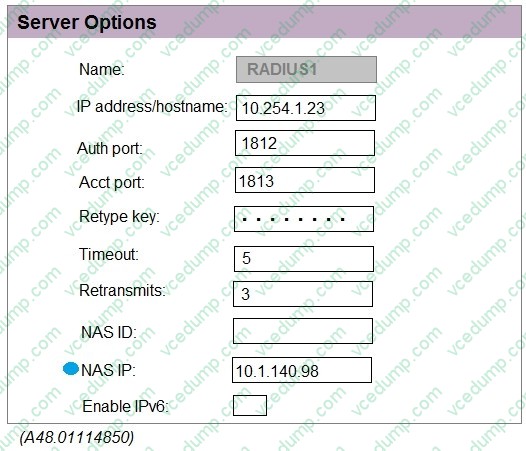
A network administrator must ensure that a ClearPass server can receive the RADIUS authentication request from a single Mobility Controller (MC) managed by a Mobility Master (MM). Based on the exhibits, what is the value of NAS-IP contained in the RADIUS access requests?
A. 10.1.140.98
B. 10.1.140.99
C. 10.1.140.100
D. 10.1.140.101 -
Question 25:
A foreign exchange broker in a shared office space uses an Aruba Mobility Master (MM)-Mobility Controller (MC) architecture along with ClearPass and AirWave. The corporate network is FXBroker121, but users report that they cannot access the FXBroker111 SSID. The team suspects that a rogue AP is in place and a malicious user tried to disguise the WLAN name.
How can the organization's network administrator identify and locate the potential rogue AP?
A. Create an AirWave RAPIDS rule with a Suspected Rogue classification and the SSID Matches FXBroker111 condition, then access any RAPID List entry that matches the rule and click on Location.
B. Use ClearPass Event viewer and search for entries with the FXBroker111 Aruba-Essid-Name VSA attribute, then obtain the value of the Aruba-AP-Group attribute.
C. Use ClearPass Event viewer and search for entries with the FXBroker111 Aruba-Essid-Name VSA attribute, then obtain the value of the Aruba-Location-id attribute.
D. Create and AirWave RAPIDS rule with a Suspected Rogue classification and the SSID Does Not Match FXBroker121 condition, then access any RAPIDS List entry that matches the rule and click on Location. -
Question 26:
A network administrator deploys APs with radios in Air Monitor mode and detects several APs and SSIDs that belong to stores next door. The Mobility Master (MM) classifies the APs and SSIDs as potential rogues. The network administrator wants to prevent the Air Monitor from applying countermeasures against these APs.
How can the network administrator accomplish this?
A. Select the BSSID and click reclassify, then select neighbor.
B. Run the Define WIP Policy task, and define the BSSIDs of the neighboring APs as interfering.
C. Select the BSSID and click reclassify, then select interfering.
D. Run the Define WIP Policy task, and define the BSSIDs of the neighboring APs as Authorized. -
Question 27:
A software development company has 700 employees who work from home. The company also has small offices located in different cities throughout the world. During working hours, they use RAPs to connect to a datacenter to upload software code as well as interact with databases.
In the past two months, brief failures have occurred in the 7240XM Mobility Controller (MC) that runs ArubaOS 8.3 and terminates the RAPs. These RAPs disconnect, affecting the users connected to the RAPs. This also causes problems with code uploads and database synchronizations. Therefore, the company decides to add a second 7240XM controller for redundancy.
How should the network administrator deploy both controllers in order to provide redundancy while preventing failover events from disconnecting users?
A. Connect both controllers with common VLANs, and create an L2-connected cluster using public addresses in the internet VLAN.
B. Connect both controllers with common VLANs, and create an HA fast failover group with public addresses in the internet VLAN.
C. Connect both controllers with different VLANs, and create an L2-connected cluster using private addresses in the internet VLAN.
D. Connect both controllers with common VLANs, and configure LMS/BLMS values equal to public addresses in the internet VLAN. -
Question 28:
Refer to the exhibit.
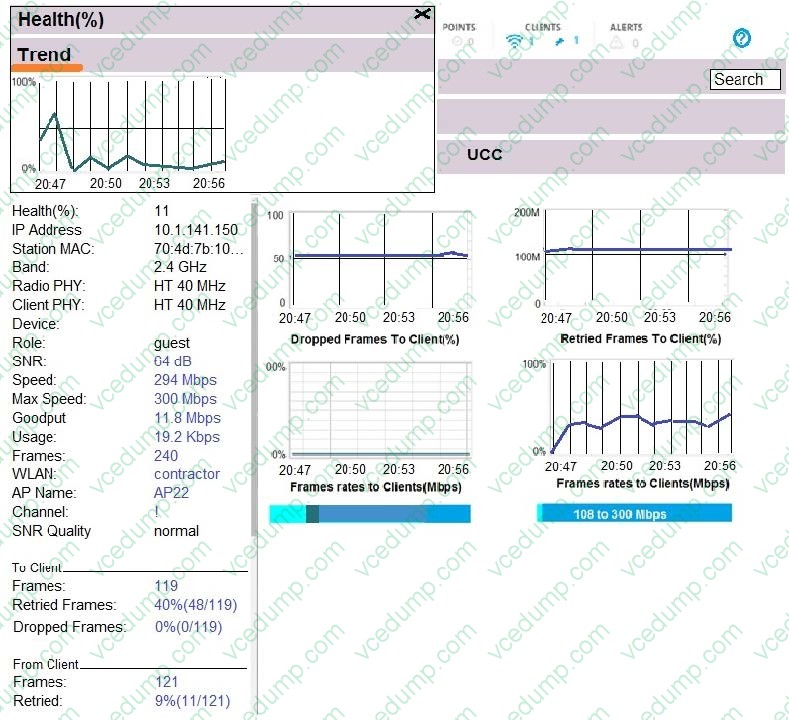
A user's laptop only operates in the 2.4 GHz band and supports 802.11n. This user reports that the network is slow at the cafeteria that is serviced by three APs, and suggests that there might be a problem with the WLAN. The network administrator finds the user in the MM, and obrains the output shown in the exhibit.
What should the network administrator do to optimize the client connection?
A. Disable lower transmit rates in the SSID profile.
B. Change the channel being used in the radio profile.
C. Reduce Min/Max channel bandwidth in the radio profile.
D. Reduce Min/Max EIRP in the ARM profile. -
Question 29:
Users run encrypted Skype for Business traffic with no WMM support over an Aruba Mobility Master (MM)-Mobility Controller (MC) based network. When voice, video, and application sharing traffic arrive at the wired side of the network, all the flows look alike due the lack of L2 or L3 markings.
How can the network administrator identify these flows and mark QoS accordingly?
A. Confirm the MC is the Openflow controller of the MMs and Openflow is enabled in VAP and the firewall roles. Then enable WMM in a VAP profile.
B. Confirm the MM is the Openflow controller of the MCs and Openflow is enabled in VAP and the firewall roles. Then integrate the MM with the Skype4Business SDN API, and enable the Skype4Business ALG in the UCC Profiles.
C. Confirm the MC is the OpenFlow controller of the MMs and Openflow is enabled in VAP and the firewall roles. Then enable the Skype4Business ALG in the UCC profiles.
D. Use a media firewall policy that match these three flows, and use permit and TOS actions with 56, 40, and 34 values for voice, video, and application sharing, respectively. Then enable the Skype4Business ALG in the UCC profiles. -
Question 30:
A financial institution contacts an Aruba partner to deploy an advanced and secure Mobility Master (MM)-Mobility Controller (MC) WLAN solution in its main campus and 14 small offices/home offices (SOHOs). Key requirements are that users
at all locations, including telecommuters with VIA, should be assigned roles with policies that filter undesired traffic. Also, advanced WIPs should be enforced at the campus only.
These are additional requirements for this deployment:
RAPs should ship directly to their final destinations without any pre-setup and should come up with the right configuration as soon as they get Internet access.
Activate should be configured with devices MACs, serial numbers, and provisioning rules that redirect them to the standalone VMC at the DMZ
Users should be able to reach DNS, FTP, Web and telephone servers in the campus as well as send and receive IP telephone calls to and from the voice 10.1.50.0/24 segment.
Local Internet access should be granted.
Refer to the exhibit.
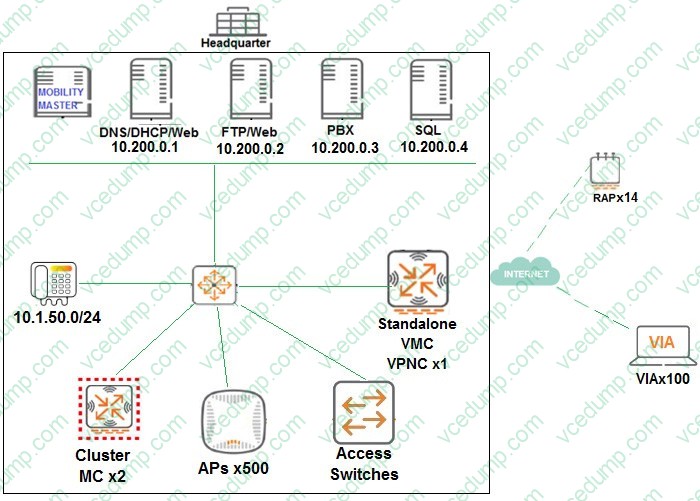
Refer to the scenario and the exhibit.
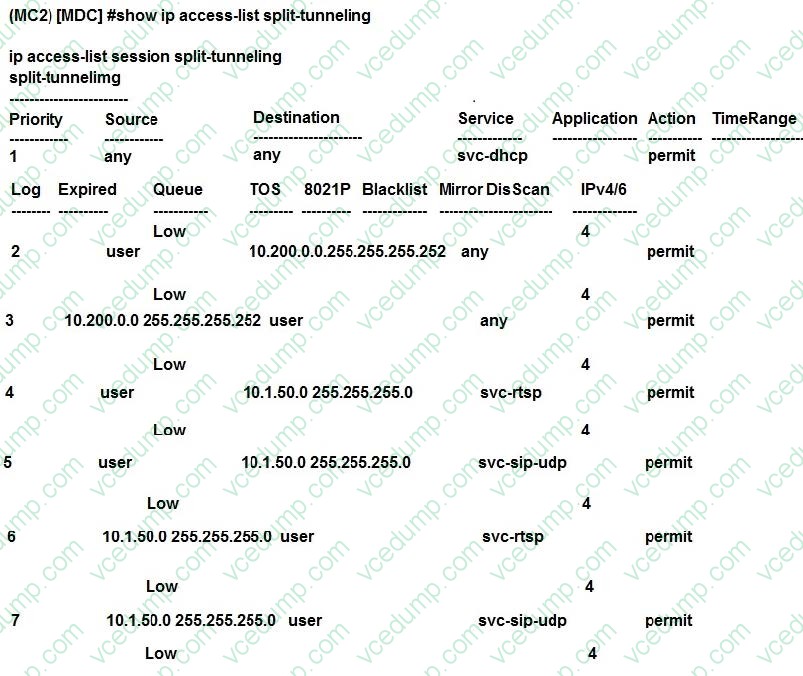
Which command must the network administrator add in the split-tunneling policy to meet the requirements for the RAP employee SSID?
A. user any svc-http permit B. user any any src-nat pool dynamic-srcnat
C. any user any src-nat pool dynamic-srcnat
D. user any any dst-nat
Related Exams:
-
HP0-003
HP OpenView Service Desk 5.x -
HP0-045
Supporting the ESL E-Series Lobraries -
HP0-052
Planning and Design of HP 9000/HP Integrity Server Solutions -
HP0-053
Enterprise Integration and Management of HP ProLiant Servers -
HP0-054
Compaq/Oracle 8i I and P with Windows NT -
HP0-055
Implementing HP ProLiant Servers -
HP0-058
Configuration and Management of HP Integrity Mid-Range Servers -
HP0-063
LF PROFESSIONAL COLOR WORKFLOW MANAGEMENT -
HP0-064
HP BladeSystems C-Class Solutions 1 -
HP0-065
Planning and Designing ProLiant Solutions for the Enterprise
Tips on How to Prepare for the Exams
Nowadays, the certification exams become more and more important and required by more and more enterprises when applying for a job. But how to prepare for the exam effectively? How to prepare for the exam in a short time with less efforts? How to get a ideal result and how to find the most reliable resources? Here on Vcedump.com, you will find all the answers. Vcedump.com provide not only HP exam questions, answers and explanations but also complete assistance on your exam preparation and certification application. If you are confused on your HPE6-A48 exam preparations and HP certification application, do not hesitate to visit our Vcedump.com to find your solutions here.