HPE6-A48 Exam Details
-
Exam Code
:HPE6-A48 -
Exam Name
:Aruba Certified Mobility Expert 8 Written -
Certification
:HP Certifications -
Vendor
:HP -
Total Questions
:61 Q&As -
Last Updated
:Jul 09, 2026
HP HPE6-A48 Online Questions & Answers
-
Question 11:
Refer to the exhibits.
Exhibit 1
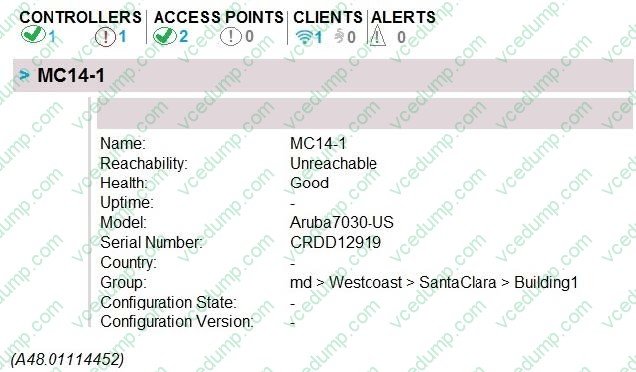
Exhibit 2
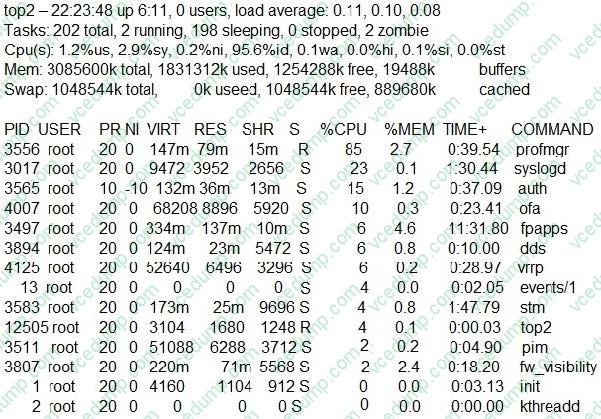
A network administrator adds a new Mobility Controller (MC) to the production Mobility Master (MM) and deploys APs that start broadcasting the employees SSID in the West wing of the building. Suddenly, the employed report client
disconnects.
When accessing the MM the network administrator notices that the MC is unreachable, then proceeds to access the MC's console and obtains the outputs shown in the exhibits.
What should the network administrator do next to solve the current problem?
A. Decommission the MC from the MM, and add it again.
B. Open a TAC case, and send the output of tar crash.
C. Verify the license pools in the MM.
D. Kill two zombie processes, then reboot the MC. -
Question 12:
Refer to the exhibit.
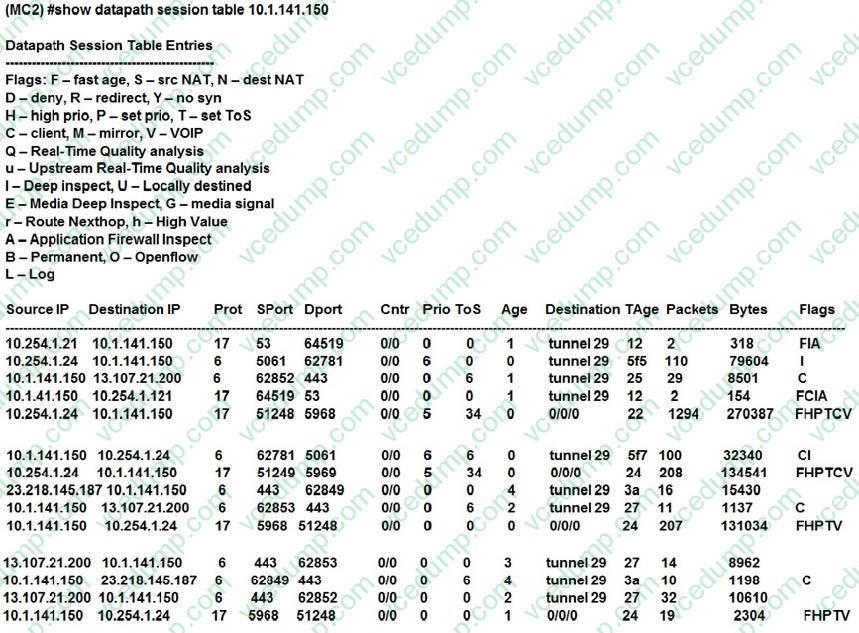
A network administrator deploys DSCP based prioritization in the entire wired network to improve voice quality for a SIP-based IP telephony system used by the company. However, users report that calls they make from the WLAN have poor audio quality, while desktop phones do not experience the same problem. The network administrator makes a test call and looks in the datapath session table.
Based on the output shown in the exhibit, what is one area that the network administrator should focus on?
A. wireless network congestion
B. WMM support on the WLAN
C. UCC based DSCP correction
D. wired network congestion -
Question 13:
Refer to the exhibit.
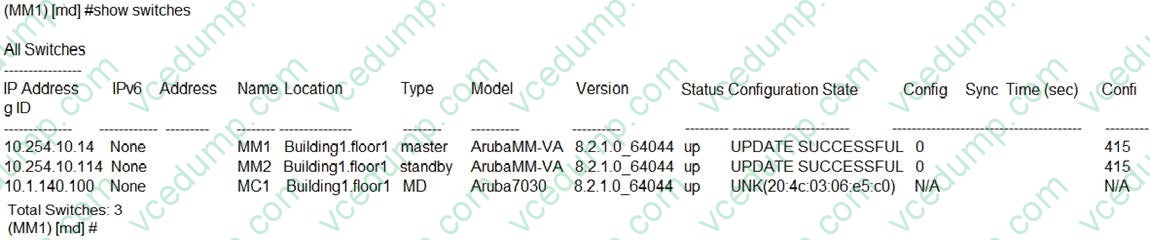
A network administrator adds a Mobility Controller (MC) in the /mm level and notices that the device does not show up in the managed networks hierarchy. The network administrator accesses the CLI, executes the show switches command, and obtains the output shown in the exhibit.
What is the reason that the MC does not appear as a managed device in the hierarchy?
A. The network administrator added the device using the wrong Pre=shared Key (PSK).
B. The digital certificate of the MC is not trusted by the MM.
C. The IP address of the MC does not match the one that was defined in the MM.
D. The network administrator has not moved the device into a group yet. -
Question 14:
Refer to the exhibits. Exhibit 1
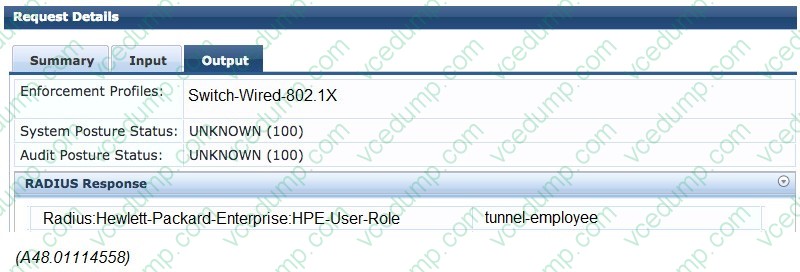
Exhibit 2
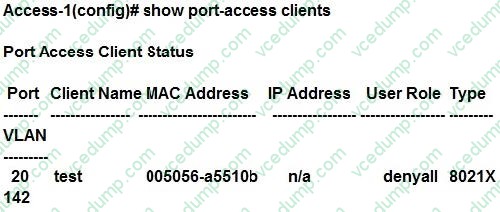
A network administrator deploys role-based tunneled node in a corporate network to unify the security policies enforcement. When users authenticate with 802.1X, ClearPass shows Accept results, and sends the HPE-User-Role attribute as expected. However, the switch always applies the denyall role.
Why does the switch fail to allocate the tunnel-employee role?
A. Denyall is a secondary role contained within tunnel-employee.
B. The switch is not configured with primary tunneled-node user role.
C. The switch is not configured with secondary tunneled-node user role.
D. RADIUS Access Accept messages time out in the switch. -
Question 15:
A customer with a multi-controller network upgrades the ArubaOS from 6.4 to 8. The customer's clients must be able to move between different locations of the campus without disconnecting their applications, when roaming or if there are Mobility Controller (MC) failures. The customer also wants to have full control of the users, and be able to change their session properties from a RADIUS server.
Which steps must the network consultant include in the implementation plan to meet these requirements?
A. 1. Create a controller cluster profile that contains the management and VRRP IP addresses of each member. 2. Apply the profile to all MCs in the cluster. 3. Confirm that the cluster is L2 connected.
B. 1. Configure a VRRP instance for all MCs 2. Create a controller cluster profile that contains the management IP and VIP addresses of each MC. 3. Apply the profile to all MCs in the cluster. 4. Confirm that the cluster is L2 connected.
C. 1. Configure a VRRP instance for each MC. 2. Create a controller cluster profile that contains the management IP of each member. 3. Apply the profile to all MCs in the cluster. 4. Confirm that the cluster is L3 connected.
D. 1. Create a controller cluster profile that contains the management and VRRP IP addresses of each member. 2. Apply the profile to the cluster leader. 3. Confirm that the cluster is L2 connected. -
Question 16:
Refer to the exhibit.
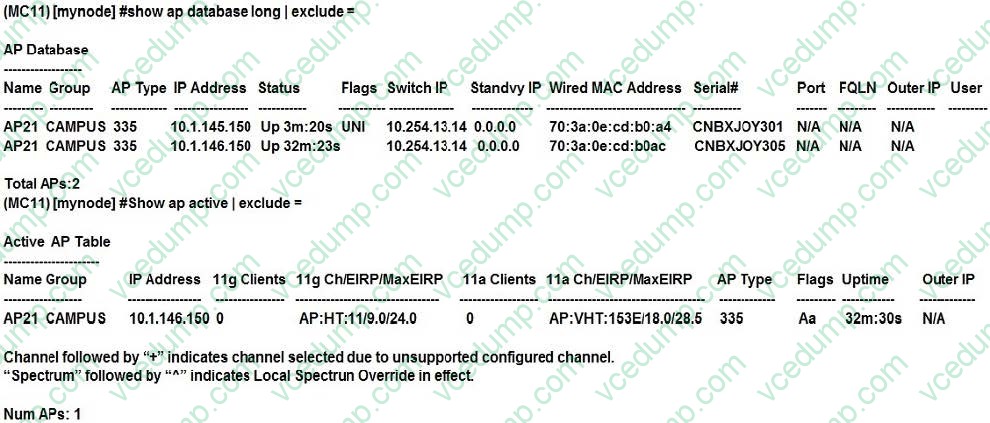
A network administrator deploys a new Mobility Master (MM)-Mobility Controller (MC) network. To test the solution, the network administrator accessess some of the AP consoles and statistically provisions them. However, these APs do not propagate the configured SSIDs. The network administrator looks at the logs and sees the output shown in the exhibit.
Which actions must the network administrator take to solve the problem?
A. Reprovision one of the APs with a different name, and add new entries with the proper group in the whitelist.
B. Reprovision the AP with a different group, and modify the name of one AP in the whitelist.
C. Create another AP group in the MC's configuration and reprovision one AP with a different group.
D. Reprovision one of the APs with a different name, and modify the name of one AP in the whitelist. -
Question 17:
Refer to the exhibit.
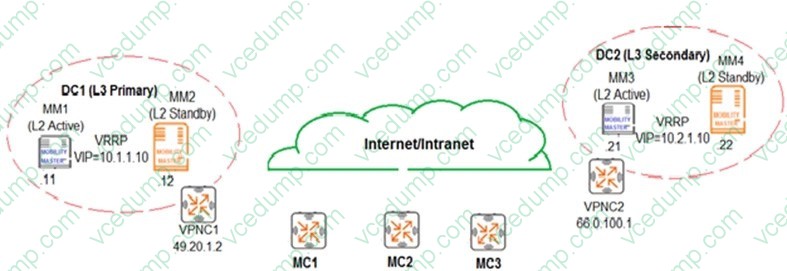
An Aruba network is deployed with L2 and L3 Mobility Master (MM) redundancy across two datacenters, as shown in the exhibit. The network administrator confirms that all Mobility Controllers (MC) are currently communicating with MM1, which is the L2 Active, and L3 Primary. Which MM IP will MCs communicate with if MM1 fails?
A. 10.1.1.10
B. 10.1.1.12
C. 10.2.1.10
D. 10.2.1.21 -
Question 18:
Refer to the exhibit.
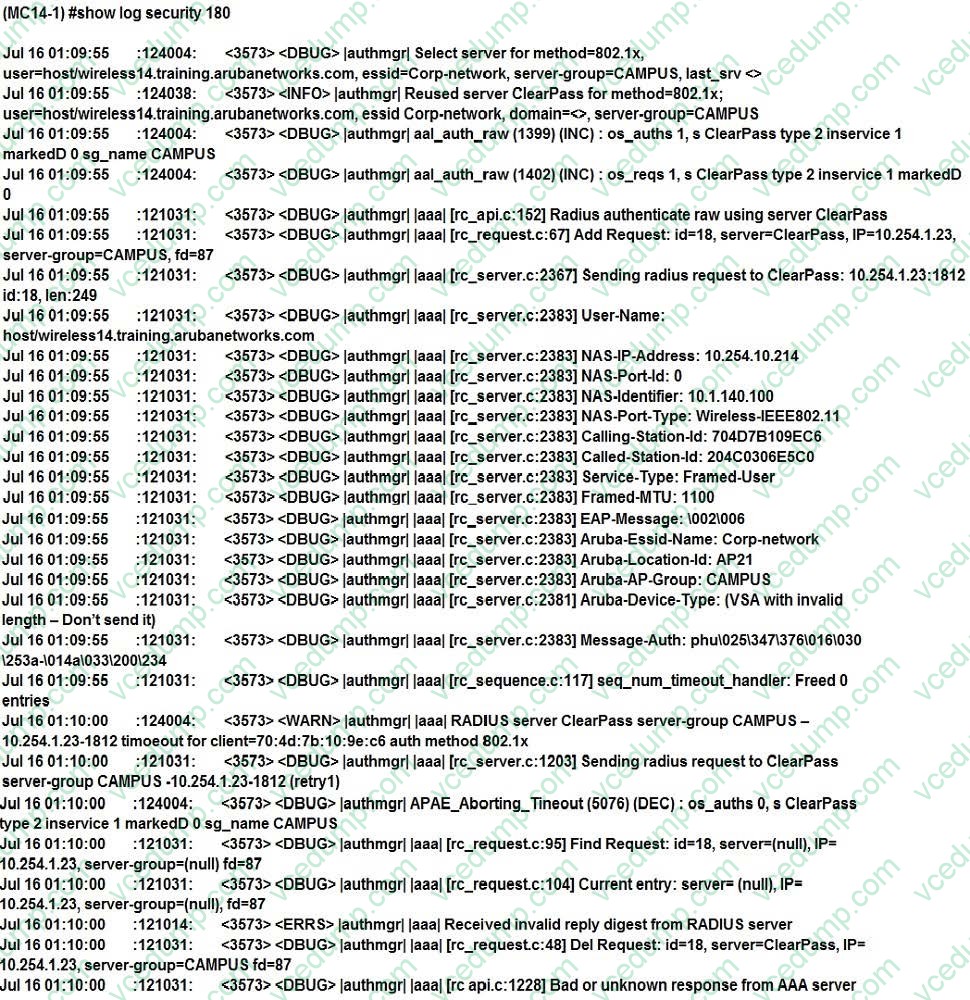
A network administrator deploys a new WLAN named Corp-Network. The security suite is WPA2 with 802.1X. A new ClearPass server is used as the authentication server. Connection attempts to this WLAN are rejected, and no trace of the attempt is seen in the ClearPass Policy Manager Access Tracker. However, the network administrator is able to see the logs shown in the exhibit.
What must the network administrator do to solve the problem?
A. Add the correct network device IP address in ClearPass.
B. Change the ClearPass server IP address in the MC.
C. Fix the RADIUS shared secret in the MC.
D. Disable machine authentication in the MC and client PC. -
Question 19:
A network administrator wants to receive a major alarm every time a controller or an Aruba switch goes down for either a local or an upstream device failure. Which alarm definition must the network administrator create to accomplish this?
A. Option A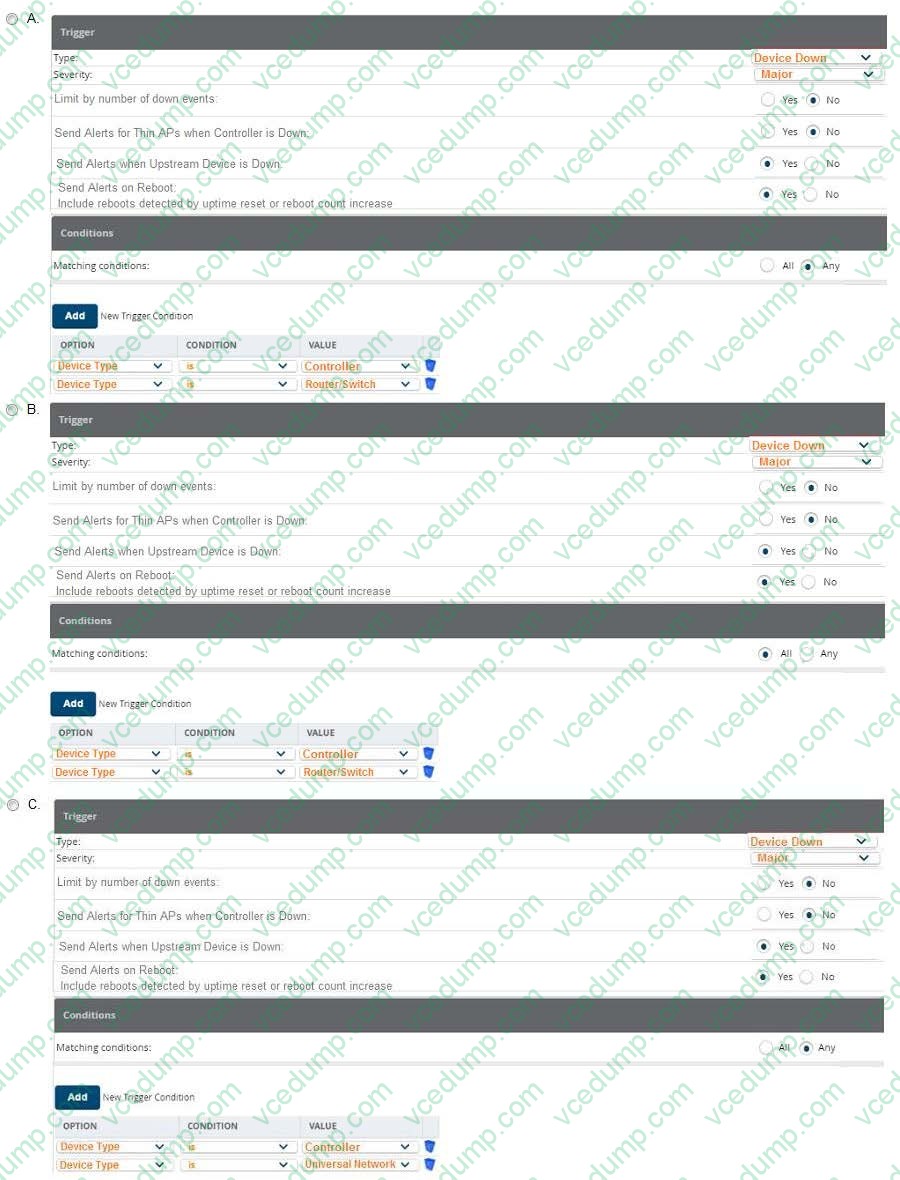
B. Option B
C. Option C -
Question 20:
An organization wants to deploy a WLAN infrastructure that provides connectivity to these client categories:
Employees Contractors Guest users Corporate IoT legacy devices that support no authentication or encryption
Employees and contractors must authenticate with company credentials and get network access based on AD group membership. Guest users are required to authenticate with captive portal using predefined credentials. Only employees will run L2 encryption.
Which implementation plan fulfills the requirements while maximizing the channel usage?
A. Create VAP1 to run WPA2-AES and 802.1x authentication, VAP2 to run opensystem encryption with MAC authentication, and VAP3 to run opensystem with captive portal.
B. Create VAP1 to run WPA2-AES and 802.1x authentication, VAP2 to run opensystem encryption with MAC authentication, and VAP3 to run opensystem with captive portal and L2 fail through.
C. Create a single VAP to run WPA2-AES and 802.1x authentication, MAC authentication L2 fail through, captive portal, and VIA support.
D. Create VAP1 to run WPA2-AES and 802.1x authentication, and VAP2 to run opensystem encryption with MAC authentication and captive portal.
Related Exams:
-
HP0-003
HP OpenView Service Desk 5.x -
HP0-045
Supporting the ESL E-Series Lobraries -
HP0-052
Planning and Design of HP 9000/HP Integrity Server Solutions -
HP0-053
Enterprise Integration and Management of HP ProLiant Servers -
HP0-054
Compaq/Oracle 8i I and P with Windows NT -
HP0-055
Implementing HP ProLiant Servers -
HP0-058
Configuration and Management of HP Integrity Mid-Range Servers -
HP0-063
LF PROFESSIONAL COLOR WORKFLOW MANAGEMENT -
HP0-064
HP BladeSystems C-Class Solutions 1 -
HP0-065
Planning and Designing ProLiant Solutions for the Enterprise
Tips on How to Prepare for the Exams
Nowadays, the certification exams become more and more important and required by more and more enterprises when applying for a job. But how to prepare for the exam effectively? How to prepare for the exam in a short time with less efforts? How to get a ideal result and how to find the most reliable resources? Here on Vcedump.com, you will find all the answers. Vcedump.com provide not only HP exam questions, answers and explanations but also complete assistance on your exam preparation and certification application. If you are confused on your HPE6-A48 exam preparations and HP certification application, do not hesitate to visit our Vcedump.com to find your solutions here.