DATABRICKS-MACHINE-LEARNING-ASSOCIATE Exam Details
-
Exam Code
:DATABRICKS-MACHINE-LEARNING-ASSOCIATE -
Exam Name
:Databricks Certified Machine Learning Associate -
Certification
:Databricks Certifications -
Vendor
:Databricks -
Total Questions
:74 Q&As -
Last Updated
:Jul 14, 2026
Databricks DATABRICKS-MACHINE-LEARNING-ASSOCIATE Online Questions & Answers
-
Question 51:
A data scientist is using the following code block to tune hyperparameters for a machine learning model:
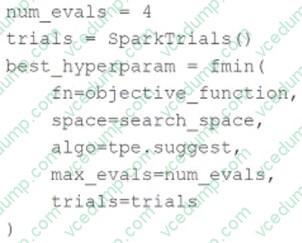
Which change can they make the above code block to improve the likelihood of a more accurate model?
A. Increase num_evals to 100
B. Change fmin() to fmax()
C. Change sparkTrials() to Trials()
D. Change tpe.suggest to random.suggest -
Question 52:
A machine learning engineer wants to parallelize the training of group-specific models using the Pandas Function API. They have developed thetrain_modelfunction, and they want to apply it to each group of DataFramedf.
They have written the following incomplete code block:
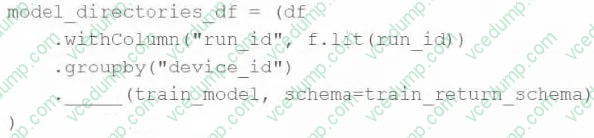
Which of the following pieces of code can be used to fill in the above blank to complete the task?
A. applyInPandas
B. mapInPandas
C. predict
D. train_model
E. groupedApplyIn -
Question 53:
A data scientist wants to use Spark ML to one-hot encode the categorical features in their PySpark DataFramefeatures_df. A list of the names of the string columns is assigned to theinput_columnsvariable.
They have developed this code block to accomplish this task:
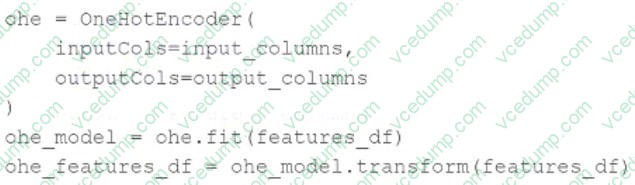
The code block is returning an error.
Which of the following adjustments does the data scientist need to make to accomplish this task?
A. They need to specify the method parameter to the OneHotEncoder.
B. They need to remove the line with the fit operation.
C. They need to use Stringlndexer prior to one-hot encodinq the features.
D. They need to useVectorAssemblerprior to one-hot encoding the features. -
Question 54:
A data scientist uses 3-fold cross-validation and the following hyperparameter grid when optimizing model hyperparameters via grid search for a classification problem:
Hyperparameter 1: [2, 5, 10] Hyperparameter 2: [50, 100]
Which of the following represents the number of machine learning models that can be trained in parallel during this process?
A. 3
B. 5
C. 6
D. 18 -
Question 55:
A data scientist has developed a random forest regressor rfr and included it as the final stage in a Spark MLPipeline pipeline. They then set up a cross-validation process with pipeline as the estimator in the following code block:
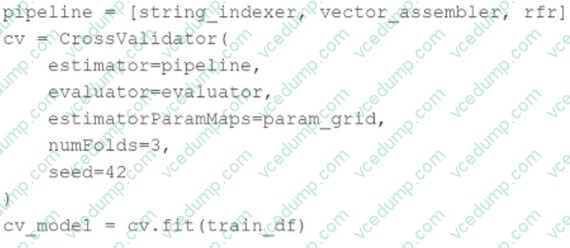
Which of the following is a negative consequence of includingpipelineas the estimator in the cross-validation process rather thanrfras the estimator?
A. The process will have a longer runtime because all stages of pipeline need to be refit or retransformed with each mode
B. The process will leak data from the training set to the test set during the evaluation phase
C. The process will be unable to parallelize tuning due to the distributed nature of pipeline
D. The process will leak data prep information from the validation sets to the training sets for each model -
Question 56:
A machine learning engineer would like to develop a linear regression model with Spark ML to predict the price of a hotel room. They are using the Spark DataFrametrain_dfto train the model.
The Spark DataFrametrain_dfhas the following schema:
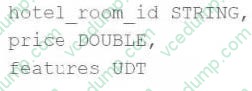
The machine learning engineer shares the following code block:

Which of the following changes does the machine learning engineer need to make to complete the task?
A. They need to call the transform method on train df
B. They need to convert the features column to be a vector
C. They do not need to make any changes
D. They need to utilize a Pipeline to fit the model
E. They need to split thefeaturescolumn out into one column for each feature -
Question 57:
A data scientist has produced three new models for a single machine learning problem. In the past, the solution used just one model. All four models have nearly the same prediction latency, but a machine learning engineer suggests that the new solution will be less time efficient during inference.
In which situation will the machine learning engineer be correct?
A. When the new solution requires if-else logic determining which model to use to compute each prediction
B. When the new solution's models have an average latency that is larger than the size of the original model
C. When the new solution requires the use of fewer feature variables than the original model
D. When the new solution requires that each model computes a prediction for every record
E. When the new solution's models have an average size that is larger than the size of the original model -
Question 58:
A machine learning engineer has created a Feature Table new_table using Feature Store Client fs. When creating the table, they specified a metadata description with key information about the Feature Table. They now want to retrieve that metadata programmatically.
Which of the following lines of code will return the metadata description?
A. There is no way to return the metadata description programmatically.
B. fs.create_training_set("new_table")
C. fs.get_table("new_table").description
D. fs.get_table("new_table").load_df()
E. fs.get_table("new_table") -
Question 59:
A data scientist has defined a Pandas UDF function predict to parallelize the inference process for a single-node model:
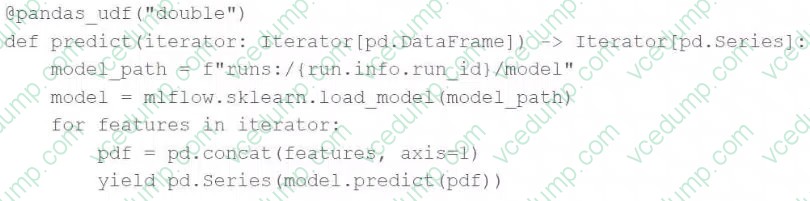
They have written the following incomplete code block to use predict to score each record of Spark DataFramespark_df:
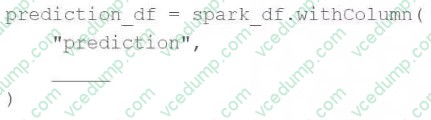
Which of the following lines of code can be used to complete the code block to successfully complete the task?
A. predict(*spark_df.columns)
B. mapInPandas(predict)
C. predict(Iterator(spark_df))
D. mapInPandas(predict(spark_df.columns))
E. predict(spark_df.columns) -
Question 60:
A data scientist has developed a linear regression model using Spark ML and computed the predictions in a Spark DataFrame preds_df with the following schema:
prediction DOUBLE actual DOUBLE
Which of the following code blocks can be used to compute the root mean-squared-error of the model according to the data in preds_df and assign it to the rmse variable?
A. Option A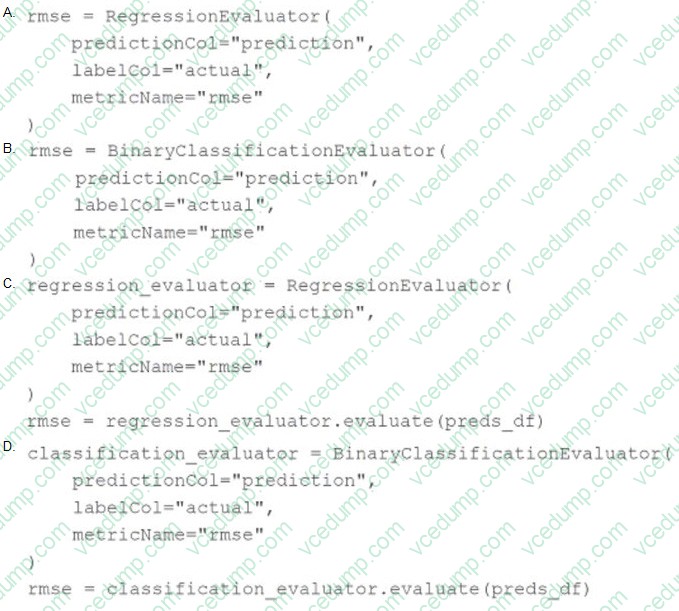
B. Option B
C. Option C
D. Option D
Related Exams:
-
DATABRICKS-CERTIFIED-ASSOCIATE-DEVELOPER-FOR-APACHE-SPARK
Databricks Certified Associate Developer for Apache Spark 3.0 -
DATABRICKS-CERTIFIED-ASSOCIATE-DEVELOPER-FOR-APACHE-SPARK-35
Databricks Certified Associate Developer for Apache Spark 3.5 - Python -
DATABRICKS-CERTIFIED-DATA-ANALYST-ASSOCIATE
Databricks Certified Data Analyst Associate -
DATABRICKS-CERTIFIED-DATA-ENGINEER-ASSOCIATE
Databricks Certified Data Engineer Associate -
DATABRICKS-CERTIFIED-GENERATIVE-AI-ENGINEER-ASSOCIATE
Databricks Certified Generative AI Engineer Associate -
DATABRICKS-CERTIFIED-PROFESSIONAL-DATA-ENGINEER
Databricks Certified Data Engineer Professional -
DATABRICKS-CERTIFIED-PROFESSIONAL-DATA-SCIENTIST
Databricks Certified Professional Data Scientist -
DATABRICKS-MACHINE-LEARNING-ASSOCIATE
Databricks Certified Machine Learning Associate -
DATABRICKS-MACHINE-LEARNING-PROFESSIONAL
Databricks Certified Machine Learning Professional
Tips on How to Prepare for the Exams
Nowadays, the certification exams become more and more important and required by more and more enterprises when applying for a job. But how to prepare for the exam effectively? How to prepare for the exam in a short time with less efforts? How to get a ideal result and how to find the most reliable resources? Here on Vcedump.com, you will find all the answers. Vcedump.com provide not only Databricks exam questions, answers and explanations but also complete assistance on your exam preparation and certification application. If you are confused on your DATABRICKS-MACHINE-LEARNING-ASSOCIATE exam preparations and Databricks certification application, do not hesitate to visit our Vcedump.com to find your solutions here.