AICPA CPA-TEST Online Practice
Questions and Exam Preparation
CPA-TEST Exam Details
Exam Code
:CPA-TEST
Exam Name
:Certified Public Accountant Test: Auditing and Attestation, Business Environment and Concepts, Financial Accounting and Reporting, Regulation
Certification
:AICPA Certifications
Vendor
:AICPA
Total Questions
:1241 Q&As
Last Updated
:Jun 03, 2026
AICPA CPA-TEST Online Questions &
Answers
Question 771:
Tom and Joan Moore, both CPAs, filed a joint 1994 federal income tax return showing $70,000 in taxable income. During 1994, Tom's daughter Laura, age 16, resided with Tom. Laura had no income of her own and was Tom's dependent.
Determine the amount of income or loss, if any that should be included on page one of the Moores' 1994 Form 1040.
In 1994, Joan received $1,300 in unemployment compensation benefits. Her employer made a $100 contribution to the unemployment insurance fund on her behalf.
A. $0 B. $500 C. $900 D. $1,000 E. $1,250 F. $1,300 G. $1,500 H. $2,000 I. $2,500 J. $3,000 K. $10,000 L. $25,000 M. $50,000 N. $55,000 O. $75,000
F. $1,300 "F" is correct. $1,300. Unemployment compensation benefits are fully taxable (when received by the employee), but contributions made by the employer to the insurance fund are not taxable.
Question 772:
At December 31, 1998, ABC Co. changed its method of accounting for demo costs from writing off the costs over two years to expensing the costs immediately. ABC made the change in recognition of an increasing number of demos placed with customers that did not result in sales. ABC had deferred demo costs of $500,000 at December 31, 1997, $300,000 of which were to be written off in 1998 and the remainder in 1999. ABC's income tax rate is 30%. In its 1998 financial
statements, what amount should ABC report as cumulative effect of change in accounting principle?
A. $0 B. $200,000 C. $350,000 D. $500,000
A. $0 Choice "a" is correct. When a change in accounting principle is considered inseparable from a change in estimate, the change is handled as a change in estimate - prospectively. No cumulative effect adjustment is made. Choices "b", "c", and "d" are incorrect since no cumulative effect adjustment is made.
Question 773:
An increase in the quantity demanded for a product would be associated with a(n):
A. Increase in the price of a complementary product. B. Increase in average household income. C. Decrease in the price of that product. D. Decrease in the price of a substitute product.
C. Decrease in the price of that product. Choice "c" is correct. The fundamental law of demand holds that there is an inverse relationship between price of the product and the quantity demanded. We move along the demand curve D-D. Choice "a" is incorrect. An increase in complementary product prices would decrease the demand curve (e.g., if PC prices increase, the demand for printers and other peripherals decrease). Choice "b" is incorrect. Increases in consumers and consumer income shift the demand curve itself. Choice "d" is incorrect. A decrease in price for a substitute product decreases demand for the other product.
Question 774:
The internal rate of return is the:
A. Rate of interest that equates the present value of cash outflows and the present value of cash inflows. B. Risk-adjusted rate of return. C. Required rate of return. D. Weighted average rate of return generated by internal funds.
A. Rate of interest that equates the present value of cash outflows and the present value of cash inflows. Explanation Explanation/Reference:Choice "a" is correct. The internal rate of return is defined as the technique that determines the present value factor such that the present value of the after-tax cash flows equals the initial investment on the project. Alternately, the internal rate of return (IRR) is the discount rate that produces a NPV of zero. Choices "b", "c", and "d" are incorrect, per the above Explanation.
Question 775:
The local video store's business increased by 12 percent after the movie theater raised its prices from $6.50 to $7.00. This is an example of:
A. Substitute goods. B. Superior goods. C. Complementary goods. D. Independent goods.
A. Substitute goods. Choice "a" is correct. For substitute goods, as the price of one good goes up, the demand for another, substitute good increases as consumers desire the lower-priced substitute good. Choice "b" is incorrect. Superior goods. Just as the demand for inferior goods declines with an increase in the income level of a consumer, superior goods will experience a spurt in demand as prices are raised. Choice "c" is incorrect. The demands for mutually "complementary goods" fluctuate together (e.g., more cereal purchases are accompanied by an increase in the demand for milk). Choice "d" is incorrect. Independent goods have unrelated demand functions (e.g., bread and vacuum cleaners).
Question 776:
ABC Corp., a publicly-owned corporation, is subject to the requirements for segment reporting. In its income statement for the year ended December 31, 1991, ABC reported revenues of $50,000,000, operating expenses of $47,000,000, and
net income of $3,000,000. Operating expenses include payroll costs of $ 15,000,000. ABC's combined identifiable assets of all industry segments at December 31, 1991, were $40,000,000.
In its 1991 financial statements, ABC should disclose major customer data if sales to any single customer amount to at least:
A. $300,000 B. $1,500,000 C. $4,000,000 D. $5,000,000
D. $5,000,000 Choice "d" is correct. $5,000,000 (10% x $50,000,000 revenue). If revenue from a single external customer is 10% or more of total revenue, then the company should disclose this fact, the total amount of revenue from the customer, and the segment or segments reporting the revenues. The identity of the customer need not be disclosed.
Question 777:
Knox, president of ABC Corp., contracted with XYZ, Inc. to supply ABC's stationery on customary terms and at a cost less than that charged by any other supplier. Knox later informed ABC's board of directors that Knox was a majority stockholder in XYZ. Quick's contract with XYZ is:
A. Void because of Knox's self-dealing. B. Void because the disclosure was made after execution of the contract. C. Valid because of Knox's full disclosure. D. Valid because the contract is fair to ABC.
D. Valid because the contract is fair to ABC. Choice "d" is correct. If a corporation enters into a contract and a director has a conflict of interest in the transaction, the contract is voidable unless the director makes full disclosure of all of the facts to the disinterested directors or the shareholders, who then approve the transaction, or the director can prove that the transaction was fair to the corporation. The stationery purchase was fair to Quick, since it was purchased at a below-market price. Thus, the contract is valid. Choice "a" is incorrect. A director's self-dealing does not automatically make a contract voiD. The contract can be upheld if it was fair. Choice "b" is incorrect. A director's self-dealing does not automatically make a contract voiD. The contract can be upheld if it was fair. Choice "c" is incorrect. If a corporation enters into a contract and a director has a conflict of interest in the transaction, the contract is voidable unless the director makes full disclosure of all of the facts to the disinterested directors or shareholders, who then approve the transaction, or the director can prove that the transaction was fair. Mere disclosure after the contract was adopted does not automatically render the contract valid.
Question 778:
If information accompanying the basic financial statements in an auditor-submitted document has been subjected to auditing procedures, the auditor may include in the auditor's report on the financial statements an opinion that the accompanying information is fairly stated in:
A. Accordance with generally accepted auditing standards. B. Conformity with generally accepted accounting principles. C. All material respects in relation to the basic financial statements taken as a whole. D. Accordance with attestation standards expressing a conclusion about management's assertions.
C. All material respects in relation to the basic financial statements taken as a whole. Choice "c" is correct. When an auditor submits a document that contains information in addition to the client's basic financial statements, and this information was subjected to auditing procedures, the auditor may include in the auditor's report an opinion that the information is fairly stated in all material respects in relation to the basic financial statements taken as a whole. This statement would follow the opinion paragraph in the standard report. Choice "a" is incorrect. Information in an ASD is not stated in an auditor's report to be in accordance with GAAS. Instead, the auditor would state that the "information has been subjected to the auditing procedures applied in the audit of the basic financial statements..." Choice "b" is incorrect. The auditor would not state that ASD information was fairly stated in accordance with GAAP. The information in an ASD is in addition to that required by GAAP. Choice "d" is incorrect. Reports on ASD are not "attest engagements."
Question 779:
ABC, Inc. has a cost of capital of 15 percent and is considering the acquisition of a new machine, which costs $400,000 and has a useful life of five years. ABC projects that earnings and cash flow will increase as follows.
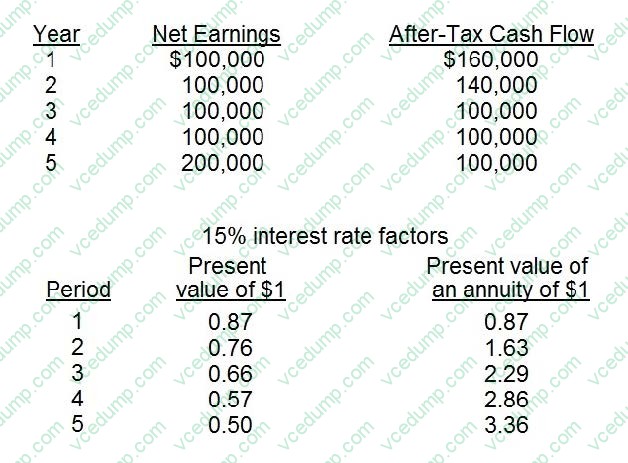
The net present value of this investment is:
A. Negative, $64,000 B. Negative, $14,000 C. Positive, $18,600 D. Positive, $200,000
C. Positive, $18,600 Explanation Explanation/Reference:Choice "c" is correct. Positive NPV, $18,600.
Question 780:
Under the Uniform Partnership Act, which of the following statements is(are) correct regarding the effect of the assignment of an interest in a general partnership?
A. The assignee is personally responsible for the assigning partner's share of past and future partnership debts. II. The assignee is entitled to the assigning partner's interest in partnership profits and surplus on dissolution of the partnership. B. I only. C. II only. D. Both I and II. E. Neither I nor II.
B. I only. Choice "b" is correct. A partner may assign his or her interest in the partnership. The effect of such an assignment is to transfer the partner's right to receive the partner's share of profits or surplus only. Such an assignment does not cause dissolution or make the assignee a new partner. The assignor is still regarded as a partner and is liable for past and future partnership debts. The assignee, since he is not a partner, is not liable for past and future partnership debts. Choice "a" is incorrect. The assignee of an interest in a general partnership is not personally responsible for the assigning partner's share of past and future partnership debts but is entitled to the assigning partner's interest in partnership profits and surplus on dissolution of the partnership. Choice "c" is incorrect. The assignee of an interest in a general partnership is entitled to the assigning partner's interest in partnership profits and surplus on dissolution of the partnership but is not personally responsible for the assigning partner's share of past and future partnership debts. Choice "d" is incorrect. The assignee of an interest in a general partnership is entitled to the assigning partner's interest in partnership profits and surplus on dissolution of the partnership but is not personally responsible for the assigning partner's share of past and future partnership debts.
Nowadays, the certification exams become more and more important and required by more and more
enterprises when applying for a job. But how to prepare for the exam effectively? How to prepare
for the exam in a short time with less efforts? How to get a ideal result and how to find the
most reliable resources? Here on Vcedump.com, you will find all the answers.
Vcedump.com provide not only AICPA exam questions,
answers and explanations but also complete assistance on your exam preparation and certification
application. If you are confused on your CPA-TEST exam preparations
and AICPA certification application, do not hesitate to visit our
Vcedump.com to find your solutions here.