CPA-TEST Exam Details
-
Exam Code
:CPA-TEST -
Exam Name
:Certified Public Accountant Test: Auditing and Attestation, Business Environment and Concepts, Financial Accounting and Reporting, Regulation -
Certification
:AICPA Certifications -
Vendor
:AICPA -
Total Questions
:1241 Q&As -
Last Updated
:Aug 03, 2026
AICPA CPA-TEST Online Questions & Answers
-
Question 691:
Investment managers develop portfolios of different investments to combine, offset, and thereby reduce overall risk. Not all risks can be eliminated by development of a portfolio. Risks that cannot be eliminated through a portfolio are called:
A. Non-market risks.
B. Unsystematic risks.
C. Firm-specific risks.
D. Systematic risks. -
Question 692:
ABC outlet, a relatively new store, is a cafe that offers customers the opportunity to browse the Internet or play computer games at their tables while they drink coffee. The customer pays a fee based on the amount of time spent signed on to the computer. The store also sells books, tee shirts, and computer accessories. ABC has been paying all of its bills on the last day of the payment period, thus forfeiting all supplier discounts. Shown below are data on ABC's two major vendors, including average monthly purchases and credit terms.
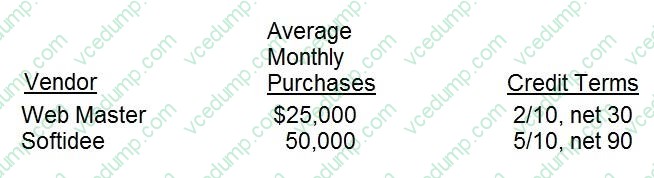
Should ABC use trade credit and continue paying at the end of the credit period?
A. No, if the cost of alternative short-term financing is more.
B. Yes, if the firm's weighted average cost of capital is equal to its weighted average trade credit.
C. No, if the cost of alternative long-term financing is more.
D. Yes, if the cost of alternative short-term financing is more. -
Question 693:
Capital assets include:
A. A corporation's accounts receivable from the sale of its inventory.
B. Seven-year MACRS property used in a corporation's trade or business.
C. A manufacturing company's investment in U.S. Treasury bonds.
D. A corporate real estate developer's unimproved land that is to be subdivided to build homes, which will be sold to customers. -
Question 694:
The following information regarding inventory policy was assembled by the ABC Corporation. The company uses a 50-week year in all calculations.
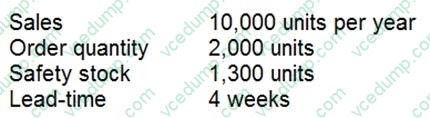
The reorder point is:
A. 3,300 units.
B. 2,100 units.
C. 1,300 units.
D. 5,200 units. -
Question 695:
According to the FASB conceptual framework, predictive value is an ingredient of:
A. Option A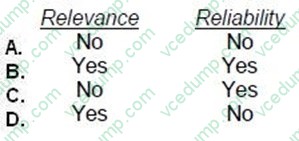
B. Option B
C. Option C
D. Option D -
Question 696:
ABC Cleaning Services is a newly established janitorial firm, and the owner is deciding which type of checking account to open. ABC is planning to keep a $500 minimum balance in the account for emergencies and plans to write an average of 80 checks per month. The bank charges $10 per month plus a $0.10 per check charge for a standard business checking account with no minimum balance. ABC also has the option of a premium business checking account, which requires a $2,500 minimum balance but has no monthly fees or per check charges. If ABC's cost of funds is 10 percent, which account should ABC choose?
A. Standard account, since the savings is $34 per year.
B. Premium account, since the savings is $34 per year.
C. Standard account, since the savings is $16 per year.
D. Premium account, since the savings is $16 per year. -
Question 697:
An auditor is engaged to report on selected financial data that are included in a client-prepared document containing audited financial statements. Under these circumstances, the report on the selected data should:
A. Be limited to data derived from the audited financial statements.
B. Be distributed only to senior management and the board of directors.
C. State that the presentation is a comprehensive basis of accounting other than GAAP.
D. Indicate that the data are not fairly stated in all material respects. -
Question 698:
In 1992, Anchor, Chain, and Hook created ABC Associates, a general partnership. The partners orally agreed that they would work full time for the partnership and would distribute profits based on their capital contributions. Anchor
contributed $5,000; Chain $10,000; and Hook $15,000. For the year ended December 31, 1993, ABC Associates had profits of $60,000 that were distributed to the partners. During 1994, ABC Associates was operating at a loss. In September
1994, the partnership dissolved.
In October 1994, Hook contracted in writing with XYZ Co. to purchase a car for the partnership. Hook had previously purchased cars from XYZ Co. for use by ABC Associates partners. ABC Associates did not honor the contract with XYZ Co.
and XYZ Co. sued the partnership and the individual partners.
A. Anchor's capital account would be reduced by 1/3 of any 1994 losses.
B. Hook's capital account would be reduced by 1/2 of any 1994 losses. -
Question 699:
Which of the following procedures most likely would be considered a weakness in an entity's internal controls over payroll?
A. A voucher for the amount of the payroll is prepared in the general accounting department based on the payroll department's payroll summary.
B. Payroll checks are prepared by the payroll department and signed by the treasurer.
C. The employee who distributes payroll checks returns unclaimed payroll checks to the payroll department.
D. The personnel department sends employees' termination notices to the payroll department. -
Question 700:
Jeb, a member in A and B LLC, sold his interest in the LLC to Chris without obtaining the other members' consent. Absent an agreement to the contrary, Chris:
A. May participate in the management of A and B. II. May receive Jeb's share of A and B's profits. III. Is not entitled to anything since Jeb did not obtain the other members' consent.
B. I only.
C. I and II only.
D. II only.
E. III only.
Tips on How to Prepare for the Exams
Nowadays, the certification exams become more and more important and required by more and more enterprises when applying for a job. But how to prepare for the exam effectively? How to prepare for the exam in a short time with less efforts? How to get a ideal result and how to find the most reliable resources? Here on Vcedump.com, you will find all the answers. Vcedump.com provide not only AICPA exam questions, answers and explanations but also complete assistance on your exam preparation and certification application. If you are confused on your CPA-TEST exam preparations and AICPA certification application, do not hesitate to visit our Vcedump.com to find your solutions here.