AICPA CPA-TEST Online Practice
Questions and Exam Preparation
CPA-TEST Exam Details
Exam Code
:CPA-TEST
Exam Name
:Certified Public Accountant Test: Auditing and Attestation, Business Environment and Concepts, Financial Accounting and Reporting, Regulation
Certification
:AICPA Certifications
Vendor
:AICPA
Total Questions
:1241 Q&As
Last Updated
:May 26, 2026
AICPA CPA-TEST Online Questions &
Answers
Question 41:
During 1992, ABC Co. increased the estimated quantity of copper recoverable from its mine. ABC uses the units of production depletion method. As a result of the change, which of the following should be reported in ABC's 1992 financial statements?
A. Option A B. Option B C. Option C D. Option D
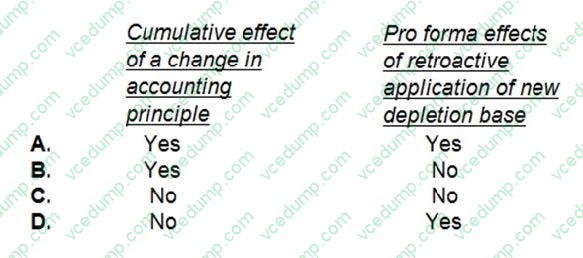
C. Option C Choice "c" is correct, No - No. This is a change in "accounting estimate," which affects only the current and subsequent periods (not prior periods and not retained earnings). "Cumulative effect of a change in accounting principle" is only used for changes in "accounting principle."
Question 42:
ABC, Inc. is interested in measuring its overall cost of capital and has gathered the following data. Under the terms described below, the company can sell unlimited amounts of all instruments.
?ABC can raise cash by selling $1,000, 8 percent, 20-year bonds with annual interest payments. In selling the issue, an average premium of $30 per bond would be received, and the firm must pay floatation costs of $30 per bond. The after-tax cost of funds is estimated to be 4.8 percent. ?ABC can sell 8 percent preferred stock at par value, $105 per share. The cost of issuing and selling the preferred stock is expected to be $5 per share. ?ABC' common stock is currently selling for $100 per share. The firm expects to pay cash dividends of $7 per share next year, and the dividends are expected to remain constant. The stock will have to be underpriced by $3 per share, and floatation costs are expected to amount to $5 per share. ?ABC expects to have available $100,000 of retained earnings in the coming year; once these retained earnings are exhausted, the firm will use new common stock as the form of common stock equity financing. ?ABC' preferred capital structure is: Long-term debt 30% Preferred stock 20 Common stock 50
The cost of funds from the sale of common stock for ABC, Inc. is:
A. 7.0 percent. B. 7.6 percent. C. 7.4 percent. D. 7.8 percent.
B. 7.6 percent. Choice "b" is correct. 7.6%. ABC would receive $92 per share ($100 less $5 flotation cost and $3 underpricing) and pay an annual dividend of $7/share. The annual cost is: This question purely asks the cost of new common shares issued. The problem gives you the expected dividend to be paid annually ($7) and the net proceeds after issue costs and market adjustments $92 (current selling price of $100 minus the $3 market adjustment and the $5 floatation costs). The cost of common shares issued is the finance charge (dividend) divided by the net proceeds of the issue $92 or 7.6%. Choices "a", "c", and "d" are incorrect, per above.
Question 43:
An examination of a financial forecast is a professional service that involves:
A. Compiling or assembling a financial forecast that is based on management's assumptions. B. Limiting the distribution of the accountant's report to management and the board of directors. C. Assuming responsibility to update management on key events for one year after the report's date. D. Evaluating the preparation of a financial forecast and the support underlying management's assumptions.
D. Evaluating the preparation of a financial forecast and the support underlying management's assumptions. Choice "d" is correct. An examination of a financial forecast is a professional service that involves: 1) evaluating the preparation of the prospective financial statements, 2) evaluating the support underlying the assumptions, 3) evaluating the presentation of the prospective financial statements in conformity with AICPA guidelines, and 4) issuing an examination report. Choice "a" is incorrect. Compiling or assembling a financial forecast based on management's assumptions is part of a compilation engagement, not an examination engagement. Choice "b" is incorrect. A financial forecast may be issued for general use. Choice "c" is incorrect. The accountant's standard report specifically states that the accountant assumes no responsibility to update the report for events and circumstances occurring after the date of the report.
Question 44:
To establish the existence and ownership of a long-term investment in the common stock of a publicly traded company, an auditor ordinarily performs a security count or:
A. Relies on the client's internal accounting controls if the auditor has reasonable assurance that the control activities are being applied as prescribed. B. Confirms the number of shares owned that are held by an independent custodian. C. Determines the market price per share at the balance sheet date from published quotations. D. Confirms the number of shares owned with the issuing company.
B. Confirms the number of shares owned that are held by an independent custodian. Choice "b" is correct. Auditors obtain a confirmation (safekeeping list) indicating the number of shares of stocks held by an outside independent custodian. Choice "a" is incorrect. Even a good system of internal control does not necessarily provide sufficient evidence of existence and ownership. Choice "c" is incorrect. Verifying the market price does not provide evidence regarding ownership or existence. Choice "d" is incorrect. Confirmations are generally sent to the independent custodian, not to the issuing company.
Question 45:
Listed below is selected financial information for the Western Division of the ABC Company for last year.
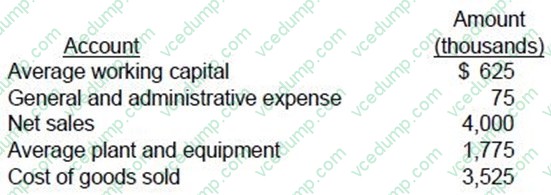
If ABC treats the Western Division as an investment center for performance measurement purposes, what is the before-tax return on investment for last year?
A. 26.76 percent. B. 22.54 percent. C. 19.79 percent. D. 16.67 percent.
D. 16.67 percent. Explanation Explanation/Reference:Choice "d" is correct. 16.67% return on investment.
Question 46:
The amount of inventory that a company would tend to hold in safety stock would increase as the:
A. Cost of carrying inventory decreases. B. Variability of sales decreases. C. Costs of running out of stock decreases. D. Length of time that goods are in transit decreases.
A. Cost of carrying inventory decreases. Choice "a" is correct. As the cost of carrying inventory decreases, safety stock would tend to increase to reduce the risk of stock outs. Choice "b" is incorrect. As sales become more predictable (sales variability decreases), less (not more) safety stock would be needed because the risk of stock outs would have decreased. Choice "c" is incorrect. If the cost of stock outs decrease, safety stock would decrease. Choice "d" is incorrect. If lead-time decreases, safety stock would decrease.
Question 47:
Which of the following formulas should be used to calculate the economic rate of return on common stock?
A. (Dividends + change in price) divided by beginning price. B. (Net income - preferred dividend) divided by common shares outstanding. C. Market price per share divided by earnings per share. D. Dividends per share divided by market price per share.
A. (Dividends + change in price) divided by beginning price. Choice "a" is correct. The economic rate of return on common stock measures the dividend income and capital growth in relation to the initial investment, the beginning price of the stock. Choice "b" is incorrect. The proposed solution is earnings per share, a ratio generally computed as the earnings available to common shareholders (net income after payment of preferred shares) divided by the common shares outstanding. Choice "c" is incorrect. Market price per share divided by earnings per share is the price/earnings or P/E ratio, not the economic rate of return on common stock. Choice "d" is incorrect. The dividends per share divided by the market price per share does not represent the economic rate of return on common stock, the ratio includes change in stock value in the denominator rather than the numerator of the equation.
Question 48:
Which of the following control activities is not usually performed in the vouchers payable department?
A. Determining the mathematical accuracy of the vendor's invoice. B. Having an authorized person approve the voucher. C. Controlling the mailing of the check and remittance advice. D. Matching the receiving report with the purchase order.
C. Controlling the mailing of the check and remittance advice. Choice "c" is correct. Internal control is enhanced if check mailing is performed by the treasury (cash disbursements) department. Choice "a" is incorrect. Mathematical accuracy of the vendor's invoice is usually verified in the vouchers payable department. Choice "b" is incorrect. Voucher approval by an authorized person is usually performed in the vouchers payable department. Choice "d" is incorrect. Matching the receiving report with the purchase order is usually performed in the vouchers payable department.
Question 49:
Which of the following must be included in a company's summary of significant accounting policies in the notes to the financial statements?
A. Description of current year equity transactions. B. Summary of long-term debt outstanding. C. Schedule of fixed assets. D. Revenue recognition policies.
D. Revenue recognition policies. Choice "d" is correct. The summary of significant accounting policies should include "policies." The only policy in the choices listed is the revenue recognition policies. Choice "a" is incorrect. A description of current year equity transactions is not a policy. It should be disclosed somewhere in the footnotes but not in the summary of significant accounting policies. Choice "b" is incorrect. A summary of long-term debt outstanding is not a policy. It should be disclosed somewhere in the footnotes but not in the summary of significant accounting policies. Choice "c" is incorrect. A schedule of fixed assets is not a policy. It should be disclosed somewhere in the footnotes but not in the summary of significant accounting policies.
Question 50:
If a product has a price elasticity of demand of 2.0, the demand is said to be:
A. Perfectly elastic. B. Perfectly inelastic. C. Relatively elastic. D. Relatively inelastic.
C. Relatively elastic. Choice "c" is correct. A price elasticity of demand of 2.0 means demand will change by 2?(as a percentage) for any change in price. This is called elastic. Choice "a" is incorrect. Perfectly elastic demand does not exist. Choice "b" is incorrect. Perfectly inelastic demand means the quantity demanded will not change when price changes. Choice "d" is incorrect. Inelastic demand responds less than 1?(as a percentage) for a change in price.
Nowadays, the certification exams become more and more important and required by more and more
enterprises when applying for a job. But how to prepare for the exam effectively? How to prepare
for the exam in a short time with less efforts? How to get a ideal result and how to find the
most reliable resources? Here on Vcedump.com, you will find all the answers.
Vcedump.com provide not only AICPA exam questions,
answers and explanations but also complete assistance on your exam preparation and certification
application. If you are confused on your CPA-TEST exam preparations
and AICPA certification application, do not hesitate to visit our
Vcedump.com to find your solutions here.