
CLO-002 Real Exam Questions

CompTIA Cloud Essentials+

218 questions available · Page 1 of 22

Updated Exam DumpsVerified AnswersPass Guarantee

Get Complete Exam Dumps
Question 1 Single choice

Which of the following is a benefit of microservice applications in a cloud environment?

  1. A

    Microservices are dependent on external shared databases found on cloud solutions.

  2. B

    Federation is a mandatory component for an optimized microservice deployment.

  3. C

    The architecture of microservice applications allows the use of auto-scaling.

  4. D

    Microservice applications use orchestration solutions to update components in each service.

Show answer and explanation

Correct answer: C

Explanation

Explanation: Microservice applications are composed of many smaller, loosely coupled, and independently deployable services, each with its own responsibility and technology stack 1. One of the benefits of microservice applications in a cloud environment is that they can use auto-scaling, which is the ability to automatically adjust the amount of computing resources allocated to a service based on the current demand 2. Auto-scaling can help improve the performance, availability, and cost-efficiency of microservice applications, as it allows each service to scale up or down according to its own needs, without affecting the rest of the application 2. Auto-scaling can also help handle unpredictable or variable workloads, such as spikes in traffic or seasonal fluctuations 2. Auto-scaling can be implemented using different cloud services, such as Google Kubernetes Engine (GKE) or Cloud Run, which provide both horizontal and vertical scaling
options for microservice applications 34.
References:
1: IBM, What are Microservices?
2: AWS, What is
Auto Scaling?
3: Google Cloud, Autoscaling Deployments
4: Google Cloud, Scaling Cloud Run services
Question 2 Single choice

A web developer configured an application to have a local user database option to ensure the application can still be used if the corporate directory is not responsive to login requests.

Which of the following security concepts BEST describes having this second database?

  1. A

    Access

  2. B

    Authorization

  3. C

    Auditing

  4. D

    Availability

Show answer and explanation

Correct answer: D

Explanation

Explanation: Availability is one of the three basic functions of security management that are present in all systems. Availability is the assertion that a computer system is available or accessible by an authorized user whenever it is needed. Systems have high order of availability to ensure that the system operates as expected when needed 1. Availability provides building of fault tolerance system in the products. It also ensures the backup processing by including hot and cold sites in the disaster recovery planning 1. Having a local user database option to ensure the application can still be used if the corporate directory is not responsive to login requests is an example of availability, as it ensures that the users can access the application even if the primary authentication service is unavailable. This is a form of backup processing that provides an alternative means of accessing the application in case of a failure or outage. Having a local user database option does not affect the access, authorization, or auditing of the application, as these are related to the identification, verification, and monitoring of the users, not the availability of the
application.
References:
Availability in Information Security - GeeksforGeeks
5 Security Concepts Every
Developer Should Understand
The 7 Basic Principles of IT Security - Techopedia.

Question 3 Single choice

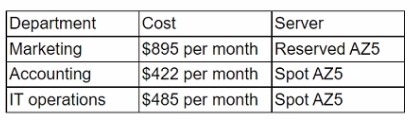
A large enterprise has the following invoicing breakdown of current cloud consumption spend:

The level of resources consumed by each department is relatively similar.

Which of the following is MOST likely affecting monthly costs?

  1. A

    The servers in use by the marketing department are in an availability zone that is generally expensive.

  2. B

    The servers in use by the accounting and IT operations departments are in different geographic zones with lower pricing.

  3. C

    The accounting and IT operations departments are choosing to bid on non-committed resources.

  4. D

    The marketing department likely stores large media files on its servers, leading to increased storage costs.

Show answer and explanation

Correct answer: D

Explanation

Explanation: The marketing department likely stores large media files on its servers, leading to increased storage costs. This is because the marketing department is responsible for creating and distributing various types of digital content, such as videos, images, podcasts, and webinars, to promote the products and services of the enterprise. These media files tend to be large in size and require more storage space than other types of data, such as text documents or spreadsheets. Therefore, the marketing department consumes more storage resources than the other departments, which increases the monthly cloud costs for the enterprise.
References:
CompTIA Cloud Essentials+ CLO-002 Study Guide, Chapter 3: Cloud Service and Delivery Models, Section 3.2: Cloud Storage, Page 97

Question 4 Single choice

A cloud developer chooses to use private key encryption for all traffic in a new application.

Which of the following security concerns does this BEST describe?

  1. A

    Integrity

  2. B

    Confidentiality

  3. C

    Availability

  4. D

    Authorization

Show answer and explanation

Correct answer: B

Explanation

Explanation: Private key encryption, also known as symmetric key encryption, is a method of encrypting data using a single secret key that is shared by both the sender and the receiver of the message 1. Private key encryption ensures that only the authorized parties who have the same key can access the encrypted data, while preventing unauthorized parties from reading or modifying it. Therefore, private key encryption is mainly used to protect the confidentiality of data, which is the security concern that deals with preventing unauthorized disclosure of information 2.
Confidentiality is one of the three main goals of information security, along with integrity and availability.
Integrity refers to the security concern that deals with preventing unauthorized modification or corruption of information. Availability refers to the security concern that deals with ensuring timely and reliable access to information 2. Authorization, on the other hand, is not a security concern, but a security mechanism that deals with granting or denying access rights to information based on predefined policies and rules 3. A cloud developer chooses to use private key encryption for all traffic in a new application. This best describes the security concern of confidentiality, as the developer wants to ensure that only the intended recipients can access the encrypted data, while keeping it secret from anyone else.
References:
1: (https://www.comptia.org/training/books/cloud-essentials-clo-002-study-guide,)
Chapter 8, page 274-275 2: (https://www.comptia.org/training/books/cloud-essentials-clo-002-study-)
guide, Chapter 8, page 263-264 3: (https://www.comptia.org/training/books/cloud-)
essentials-clo-002-study-guide, Chapter 8, page 268-269

Question 5 Single choice

For which of the following reasons is the infrastructure as code technique used?

  1. A

    To improve the ability to migrate applications to different cloud providers to avoid vendor lock-in.

  2. B

    To specify the hardware configuration and system installation procedures in machine-readable formats.

  3. C

    To capture the system configurations to track changes and remediate configuration drift.

  4. D

    To assign server administration responsibilities to software developers for application deployments.

Show answer and explanation

Correct answer: C

Explanation

Explanation: Infrastructure as code (IaC) is a software engineering approach that allows the provisioning and management of infrastructure resources using code and automation 1. It involves defining infrastructure configurations and provisioning them through code, rather than manually configuring and managing infrastructure resources 2. One of the main reasons for using IaC is to capture the system configurations to track changes and remediate configuration drift 3. Configuration drift is the phenomenon where the actual state of an infrastructure resource deviates from its desired state over time due to manual interventions, updates, patches, or other factors. Configuration drift can cause inconsistencies, errors, and security issues in the infrastructure environment. IaC helps to prevent and detect configuration drift by storing the infrastructure configuration code in a version control system and applying it consistently across all environments. IaC also enables the use of automated testing and validation tools to verify the compliance and functionality of the infrastructure resources. By using IaC, DevOps teams can ensure that the infrastructure is always in a known and reproducible state, and that any changes are documented and traceable.
References:
1: (https://technology.gov.capital/infrastructure-as-code-iac/)
2: (https://aws.amazon.com/what-is/iac/)
3: (https://learn.microsoft.com/en-us/devops/deliver/what-is-infrastructure-as-code)
: (https://www.comptia.org/training/books/cloud-essentials-clo-002-study-guide,)
Chapter 5, page 179-180

Question 6 Single choice

An analyst is reviewing a report on a company's cloud resource usage. The analyst has noticed many of the cloud instances operate at a fraction of the full processing capacity.

Which of the following actions should the analyst consider to lower costs and improve efficiency?

  1. A

    Consolidating into fewer instances

  2. B

    Using spot instances

  3. C

    Right-sizing compute resource instances

  4. D

    Negotiating better prices on the company's reserved instances

Show answer and explanation

Correct answer: C

Explanation

Explanation: Right-sizing compute resource instances is the process of matching instance types and sizes to workload performance and capacity requirements at the lowest possible cost. It's also the process of identifying opportunities to eliminate or downsize instances without compromising capacity or other requirements, which results in lower costs and higher efficiency 1. Right-sizing is a key mechanism for optimizing cloud costs, but it is often ignored or delayed by organizations when they first move to the cloud.
They lift and shift their environments and expect to right-size later. Speed and performance are often prioritized over cost, which results in oversized instances and a lot of wasted spend on unused resources 2.
Right-sizing compute resource instances is the best action that the analyst should consider to lower costs and improve efficiency, as it can help reduce the amount of resources and money spent on instances that operate at a fraction of the full processing capacity. Right-sizing can also improve the performance and reliability of the instances by ensuring that they have enough resources to meet the workload demands.
Right-sizing is an ongoing process that requires continuous monitoring and analysis of the instance usage and performance metrics, as well as the use of tools and frameworks that can simplify and automate the right-sizing decisions 1.
Consolidating into fewer instances, using spot instances, or negotiating better prices on the company's reserved instances are not the best actions that the analyst should consider to lower costs and improve efficiency, as they have some limitations and trade-offs compared to right-sizing. Consolidating into fewer instances can reduce the number of instances, but it does not necessarily optimize the type and size of the instances. Consolidating can also introduce performance and availability issues, such as increased latency, reduced redundancy, or single points of failure 3. Using spot instances can reduce the cost of instances, but it also introduces the risk of interruption and termination, as spot instances are subject to fluctuating prices and availability based on the supply and demand of the cloud provider 4. Negotiating better prices on the company's reserved instances can reduce the cost of instances, but it also requires a long-term commitment and upfront payment, which reduces the flexibility and scalability of the cloud environment 5.
References:
Right Sizing - Cloud Computing Services
The 6-Step Guide To Rightsizing
Your Instances - CloudZero
Consolidating Cloud Services: How to Do It Right | CloudHealth by VMware;
Spot Instances - Amazon Elastic Compute Cloud
Reserved Instances - Amazon Elastic Compute Cloud.

Question 7 Single choice

A company with a variable number of employees would make good use of the cloud model because of:

  1. A

    multifactor authentication

  2. B

    self-service

  3. C

    subscription services

  4. D

    collaboration

Show answer and explanation

Correct answer: C

Explanation

Explanation: A company with a variable number of employees would make good use of the cloud model because of subscription services. Subscription services are a type of cloud pricing model that allows customers to pay a fixed fee for a certain amount of cloud resources or services for a specific period of time, such as monthly or annually. Subscription services can offer benefits such as predictable costs, scalability, flexibility, and reduced upfront investment. A company with a variable number of employees can use subscription services to adjust the cloud resources or services according to the changing demand and size of the workforce, without wasting money on unused capacity or paying extra fees for exceeding the limit. Subscription services can also enable the company to access the latest cloud technologies and features without having to purchase or maintain them. The other options are not the best reasons for a company with a variable number of employees to use the cloud model. Multifactor authentication is a security method that requires users to provide two or more pieces of evidence to verify their identity, such as a password, a code, or a biometric factor. Multifactor authentication can enhance the security of the cloud services, but it is not related to the number of employees. Self-service is a cloud characteristic that allows users to provision, manage, and terminate cloud resources or services on demand, without requiring the intervention of the cloud provider or the IT department. Self-service can improve the efficiency and agility of the cloud services, but it is not related to the number of employees. Collaboration is a cloud benefit that enables users to work together on projects, documents, or tasks using cloud-based tools and platforms, such as online file sharing, video conferencing, or project management. Collaboration can increase the productivity and innovation of the cloud services, but it is not related to the number of
employees.
References:
CompTIA Cloud Essentials+ Certification Study Guide, Second Edition (Exam
CLO-002), Chapter 1: Cloud Principles and Design, Section 1.2: Cloud Computing Concepts, p. 26-27.

Question 8 Multiple choice

Which of the following technologies would help a game company prepare its cloud infrastructure to support a global distribution workload of a newly released online game? (Choose two.)

  1. A

    Auto-scaling

  2. B

    VDI

  3. C

    Data portability

  4. D

    CDN

  5. E

    Templates

  6. F

    Blockchain

Show answer and explanation

Correct answers: A, D

Explanation

Explanation: Auto-scaling and CDN are two technologies that would help a game company prepare its cloud infrastructure to support a global distribution workload of a newly released online game.
Auto-scaling is the ability of a cloud service to automatically adjust the amount of resources, such as compute, storage, or bandwidth, based on the demand or load of the service. Auto-scaling can help a game company to handle the spikes or fluctuations in the number of players or traffic that may occur during the launch or peak times of a new online game. Auto-scaling can also help the game company to optimize the performance, availability, and cost of the cloud service, as it can scale up or down the resources as needed. Auto-scaling can be triggered by predefined rules, metrics, or schedules, or by using machine learning or artificial intelligence to predict the demand patterns12 CDN stands for Content Delivery Network, which is a network of distributed servers that deliver content, such as web pages, images, videos, or games, to the end-users based on their geographic location, the origin of the content, and the network conditions. CDN can help a game company to distribute its online game to a global audience, as it can reduce the latency, bandwidth, and load on the origin server, and improve the user experience, security, and reliability of the content delivery. CDN can also help the game company to cope with the high volume of requests or traffic that may occur during the launch or peak times of a new online game. CDN can use various techniques, such as caching, compression, encryption, or load balancing, to optimize the content delivery34 References: CompTIA Cloud Essentials+ Certification Exam Objectives5, CompTIA
Cloud Essentials+ Study Guide, Chapter 4: Cloud Storage6, Chapter 6: Cloud Connectivity and Load Balancing7

Question 9 Single choice

Which of the following is the cloud storage technology that would allow a company with 12 nearly identical servers to have the SMALLEST storage footprint?

  1. A

    Capacity on demand

  2. B

    Compression

  3. C

    Software-defined storage

  4. D

    Deduplication

Show answer and explanation

Correct answer: D

Explanation

Explanation: Deduplication is the cloud storage technology that would allow a company with 12 nearly identical servers to have the smallest storage footprint. Deduplication is the process of eliminating redundant or duplicate data blocks within a storage system, and replacing them with pointers to a single copy of the data. Deduplication can reduce the amount of storage space required, as well as the bandwidth and cost of data transfer. Deduplication is especially effective for data that has a high degree of similarity, such as backup data, virtual machine images, or server data. Deduplication can be performed at the source or the target, and at the file or the block level.
References:
CompTIA Cloud Essentials+
Certification Exam Objectives1, CompTIA Cloud Essentials+ Study Guide, Chapter 4: Cloud Storage2, Data Deduplication in Cloud Computing3

Question 10 Single choice

A company migrated all of its infrastructure to the cloud. The cloud security team must review the security post-migration.

Which of the following is the MOST appropriate task for the cloud security team to perform?

  1. A

    Risk register

  2. B

    Threat assessment

  3. C

    Application scan

  4. D

    Vulnerability scan

Show answer and explanation

Correct answer: D

Explanation

Explanation: A vulnerability scan is a process of identifying and reporting potential security weaknesses in a system or network. A vulnerability scan can help detect misconfigurations, outdated software, missing patches, and other issues that could compromise the security of the cloud environment. A vulnerability scan is an appropriate task for the cloud security team to perform after migrating the infrastructure to the cloud, as it can help identify and remediate any security gaps that may have occurred during the migration process. A vulnerability scan can also help the cloud security team comply with the security standards and regulations that apply to the cloud service provider and the cloud customer. A risk register is a document that lists the identified risks, their likelihood, impact, and mitigation strategies for a project or organization.
A risk register is not a post-migration task, but rather a pre-migration task that should be created and updated throughout the cloud migration process. A risk register can help the cloud security team assess and manage the risks associated with the cloud migration, and plan for contingencies and backups in case of any unforeseen events.
A threat assessment is a process of identifying and analyzing the potential threats that could harm a system or network. A threat assessment can help the cloud security team determine the sources, motives, capabilities, and methods of the attackers, and prioritize the most critical and likely threats. A threat assessment is not a post-migration task, but rather a continuous task that should be performed regularly to monitor and respond to the evolving threat landscape. A threat assessment can help the cloud security team enhance the security posture and resilience of the cloud environment, and implement appropriate countermeasures and controls.
An application scan is a process of testing and verifying the functionality and security of an application. An application scan can help detect and report any errors, bugs, vulnerabilities, or performance issues in an application. An application scan is not a post-migration task, but rather a development and deployment task that should be performed before and after launching an application in the cloud. An application scan can help the cloud security team ensure the quality and reliability of the application, and fix any issues that could affect the user experience or security of the application.
References:
CompTIA Cloud Essentials+ CLO-002 Study Guide, Chapter 4: Cloud Security Principles and Practices, pages 153-154.