CCBA Exam Details
-
Exam Code
:CCBA -
Exam Name
:Certification of Competency in Business Analysis (CCBA) -
Certification
:IIBA Certifications -
Vendor
:IIBA -
Total Questions
:522 Q&As -
Last Updated
:Jul 14, 2026
IIBA CCBA Online Questions & Answers
-
Question 461:
A business analyst (BA) is working on a project to provide a temporary solution that will last for two months. The BA is feeling overwhelmed with the work needed to create the huge number of links to provide full traceability from solution requirements to design for this solution. How can the BA justify omitting all possible links?
A. Such traceability is at a lower level of abstraction for this project
B. The value each link is delivering in this situation is not high
C. Traceability is a low priority as the BA has other work to complete
D. It is impossible for anyone to confirm if such links are correct -
Question 462:
A large online retailer is introducing new technology to upgrade its aging ordering process. The business analyst (BA) has drawn a stakeholder matrix showing information on how to engage with the stakeholders throughout the project.
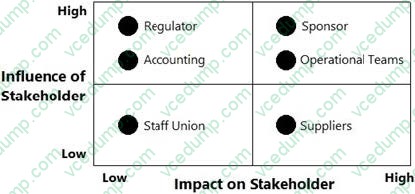
Using the stakeholder matrix as a guide, how should the BA engage the suppliers?
A. Meet with the suppliers to discuss their needs
B. Ensure the suppliers are kept informed by showing interest in their needs
C. Communicate changes to the suppliers by general communication
D. Focus efforts to engage with the suppliers regularly -
Question 463:
Which stakeholder in the solution assessment task will provide information on technical constraints that could limit the solutions that may be implemented?
A. Project manager
B. Suppliers
C. Sponsor
D. Operational support -
Question 464:
A business analyst (BA) is given an additional requirement near the end of the development phase that needs to be incorporated into the system as part of the same release. In this situation, the first activity the BA performs to understand the effect of the proposed change is to:
A. determine whether stakeholders are available for further elicitation.
B. consult with the technical team for technical feasibility.
C. determine whether the additional requirement is traceable to a need.
D. check with the project manager for timeline and budget metrics. -
Question 465:
A new regulation results in organizations needing to change online contractual wording. A business analyst (BA) has elicited the requirements and documented them in a change control request Where will the BA find out which stakeholder has the authority to approve, deny, or defer the change request?
A. Information management approach
B. Governance approach
C. Business analysis approach
D. Stakeholder engagement approach -
Question 466:
Several user groups are impacted by a proposed change to their daily work flow. How should the business analyst (BA) convey these changes so that the user groups understand the impact?
A. Develop a data model diagram
B. Create business process models
C. Write functional requirements
D. Establish a communication plan -
Question 467:
Wanda is the business analyst for her organization and she is currently working on the specify and model requirements process. One of the elements of this process is the documentation of the textual requirements. Wanda must describe the capabilities of the solution, any conditions that must exist for the requirements to operate, and what third component of the textual requirement?
A. Any constraints that may prevent the solution from fulfilling the requirement
B. Describe a situation or problem
C. Write in the active voice
D. Express only one requirement at a time -
Question 468:
Which one of the following statements is most true about changing requirements in a change-driven approach to business analysis and requirements management?
A. Change-driven approaches must use a change control system with a change control board.
B. Change-driven approaches only use a change control system for approved changes.
C. Change-driven approaches don't use a formal change control process.
D. Change-driven approaches are driven by change control processes. -
Question 469:
A business analyst (BA) has just started a large project and is collaborating with stakeholders to define requirements. Another BA is joining soon to help with this initiative. What action should the BA take to ensure that the new BA understands the project?
A. Delay elicitation activities until the new BA joins
B. Run elicitation sessions in parallel to speed up the process
C. Ask the new BA to define the stakeholder engagement approach
D. Document outcomes of discussions with stakeholders -
Question 470:
A senior manager wants to know at what stage the business analyst (BA) is with the requirements management process. The BA immediately sends a 600-page document with models and business rules to all stakeholders. Which best practice did the BA violate in this situation?
A. The business rules were included
B. The communication method was inappropriate
C. The distribution included all project stakeholders
D. The models were included
Related Exams:
-
CBAP
Cetified business analysis professional (CBAP) -
CBDA
Certification in Business Data Analytics (CBDA) -
CCBA
Certification of Competency in Business Analysis (CCBA) -
ECBA
Entry Certificate in Business Analysis (ECBA) -
IIBA-AAC
IIBA Agile Analysis Certification (AAC) -
IIBA-CCA
Certificate in Cybersecurity Analysis (CCA) -
IIBA-CPOA
Certificate in Product Ownership Analysis (IIBA-CPOA)
Tips on How to Prepare for the Exams
Nowadays, the certification exams become more and more important and required by more and more enterprises when applying for a job. But how to prepare for the exam effectively? How to prepare for the exam in a short time with less efforts? How to get a ideal result and how to find the most reliable resources? Here on Vcedump.com, you will find all the answers. Vcedump.com provide not only IIBA exam questions, answers and explanations but also complete assistance on your exam preparation and certification application. If you are confused on your CCBA exam preparations and IIBA certification application, do not hesitate to visit our Vcedump.com to find your solutions here.