CBAP Exam Details
-
Exam Code
:CBAP -
Exam Name
:Cetified business analysis professional (CBAP) -
Certification
:IIBA Certifications -
Vendor
:IIBA -
Total Questions
:498 Q&As -
Last Updated
:Jul 14, 2026
IIBA CBAP Online Questions & Answers
-
Question 241:
You are the business analyst for your organization and are training Tracy on business analysis duties. You are explaining to Tracy how it's important for a business analyst to generate new ideas to approaching problems, solving problems, and to generate alternative solutions. You stress that it's important for the business analyst to generate new ideas and innovative concepts.
What type of analytical thinking are you describing for Tracy?
A. Lateral thinking
B. Brainstorming
C. Creative thinking
D. Decision making -
Question 242:
An insurance company wants to implement a business intelligence solution to consolidate data from various different internal systems to provide a better understanding of their customer base.
A business analyst (BA) is engaged to put together a tender (bid) to be sent to various business intelligence providers and implementation partners. Among other information, the business analyst requests the following:
Licensing costs for Year 0 based on meeting 1 Central Processing Unit (CPU) license
Licensing costs for specific user types such as Report Creators. Online Analytical Processing (OLAP) users and Power uses Predicted licensing costs for renewing in Years 1 ad 2 Full implementation costs After reviewing the received vendor responses the project team shortlists the candidates to 3 and the BA structures the received information as follows:
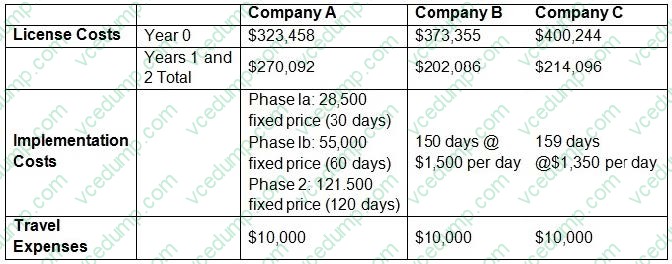
The BA also conducts a sensitivity analysis to compare the expected costs should the company's needs grow based on the following information:
Scenario 1: Ten extra report creator, 1 extra OLAP user and 1 extra power user licenses and 2 extra CPU licenses Scenario 2: Twenty five extra report creator, 1 extra OLAP user and 1 extra power user licenses and 3 extra CPU licenses

The insurance company has a maximum budget of $810,000 for the entire implementation and operation over the first three years. Which vendor or vendors meet that criteria?
A. Company A
B. Company B
C. Both companies B and C
D. Both companies A and C -
Question 243:
You are the business analyst for your organization and are working with Ralph who is also a business analyst at your company. You have moved one of the requirements higher in the prioritization of the requirements because it is needed to be implemented before some of the more important requirements are done. Ralph disagrees with your placement of the requirement because you are to rank the requirements based on their level of difficulty.
Who is correct and why?
A. Ralph is correct because the requirements are always to be ranked by importance or business value.
B. You are correct because the lower priority requirements must be completed before the higher priority requirements can be done.
C. You are correct because you are the senior business analyst.
D. Ralph is correct because the sequence of requirements is actually done with the project activity list. -
Question 244:
What business analysis element tries to identify as many potential options as possible to meet the business objectives and fill identified gaps in capabilities?
A. Ranking of approaches
B. Decision analysis
C. Documentation of assumptions and constraints
D. Alternative generation -
Question 245:
A company has a process improvement initiative that is projected to increase revenue by $150,000 USD non-compounded per year. The budgeted cost of the initiative is $200.000 and supporting the initiative will cost $30.000 for years two and three.
What is the projected return on investment over the first 3 years?
A. 44%
B. 73%
C. 40%
D. 51% -
Question 246:
Jane is the business analyst for her organization and she is completing passive observation to identify improvement opportunities in the workflow. She notices that some of the employees perform certain customer-facing activities in a different format than the other workers.
Is this a problem that can be addressed as part of an improvement opportunity?
A. It can be a problem as customers could become confused or frustrated because of the different approaches to the work.
B. It is not a problem unless there is a drop in sales so it should be left alone.
C. It can be a problem as the enterprise environmental factors always call for consistency in all processes.
D. It is not a problem unless the customer complains. If Jane has not noticed the customers complaining then the process should be left along. -
Question 247:
A business unit of a transnational manufacturer wants to implement a robust process for addressing integrity-critical equipment deterioration incidents. Timely and complete resolution of such incidents is vital for the business unit's continuous safe and profitable operation. Treating each incident involves many employees from different departments extensively collaborating and exchanging information. That information is spread across multiple systems having their access limited to particular user groups. With the current manual process, some incidents get forgotten and remain unresolved for years.
The project's Sponsor is an Equipment Integrity and Reliability Advisor, who moved into this position from another business unit. That business unit implemented a proprietary application to integrate the information and to assist in tracking and managing the incidents. Having a positive experience with the application, the Sponsor is suggesting to customize it and reuse in the new business unit.
The business unit's Enterprise Architect (EA), who is responsible for assessing solution options and presenting them to executive decision makers, has a few concerns with adopting the existing application. The application uses point-to-point interfaces with other data sources whereas the business unit's target architecture relies on a data warehouse-based integration. Moreover, the two business units use different legacy systems, as well as different front-end implementation technologies. Additionally, the existing application is monolingual, while the business unit needs user interfaces and some data to be presented in two languages. With all of this, it may be easier to build a new application from scratch than to customize the existing one. To understand which option is better, the EA asks a business analyst (BA) to define business requirements.
Through the elicitation process, the BA identifies the following requirement: "Particular incident-related activities require approval by authorized personnel before beginning them, as well as confirmation of acceptance of their completion."
What kind of asset should the BA provide to fully specify the approval requirement?
A. A process diagram
B. A RACI matrix
C. A use case model
D. A business rule -
Question 248:
A software company has won a contract to implement its product for a client. As part of the implementation work, a business analyst (BA) is asked to compile information about the other client applications that will integrate with the new system and provide the information graphically. To establish the boundaries of the new system, the business leaders need to know the interfacing client applications and the type of information that will be exchanged between the existing and new systems.
Which type of diagram should the BA use?
A. Process
B. Sequence
C. Activity
D. Context -
Question 249:
Henry is the business analyst for his organization. Management has created a pre-determined budget of $450,000 for his solution. Henry has identified the project requirements but now wants to prioritize them based on timeboxing and budgeting. Henry examines the cost of the requirements and begins removing the requirements from the allowed list in order to meet the $450,000 budget.
What timeboxing or budgeting approach is Henry using?
A. Parametric
B. All in
C. Selective
D. All out -
Question 250:
A business analyst (BA) has been coordinating several meetings with stakeholders to reach consensus regarding the solution design to implement a global currency exchange system for an international bank. Consensus has not been reached yet, although BA has great communication skills and is trusted by all stakeholders. The stakeholders formally approved the business need initially.
Why is there disagreement?
A. The requirements are interpreted differently by each stakeholder.
B. The requirements are incorrectly traced.
C. The approval authority for the solution is unclear.
D. More solution alternatives need to be generated.
Related Exams:
-
CBAP
Cetified business analysis professional (CBAP) -
CBDA
Certification in Business Data Analytics (CBDA) -
CCBA
Certification of Competency in Business Analysis (CCBA) -
ECBA
Entry Certificate in Business Analysis (ECBA) -
IIBA-AAC
IIBA Agile Analysis Certification (AAC) -
IIBA-CCA
Certificate in Cybersecurity Analysis (CCA) -
IIBA-CPOA
Certificate in Product Ownership Analysis (IIBA-CPOA)
Tips on How to Prepare for the Exams
Nowadays, the certification exams become more and more important and required by more and more enterprises when applying for a job. But how to prepare for the exam effectively? How to prepare for the exam in a short time with less efforts? How to get a ideal result and how to find the most reliable resources? Here on Vcedump.com, you will find all the answers. Vcedump.com provide not only IIBA exam questions, answers and explanations but also complete assistance on your exam preparation and certification application. If you are confused on your CBAP exam preparations and IIBA certification application, do not hesitate to visit our Vcedump.com to find your solutions here.