BUSINESS-ENVIRONMENT-AND-CONCEPTS Exam Details
-
Exam Code
:BUSINESS-ENVIRONMENT-AND-CONCEPTS -
Exam Name
:Certified Public Accountant (Business Environment amd Concepts) -
Certification
:Test Prep Certifications -
Vendor
:Test Prep -
Total Questions
:530 Q&As -
Last Updated
:May 31, 2026
Test Prep BUSINESS-ENVIRONMENT-AND-CONCEPTS Online Questions & Answers
-
Question 431:
Capital investments require balancing risk and return. Managers have a responsibility to ensure that the investments that they make in their own firms increase shareholder value. Managers have met that responsibility if the return on the capital investment:
A. Exceeds the rate of return associated with the firm's beta factor.
B. Is less than the rate of return associated with the firm's beta factor.
C. Is greater than the prime rate of return.
D. Is less than the prime rate of return. -
Question 432:
Vested, Inc. made some changes in operations and provided the following information:
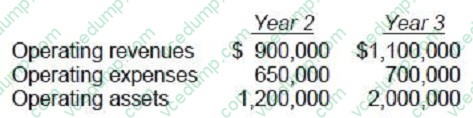
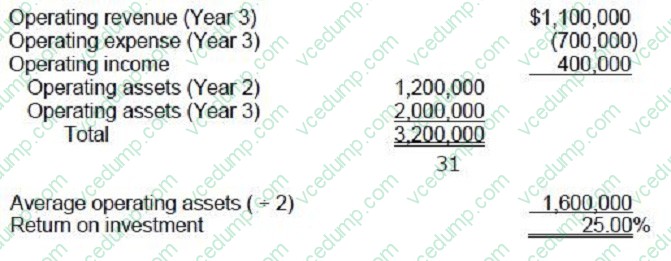
What percentage represents the return on investment for year 3?
A. 28.57%
B. 25%
C. 20.31%
D. 20% -
Question 433:
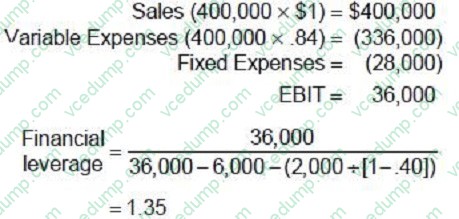
Carlisle Company presently sells 400,000 bottles of perfume each year. Each bottle costs $.84 to produce and sells for $1.00. Fixed costs are $28,000 per year. The firm has annual interest expense of $6,000, preferred stock dividends of $2,000 per year, and a 40 percent tax rate. Carlisle uses the following formulas to determine the company's leverage.
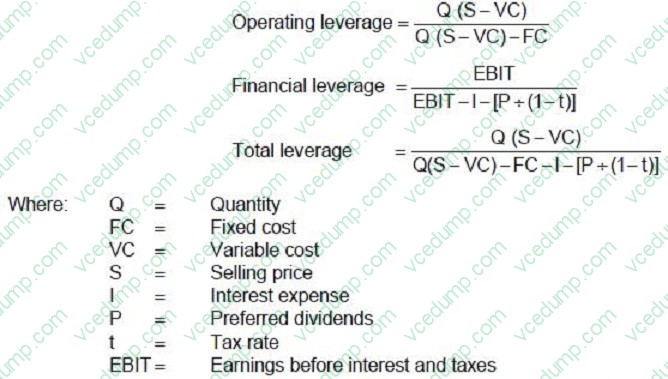
The degree of financial leverage for Carlisle Company is:
A. 2.4
B. 1.78
C. 1.35
D. 2.3 -
Question 434:
Management accountants are frequently asked to analyze various decision situations including the following.
I. The cost of a special device that is necessary if a special order is accepted.
II. The cost proposed annually for the plant service for the grounds at corporate headquarters.
III. Joint production costs incurred, to be considered in a sell-at-split versus a process-further decision.
IV.
The costs associated with alternative uses of plant space, to be considered in a make/buy decision.
V.
The cost of obsolete inventory acquired several years ago, to be considered in a keep-versus disposal decision.
The costs described in situations I and IV above are:
A. Prime costs.
B. Sunk costs.
C. Discretionary costs.
D. Relevant costs.
I. The cost of a special device that is necessary if a special order is accepted. II. The cost proposed annually for the plant service for the grounds at corporate headquarters. III. Joint production costs incurred, to be considered in a sell-at-split versus a process-further decision. IV. The costs associated with alternative uses of plant space, to be considered in a make/buy decision. -
Question 435:
The imputed interest rate used in the residual income approach for performance measurement and evaluation can best be characterized as the:
A. Historical weighted average cost of capital for the company.
B. Average return on investment that has been earned by the company over a particular time period.
C. Average return on assets employed over a particular time period.
D. Average prime lending rate for the year being evaluated. -
Question 436:
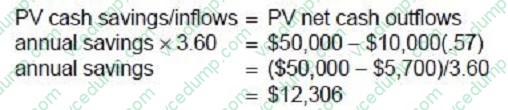
Para Co. is reviewing the following data relating to an energy saving investment proposal:

What would be the annual savings needed to make the investment realize a 12% yield?
A. $8,189
B. $11,111
C. $12,306
D. $13,889 -
Question 437:
A stockholder's right to inspect books and records of a corporation will be properly denied if the stockholder:
A. Wants to use corporate stockholder records for a personal business.
B. Employs an agent to inspect the books and records.
C. Intends to commence a stockholder's derivative suit.
D. Is investigating management misconduct. -
Question 438:
The term underwriting spread refers to the:
A. Commission percentage an investment banker receives for underwriting a security lease.
B. Discount investment bankers receive on securities they purchase from the issuing company.
C. Difference between the price the investment banker pays for a new security issue and the price at which the securities are resold.
D. Commission a broker receives for either buying or selling a security on behalf of an investor. -
Question 439:
For the next 2 years, a lease is estimated to have an operating net cash inflow of $7,500 per annum, before adjusting for $5,000 per annum tax basis lease amortization, and a 40% tax rate. The present value of an ordinary annuity of $1 per year at 10% for 2 years is $1.74. What is the lease's after-tax present value using a 10% discount factor?
A. $2,610
B. $4,350
C. $9,570
D. $11,310 -
Question 440:
Which of the following requirements must be met to have a valid partnership exist?
I. Co-ownership of all property used in a business.
II.
Co-ownership of a business for profit.
A. I only.
B. II only.
C. Both I and II.
D. Neither I nor II.
I. Co-ownership of all property used in a business. II. Co-ownership of a business for profit.

Related Exams:
-
AACD
American Academy of Cosmetic Dentistry -
ACLS
Advanced Cardiac Life Support -
ASSET
ASSET Short Placement Tests Developed by ACT -
ASSET-TEST
ASSET Short Placement Tests Developed by ACT -
BUSINESS-ENVIRONMENT-AND-CONCEPTS
Certified Public Accountant (Business Environment amd Concepts) -
CBEST-SECTION-1
California Basic Educational Skills Test - Math -
CBEST-SECTION-2
California Basic Educational Skills Test - Reading -
CCE-CCC
Certified Cost Consultant / Cost Engineer (AACE International) -
CGFNS
Commission on Graduates of Foreign Nursing Schools -
CLEP-BUSINESS
CLEP Business: Financial Accounting, Business Law, Information Systems & Computer Applications, Management, Marketing
Tips on How to Prepare for the Exams
Nowadays, the certification exams become more and more important and required by more and more enterprises when applying for a job. But how to prepare for the exam effectively? How to prepare for the exam in a short time with less efforts? How to get a ideal result and how to find the most reliable resources? Here on Vcedump.com, you will find all the answers. Vcedump.com provide not only Test Prep exam questions, answers and explanations but also complete assistance on your exam preparation and certification application. If you are confused on your BUSINESS-ENVIRONMENT-AND-CONCEPTS exam preparations and Test Prep certification application, do not hesitate to visit our Vcedump.com to find your solutions here.