BUSINESS-ENVIRONMENT-AND-CONCEPTS Exam Details
-
Exam Code
:BUSINESS-ENVIRONMENT-AND-CONCEPTS -
Exam Name
:Certified Public Accountant (Business Environment amd Concepts) -
Certification
:Test Prep Certifications -
Vendor
:Test Prep -
Total Questions
:530 Q&As -
Last Updated
:May 31, 2026
Test Prep BUSINESS-ENVIRONMENT-AND-CONCEPTS Online Questions & Answers
-
Question 321:
In evaluating a capital budget project, the use of the net present value model is generally not affected by the:
A. Method of funding the project.
B. Initial cost of the project.
C. Amount of added working capital needed for operations during the term of the project.
D. Amount of the project's associated depreciation tax allowance. -
Question 322:
Andrew Corporation is evaluating a capital investment that would result in a $30,000 higher contribution margin benefit and increased annual personnel costs of $20,000. The effects of income taxes on the net present value computation on these benefits and costs for the project are to:
A. Decrease both benefits and costs.
B. Decrease benefits but increase costs.
C. Increase benefits but decrease costs.
D. Increase both benefits and costs. -
Question 323:
In 1992, Anchor, Chain, and Hook created ACH Associates, a general partnership. The partners orally agreed that they would work full time for the partnership and would distribute profits based on their capital contributions. Anchor contributed $5,000; Chain $10,000; and Hook $15,000. For the year ended December 31, 1993, ACH Associates had profits of $60,000 that were distributed to the partners. During 1994, ACH Associates was operating at a loss. In September 1994, the partnership dissolved. In October 1994, Hook contracted in writing with Ace Automobile Co. to purchase a car for the partnership. Hook had previously purchased cars from Ace Automobile Co. for use by ACH Associates partners. ACH Associates did not honor the contract with Ace Automobile Co. and Ace Automobile Co. sued the partnership and the individual partners.
A. Ace Automobile Co. would lose a suit brought against ACH Associates because Hook, as a general partner, has no authority to bind the partnership.
B. Ace Automobile Co. would win a suit brought against ACH Associates because Hook's authority continues during dissolution. -
Question 324:
Economic theory identifies two basic types of goods: inferior goods and superior goods. As consumer income rises, a lower percentage of earnings are expended on inferior goods while a higher percentage of earnings are spent on superior goods. Overall strategies for achieving organizational missions would most likely match with types of goods as follows:
A. Cost leadership strategies for superior goods, differentiation strategies for inferior goods.
B. Cost leadership strategies for inferior goods, differentiation strategies for superior goods.
C. Cost leadership strategies would most likely be used for both inferior and superior goods.
D. Differentiation strategies would most likely be used for both inferior and superior goods. -
Question 325:
Which of the following statements is correct with respect to the differences and similarities between a corporation and a limited partnership?
A. Stockholders may be entitled to vote on corporate matters but limited partners are prohibited from voting on any partnership matters.
B. Stock of a corporation may be subject to the registration requirements of the federal securities laws but limited partnership interests are automatically exempt from those requirements.
C. Directors owe fiduciary duties to the corporation and limited partners owe such duties to the partnership.
D. A corporation and a limited partnership may be created only under a state statute and each must file a copy of its organizational document with the proper governmental body. -
Question 326:
In 1990, Amber Corp., a closely held corporation, was formed by Adams, Frank, and Berg as incorporators and stockholders. Adams, Frank, and Berg executed a written voting agreement which provided that they would vote for each other as
directors and officers. In 1994, stock in the corporation was offered to the public. This resulted in an additional 300 stockholders. After the offering, Adams holds 25%, Frank holds 15%, and Berg holds 15% of all issued and outstanding stock.
Adams, Frank, and Berg have been directors and officers of the corporation since the corporation was formed. Regular meetings of the board of directors and annual stockholders meetings have been held.
For this question refer to the formation of Amber Corp. and the rights and duties of its stockholders, directors, and officers.
A. Adams, Frank, and Berg must be elected as directors because they own 55% of the issued and outstanding stock.
B. Adams, Frank, and Berg must always be elected as officers because they own 55% of the issued and outstanding stock.
C. Adams, Frank, and Berg must always vote for each other as directors because they have a voting agreement. -
Question 327:
Anson Industries, a vertically integrated producer and retailer of high end audio visual equipment has mapped out its overall business process as beginning with product development followed by product testing then raw materials purchasing
then manufacturing and assembly, and, finally, sales and service.
Finance staff at Anson Industries are trying to evaluate the efficiency and the effectiveness of each process and the relationship between each process. This evaluation is often referred to as:
A. Process improvement.
B. Continuous quality improvement.
C. Value chain analysis.
D. Benchmarking. -
Question 328:
The sales manager at Ryan Company feels confident that if the credit policy at Ryan's was changed, sales would increase and, consequently, the company would utilize excess capacity. The two credit proposals being considered are as follows:
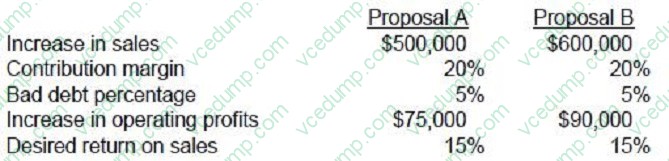
Currently, payment terms are net 30. The proposal payment terms for Proposal A and Proposal B are net 45 and net 90, respectively. An analysis to compare these two proposals for the change in credit policy would include all of the following factors, except the:
A. Cost of funds for Ryan.
B. Current bad debt experience.
C. Impact on the current customer base of extending terms to only certain customers.
D. Bank loan covenants on days sales outstanding. -
Question 329:
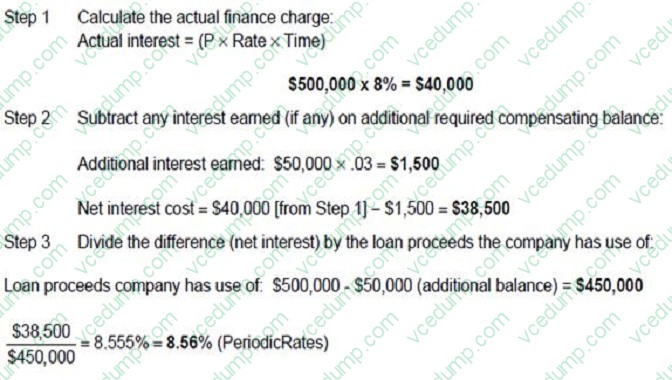
A company obtained a short-term bank loan of $500,000 at an annual interest rate of eight percent. As a condition of the loan, the company is required to maintain a compensating balance of $100,000 in its checking account. The checking account earns interest at an annual rate of three percent. Ordinarily, the company maintains a balance of $50,000 in its account for transaction purposes. What is the effective interest rate of the loan?
A. 7.77 percent.
B. 8.50 percent.
C. 9.44 percent.
D. 8.56 percent. -
Question 330:
The three elements needed to estimate the cost of equity capital for use in determining a firm's weighted average cost of capital are:
A. Current dividends per share, expected growth rate in earnings per share, and current market price per share of common stock.
B. Current earnings per share, expected growth rate in dividends per share, and current market price per share of common stock.
C. Current earnings per share, expected growth rate in earnings per share, and current book value per share of common stock.
D. Current dividends per share, expected growth rate in dividends per share, and current market price per share of common stock.
Related Exams:
-
AACD
American Academy of Cosmetic Dentistry -
ACLS
Advanced Cardiac Life Support -
ASSET
ASSET Short Placement Tests Developed by ACT -
ASSET-TEST
ASSET Short Placement Tests Developed by ACT -
BUSINESS-ENVIRONMENT-AND-CONCEPTS
Certified Public Accountant (Business Environment amd Concepts) -
CBEST-SECTION-1
California Basic Educational Skills Test - Math -
CBEST-SECTION-2
California Basic Educational Skills Test - Reading -
CCE-CCC
Certified Cost Consultant / Cost Engineer (AACE International) -
CGFNS
Commission on Graduates of Foreign Nursing Schools -
CLEP-BUSINESS
CLEP Business: Financial Accounting, Business Law, Information Systems & Computer Applications, Management, Marketing
Tips on How to Prepare for the Exams
Nowadays, the certification exams become more and more important and required by more and more enterprises when applying for a job. But how to prepare for the exam effectively? How to prepare for the exam in a short time with less efforts? How to get a ideal result and how to find the most reliable resources? Here on Vcedump.com, you will find all the answers. Vcedump.com provide not only Test Prep exam questions, answers and explanations but also complete assistance on your exam preparation and certification application. If you are confused on your BUSINESS-ENVIRONMENT-AND-CONCEPTS exam preparations and Test Prep certification application, do not hesitate to visit our Vcedump.com to find your solutions here.