Test Prep BUSINESS-ENVIRONMENT-AND-CONCEPTS Online Practice
Questions and Exam Preparation
BUSINESS-ENVIRONMENT-AND-CONCEPTS Exam Details
Exam Code
:BUSINESS-ENVIRONMENT-AND-CONCEPTS
Exam Name
:Certified Public Accountant (Business Environment amd Concepts)
Certification
:Test Prep Certifications
Vendor
:Test Prep
Total Questions
:530 Q&As
Last Updated
:May 31, 2026
Test Prep BUSINESS-ENVIRONMENT-AND-CONCEPTS Online Questions &
Answers
Question 291:
Harry, Betty, and Jim decide to form a hair salon business. Betty and Jim agree to equally manage the business and have agreed to accept full personal liability for obligations of the business. Harry contributes money to help them get started.
Harry does not want any personal liability but does want access to the books and records and to share in the profits. They have all agreed that unanimous consent is needed to transfer their ownership interests. Assume any necessary filings
have been made.
What type of business entity best reflects the terms of their agreement?
The three have formed:
A. A limited partnership. B. A limited liability company. C. A general partnership. D. A corporation.
A. A limited partnership.
Choice "a" is correct. A limited partnership best reflects the terms of the parties' agreement. A limited partnership has one or more general partners and one or more limited partners. The general partners are personally liable for partnership obligations and run the business (such as Betty and Jim agreed). A limited partner does not have personal liability for partnership obligations and does not take part in management; however, limited partners have a right to inspect partnership books and records relevant to their interest. Thus, a limited partnership has the attributes that Harry agreed to. Finally, all partners must unanimously consent to a transfer of an ownership interest in a limited partnership, as the parties agreed here. Thus, a limited partnership best reflects the agreement of the parties. Choice "b" is incorrect. Members of a limited liability company are not personally liable for the company's debt. (They may agree otherwise, but this is not a general attribute of a limited liability company.) Because the facts say Betty and Jim each agreed to have full personal liability, a limited liability company does not best reflect the parties' agreement. Choice "c" is incorrect. All partners are personally liable for all obligations of a general partnership. Because the facts say Harry did not accept personal liability, the agreement does not reflect a general partnership. Choice "d" is incorrect. Corporate shareholders generally are not liable for the corporation's obligations. (They may agree otherwise, but this is not a basic attribute of a corporation.) As the facts say Betty and Jim share full personal liability, the agreement does not reflect a corporation.
Question 292:
The optimal level of inventory would be affected by all of the following, except the:
A. Cost per unit of inventory. B. Current level of inventory. C. Cost of placing an order for merchandise. D. Lead time to receive merchandise ordered.
B. Current level of inventory.
Choice "b" is correct. The current level of inventory has no impact on the optimal level of inventory. Choices "a", "c", and "d" are incorrect. The optimal level of inventory is affected by:
1.
The inventory usage rate.
2.
The cost per unit of inventory - which will have a direct impact on inventory carrying costs.
3.
The cost of placing on order impacts order frequency, which affects order size and optimal inventory levels.
Question 293:
Hagar Company's bank requires a compensating balance of 20 percent on a $100,000 loan. If the stated interest on the loan is 7 percent, what is the effective cost of the loan?
A. 7.00 percent. B. 8.18 percent. C. 8.40 percent. D. 8.75 percent.
D. 8.75 percent.
Choice "d" is correct. Total interest for the loan is $100,000 ?7% or $7,000. The effective amount received is $80,000 after the 20% compensating balance. The effective interest is $7,000 / $80,000 = 8.75% Choices "a", "b", and "c" are incorrect, per the above calculation.
Question 294:
The Moore Corporation is considering the acquisition of a new machine. The machine can be purchased for $90,000; it will cost $6,000 to transport to Moore's plant and $9,000 to install. It is estimated that the machine will last 10 years, and it is expected to have an estimated salvage value of $5,000. Over its 10-year life, the machine is expected to produce 2,000 units per year with a selling price of $500 and combined material and labor costs of $450 per unit. Federal tax regulations permit machines of this type to be depreciated using the straight-line method over 5 years with no estimated salvage value. Moore has a marginal tax rate of 40 percent.
What is the net cash flow for the third year that Moore Corporation should use in a capital budgeting analysis?
A. $68,400 B. $64,200 C. $53,700 D. $47,400
A. $68,400
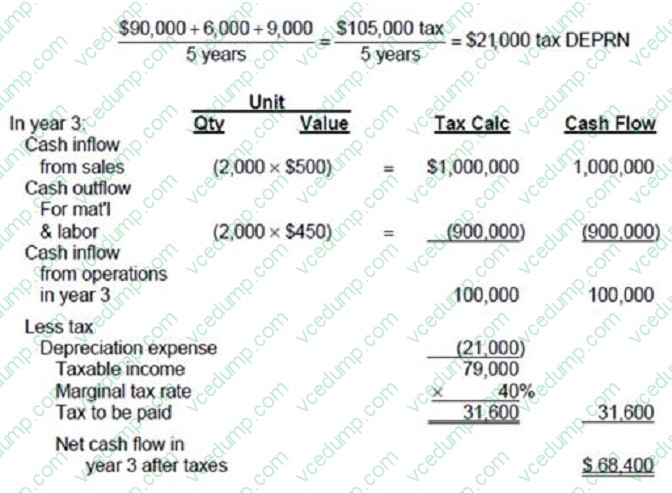
Choice "a" is correct. $68,400 net cash flow for the third year.
Alternate Computation:
In year 3, Moore will generate a $100,000 profit from the incremental sales (2000 units ?($500 - $450)). This profit will be taxed at 40%, so the net after-tax increase in cash flow is $60,000 BEFORE the depreciation tax shield is considered. Depreciation is not a cash outflow, but it will reduce the amount of tax the company has to pay (by 40% of the depreciation), and this has an effect on the cash-flow for the company. Depreciation, as calculated above, is $21,000 per year ($105,000 cost of the machine divided by 5 years). The depreciation tax shield is $8,400 ($21,000 ?40%), so the total after-tax cash flows in year 3 for the new machine is $60,000 + $8,400 = $68,400.
Question 295:
Smith was an officer of CCC Corp. As an officer, the business judgment rule applies to Smith in which of the following ways?
A. Because Smith is not a director, the rule does not apply. B. If Smith makes, in good faith, a serious but honest mistake in judgment, Smith is generally not liable to CCC for damages caused. C. If Smith makes, in good faith, a serious but honest mistake in judgment, Smith is generally liable to CCC for damages caused, but CCC may elect to reimburse Smith for any damages Smith paid. D. If Smith makes, in good faith, a serious but honest mistake in judgment, Smith is generally liable to CCC for damages caused, and CCC is prohibited from reimbursing Smith for any damages Smith paid.
B. If Smith makes, in good faith, a serious but honest mistake in judgment, Smith is generally not liable to CCC for damages caused.
Choice "b" is correct. The business judgment rule applies to officers as well as directors, who in their capacity, act in a manner the officer believes to be in the best interest of the corporation, and with the care an ordinarily prudent person in a
like position would exercise. If the standards of the business judgment rule are met, the officer is not liable to the company for resulting damages.
Choices "a", "c", and "d" are incorrect, per the above rule.
Question 296:
If a nation has many rival domestic firms which are all competitive in the global marketplace for a product, which of the four major factors that Michael Porter has indicated impact the global competitive environment would allow this nation to fare better with respect to global competitive advantage?
A. Conditions of the factors of production. B. Conditions of domestic demand. C. Related and supporting industries. D. Firm strategy, structure, and rivalry.
C. Related and supporting industries.
Choice "c" is correct. The factor of related and supporting industries deals with whether there are suppliers of material inputs that exist within a nation or whether there are rival firms who are competitive in the international environment, both of which would increase the nation's competitive advantage. Choice "a" is incorrect. If a nation has a strong set of factors of production (such as low-cost, high quality raw material inputs), that are required in a given industry, it will fare better with regard to competitive advantage. However, this factor is different from the "many rival domestic firms which are all competitive in the global marketplace for a product" as stated in the question. Choice "b" is incorrect. The factor of conditions of domestic demand related to the nation's domestic demand for the product, which is directly related to the ability of the nation to fare better with regard to competitive advantage. However, this factor is different from the "many rival domestic firms which are all competitive in the global marketplace for a product" as stated in the question. Choice "d" is incorrect. The factor of firm strategy, structure, and rivalry relates to the practices of a nation with respect to how the companies are managed and organized, along with the laws of the nation that regulate the formation of the companies, and how intense the rivalry is with respect to competing firms in the nation. However, this factor is different from the "many rival domestic firms which are all competitive in the global marketplace for a product" as stated in the question.
Question 297:
In markets that are imperfectly competitive, such as monopoly and monopolistic competition, firms produce at an output where:
A. Price equals marginal cost. B. Average costs are minimized. C. Price equals average cost. D. Marginal cost equals marginal revenue.
D. Marginal cost equals marginal revenue.
Choice "d" is correct. Firms produce up to the point where marginal cost equals marginal revenue, whether the markets are perfectly competitive or imperfectly competitive. Choice "a" is incorrect. Very close, but it's actual marginal revenue, not price. It is assumed that revenue is not fixed on a unit basis. Choice "b" is incorrect. Beyond the point of average costs being minimized, marginal cost will rise. Still, it will make sense to increase production until marginal cost equals marginal revenue. Choice "c" is incorrect. Marginal revenue, not price, as revenue is assumed to vary on a per unit basis, and not average cost, since it will increase profits to expand production until marginal revenue equals marginal cost.
Question 298:
An increase in the market supply of beef would result in a(n):
A. Decrease in the quantity of beef demanded. B. Increase in the price of beef. C. Decrease in the demand for beef. D. Increase in the quantity of beef demanded.
D. Increase in the quantity of beef demanded.
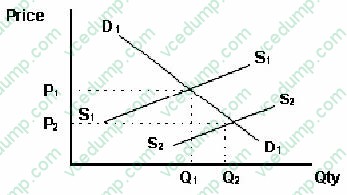
Choice "d" is correct. As illustrated above, a shift outward (increase) in supply, increases quantity demanded (Q2) at equilibrium, accompanied by a decline in price. Thus, an increase in the market supply of beef would result in an increase in
the quantity of beef demanded.
Choices "a" and "b" are incorrect, as seen in the graph above. There is an increase in the quantity of beef demanded and a decrease in the price of beef. Choice "c" is incorrect, because there is no information in the question pertaining to any
"shift" in the beef demand curve or in the demand for any complimentary products (e.g., pork).
Question 299:
Which of the following represents a firm's average gross receivable balance?
I. Days' sales in receivables x accounts receivable turnover.
II. Average daily sales x average collection period.
III.
Net sales ÷ average gross receivables.
A. I only. B. I and II only. C. II only. D. II and III only. I. Days' sales in receivables x accounts receivable turnover. II. Average daily sales x average collection period. III. Net sales ÷ average gross receivables.
C. II only.
Choice "c" is correct. II only - Average daily sales ($27,397) ?Average collection period (36.5) = $1,000,000 Avg gross A/R
Not I - Days' sales in receivables (36.5) ?AR turnover 10 = 365 days in year.
Not III - Net sales ($10,000,000) ?Avg gross receivables ($1,000,000) = 10 AR turnover.
Question 300:
A partnership agreement must be in writing if:
A. Any partner contributes more than $500 in capital. B. The partners reside in different states. C. The partnership intends to own real estate. D. The partnership's purpose cannot be completed within one year of formation.
D. The partnership's purpose cannot be completed within one year of formation.
Choice "d" is correct. Under the statute of frauds, a partnership agreement must be in writing if by its terms the agreement cannot be completed within one year. Choice "a" is incorrect. No such rule. Although the statute of frauds requires a
contract for the sale of goods for $500 or more to be evidenced by a writing, a writing is not required to contribute more than $500 in capital to a partnership.
Choice "b" is incorrect. No such rule, a far out distracter.
Choice "c" is incorrect. While a contract to buy or sell real estate will require a writing, a partnership agreement to own/buy real estate need not be in writing.
Nowadays, the certification exams become more and more important and required by more and more
enterprises when applying for a job. But how to prepare for the exam effectively? How to prepare
for the exam in a short time with less efforts? How to get a ideal result and how to find the
most reliable resources? Here on Vcedump.com, you will find all the answers.
Vcedump.com provide not only Test Prep exam questions,
answers and explanations but also complete assistance on your exam preparation and certification
application. If you are confused on your BUSINESS-ENVIRONMENT-AND-CONCEPTS exam preparations
and Test Prep certification application, do not hesitate to visit our
Vcedump.com to find your solutions here.