830-01 Exam Details
-
Exam Code
:830-01 -
Exam Name
:RCPE Certified Professional WAN Optimization -
Certification
:Riverbed Certifications -
Vendor
:Riverbed -
Total Questions
:402 Q&As -
Last Updated
:May 30, 2026
Riverbed 830-01 Online Questions & Answers
-
Question 121:
Once a SteelHead is registered for Cloud (SaaS) optimization it contacts the Cloud portal every 5 minutes to receive the latest information about the service. What would happen if a Firewall change stops the HTTPS communication with the Portal?
A. The Cloud optimization stops working after 5 minutes
B. The Cloud optimization continues to work with the last information received from the Portal
C. The SteelHead will try HTTP (port 80) to contact the Portal once it sees no response using 443
D. The Cloud optimization Service cannot redirect traffic because DNS resolution is performed through Primary interface -
Question 122:
In a serial cluster deployment of Interceptor appliances, which interfaces are connected from one Interceptor appliance to another Interceptor appliance assuming they are connected back to back?
A. LAN0_0 to LAN0_1
B. WAN0_0 to WAN0_0
C. WAN0_0 to LAN0_0
D. LAN0_0 to LAN0_0 -
Question 123:
What is the default authorization policy used by Steelhead appliances?
A. Remote-Last
B. Local-Only
C. Local-First
D. Remote-Only
E. Remote-First -
Question 124:
Refer to the HTTP trace exhibit.
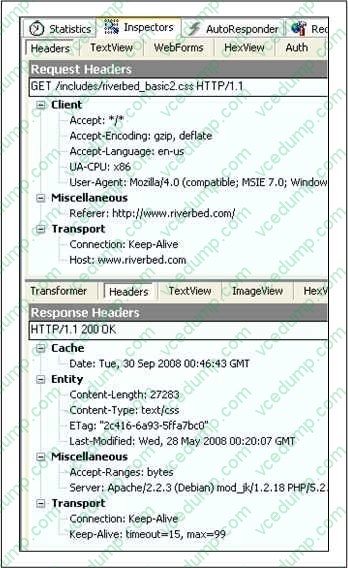
You noticed in the HTTP reports that you are not seeing any hits. What is required in order for HTTP optimization to work?
A. Client request is missing the "Cache" header
B. Keep-alive timeout on the server it too short
C. Server does not support HTTP 1.1 extensions
D. The "Content-Length" is too long. The HTTP blade can only handle 16K of data.
E. Server is not setting a cookie -
Question 125:
You are configuring HighSpeed TCP in an environment with an OC-3 (155Mb/s) and 60 milliseconds of round-trip latency. You know that the rule of thumb is to set the Steelhead appliance's WAN Default Send Buffer Size and WAN Default Receive Buffer Size to 2*BDP for the link. The buffer size setting for this link would be closest to: (Hint: Use the calculator)
A. 4,665,000 bytes
B. 9,330,000 bytes
C. 3,110 bytes
D. 6,220 bytes
E. 2,325,000 bytes -
Question 126:
Which of the following are examples of Networking policies on the CMC appliance? (Select 3)
A. WCCP
B. HighSpeed TCP
C. Routing
D. Port Labels
E. HTTP Protocol -
Question 127:
Which of the following methods can be used to reduce the load on a router configured to use outbound interface WCCP redirection? (Select 3)
A. Using inbound interface redirection instead
B. Use fixed-target rules and remove WCCP on the WAN facing interfaces
C. Use Redirect lists to control what traffic gets redirected
D. Use the router command "load interval 30" to restrict WCCP to use 30% of the CPU
E. Use Event Element Manager (EEM) to load balance between a clustered Steelhead appliance deployment -
Question 128:
You are troubleshooting a TCP connection that is not being optimized. On the Current Connections report, you expand the connection and see the pass-through reason is `Pre-existing connection'. Without restarting the oprimization service, how could you get this connection to optimize?
A. Reset the connection in the Current Connections report.
B. Create a full-transparency in-path rule for the source and destination hosts.
C. Create a fixed-target in-path rule for the source and destination hosts.
D. Enable auto-kick-off on the default in-path rule.
E. Enable Simplified Routing in `all' mode. -
Question 129:
Given four Steelheads are deployed in a WCCP cluster and all Steelheads are optimizing traffic to and from the data center. Steelhead-A fails and only Steelhead-B and Steelhead-C are intercepting new connections while Steelhead-D is NOT optimizing any traffic. What is the likely problem?
A. The load balancing algorithm on the router is broken
B. Simplified routing is not enabled
C. Steelhead-B and Steelhead-C are missing the "in-path neighbor continue-intercept" command
D. Steelhead-D is missing the "in-path neighbor allow-failure" command
E. Need to issue the command "in-path accept connections" on Steelhead-D -
Question 130:
The primary data center Interceptor is configured to fail-to-block. What best describes the result of stopping the Interceptor appliance service?
A. All traffic passes through the Interceptor appliance
B. The Interceptor allows UDP traffic to pass-through, but blocks all TCP traffic
C. Previously optimized connections continue to be redirected, but new TCP connections are passed through
D. All traffic through the Interceptor will be blocked
E. The Interceptor appliance communicates to the Steelhead appliances to disable their optimization service
Related Exams:
-
101-01
Riverbed Certified Solutions Associate -
201-01
Riverbed Certified Solutions Associate - Network Performance Management -
299-01
Riverbed Certified Solutions Professional - Network Performance Management -
499-01
Riverbed Certified Solutions Professional - Application Performance Management -
501-01
Riverbed Certified Solutions Associate - Hyper-converged Branch -
599-01
Riverbed Certified Solutions Professional - Storage Delivery Exam -
810-01
RCPE Certified Professional Network & Infrastructure Visibility -
830-01
RCPE Certified Professional WAN Optimization
Tips on How to Prepare for the Exams
Nowadays, the certification exams become more and more important and required by more and more enterprises when applying for a job. But how to prepare for the exam effectively? How to prepare for the exam in a short time with less efforts? How to get a ideal result and how to find the most reliable resources? Here on Vcedump.com, you will find all the answers. Vcedump.com provide not only Riverbed exam questions, answers and explanations but also complete assistance on your exam preparation and certification application. If you are confused on your 830-01 exam preparations and Riverbed certification application, do not hesitate to visit our Vcedump.com to find your solutions here.