70-741 Exam Details
-
Exam Code
:70-741 -
Exam Name
:Networking with Windows Server 2016 -
Certification
:Microsoft Certifications -
Vendor
:Microsoft -
Total Questions
:299 Q&As -
Last Updated
:Feb 08, 2022
Microsoft 70-741 Online Questions & Answers
-
Question 251:
Note: This question is part of a series of questions that present the same scenario. Each question in the series contains a unique solution that might meet the stated goals. Some question sets might have more than one
correct solution, while others might not have a correct solution.
After you answer a question in this section, you will NOT be able to return to it. As a result, these questions will not appear in the review screen.
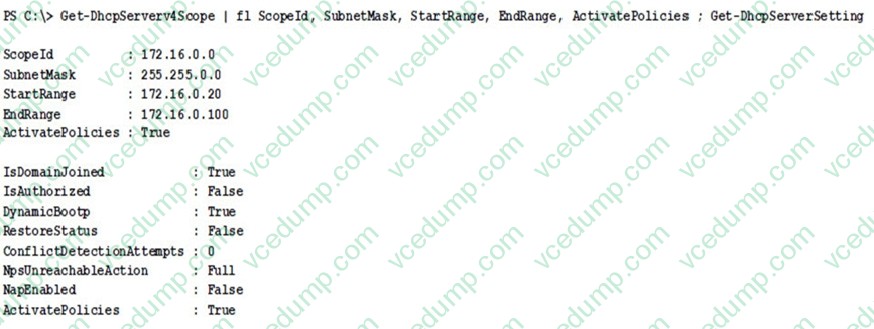
Your network contains an Active Directory domain named adatum.com. The domain contains two DHCP servers named Server1 and Server2. Server1 has the following IP configuration.
Server2 has the following IP configuration.
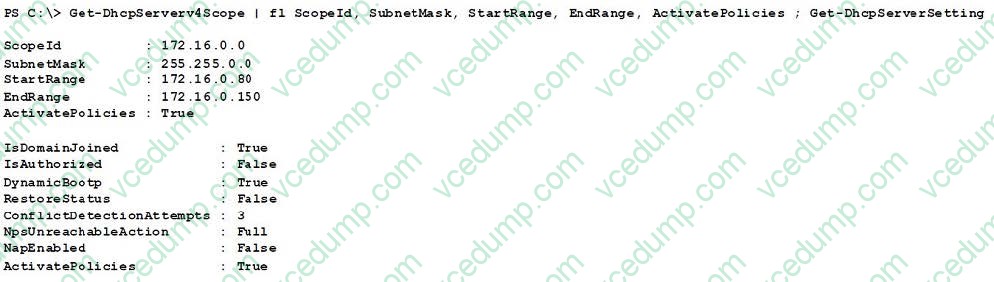
Some users report that sometimes they cannot access the network because of conflicting IP addresses.
You need to configure DHCP to avoid leasing addresses that are in use already.
Solution: On Server1, you modify the ActivatePolicies setting of the scope.
Does this meet the goal?
A. Yes
B. No -
Question 252:
HOTSPOT
You have a DirectAccess server that is accessible by using the name directaccess.fabrikam.com.
On the DirectAccess server, you install a new server certificate that has a subject name of directaccess.contoso.com, and then you configure DNS records for directaccess.contoso.com.
You need to change the endpoint name for DirectAccess to directaccess.contoso.com.
What command should you run? To answer, select the appropriate options in the answer area.
Hot Area:

-
Question 253:
Note: This question is part of a series of questions that present the same scenario. Each question in the series contains a unique solution. Determine whether the solution meets the stated goals.
Your network contains an Active Directory domain named contoso.com. The domain contains a DNS server named Server1. All client computers run Windows 10.
On Server1, you have the following zone configuration.

You have the following subnets defined on Server1.
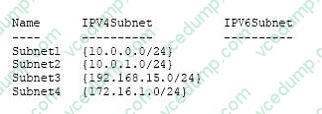
You need to prevent Server1 from resolving queries from DNS clients located on Subnet4. Server1 must resolve queries from all other DNS clients.
Solution: From Windows Firewall with Advanced Security on Server1, you create an inbound rule.
Does this meet the goal?
A. Yes
B. No -
Question 254:
Your network contains an Active Directory domain named contoso.com. The domain contains a Hyper-V host.
You are deploying Software Defined Network (SDN) by using Windows Server 2016.
You deploy a virtual machine that runs Windows Server 2016, and you install the Network Controller server role.
You need to configure the virtual machine as the network controller.
What should you do?
A. Run the Install-NetworkControllerCluster cmdlet and set ClientAuthentication to X509.
B. Run the Install-NetworkController cmdlet and set ClientAuthentication to None.
C. Run the Install-NetworkControllerCluster cmdlet and set ClientAuthentication to None.
D. Run the Install-NetworkController cmdlet and set ClientAuthentication to Kerberos. -
Question 255:
Note: This question is part of a series of questions that present the same scenario. Each question in the series contains a unique solution that might meet the stated goals. Some question sets might have more than one correct solution, while
others might not have a correct solution.
After you answer a question in this section, you will NOT be able to return to it. As a result, these questions will not appear in the review screen.
Your network contains an Active Directory domain named contoso.com. The domain contains a DHCP server named Server1. All client computers run Windows 10 and are configured as DHCP clients.
Your helpdesk received calls today from users who failed to access the network from their Windows 10 computer.
You open the DHCP console as shown in the exhibit. (Click the Exhibit button.)
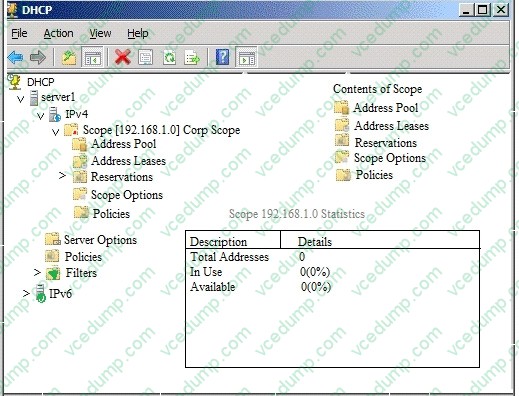
You need to ensure that all of the Windows 10 computers can receive a DHCP lease.
Solution: You start the DHCP Server service.
Does this meet the goal?
A. Yes
B. No -
Question 256:
Note: This question is part of a series of questions that present the same scenario. Each question in the series contains a unique solution that might meet the stated goals. Some question sets might have more than one correct solution, while
others might not have a correct solution.
After you answer a question in this sections, you will NOT be able to return to it. As a result, these questions will not appear in the review screen.
You network contains an Active Directory domain named contoso.com. The domain contains a member server named Server1 that runs Windows Server 2016 and has the DNS Server role installed. Automatic scavenging of state records is
enabled and the scavenging period is set to 10 days.
All client computers dynamically register their names in the contoso.com DNS zone on Server1.
You discover that the names of multiple client computers that were removed from the network several weeks ago can still be resolved.
You need to configure Server1 to automatically remove the records of the client computers that have been offline for more than 10 days.
Solution: You run the dnscmd.exe command and specify the /AgeAllRecords parameter for the zone.
Does this meet the goal?
A. Yes
B. No -
Question 257:
With client reservations, you can reserve an IP address for permanent use by a DHCP client. Typically, you will need to do this if the client uses an IP address that was assigned using another method for TCP/IP configuration.
If you are reserving an IP address for a new client, or an address that is different from its current one, you should verify that the address has not already been leased by the DHCP server. Reserving an IP address in a scope does not
automatically force a client currently using that address to stop using it.
Which ipconfig command would you use if the address is already in use?
A. ipconfig /flushdns
B. ipconfig /release
C. ipconfig /registerdns
D. ipconfig /renew -
Question 258:
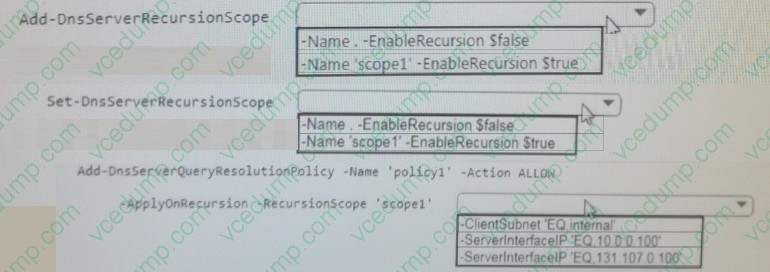
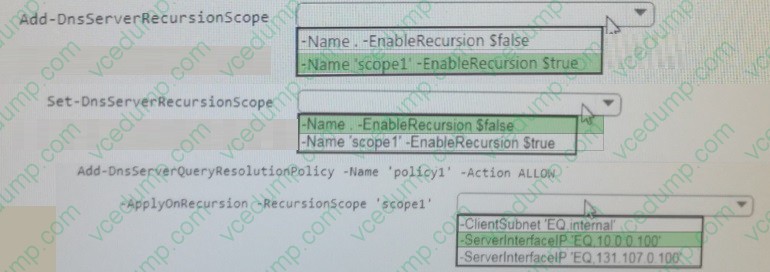
Server1 provides DNS name resolution to both internal and external clients. Server1 hosts the primary zone for contoso.com. You need to configure Server1 to meet the following requirements:
* Internal clients must be able to use Server 1 to resolve internal-based DNS names.
* External clients must not be able to use Server1 to resolve Internal-based DNS names.
* External clients must able to use Server1 to resolve names in the contoso.com zone. Which commands should you run on Server1.? To answer select the appropriate option in answer area.
Hot Area:
-
Question 259:
You are implementing a new network. The network contains a DHCP server named DHCP1 that runs Windows Server 2016. DHCP1 contains a scope named Scope1 for the 192.168.0/24 subnet. Your company has the following policy for allocating IP addresses:
1.
All server addresses must be excluded from DHCP scopes
2.
All client computers must receive IP addresses from Scope1
3.
All Windows servers must have IP addresses in the range of 192.168.0.200 to 192.168.0.240
4.
All other network devices must have IP addresses in the range of 192.168.0.180 to 192.168.0.199
You deploy a print device named Print1.
You need to ensure that Print1 adheres to the policy for allocating IP addresses.
Which command should you use?
A. Add-DhcpServerv4Lease
B. Add-DhcpServerv4ExclusionRange
C. Add-DhcpServerv4Filter
D. Add-DhcpServerv4Reservation -
Question 260:
Note: This question is part of a series of questions that present the same scenario. Each question in the series contains a unique solution. Determine whether the solution meets the stated goals.
Your network contains an Active Directory domain named contoso.com. The domain contains a DNS server named Server1. All client computers run Windows 10.
On Server1, you have the following zone configuration.
You have the following subnets defined on Server1.
You need to prevent Server1 from resolving queries from DNS clients located on Subnet4. Server1 must resolve queries from all other DNS clients.
Solution: From the Security Setting of each zone on Server1, you modify the permissions.
Does this meet the goal?
A. Yes
B. No

Related Exams:
-
62-193
Technology Literacy for Educators -
70-243
Administering and Deploying System Center 2012 Configuration Manager -
70-355
Universal Windows Platform – App Data, Services, and Coding Patterns -
77-420
Excel 2013 -
77-427
Excel 2013 Expert Part One -
77-725
Word 2016 Core Document Creation, Collaboration and Communication -
77-726
Word 2016 Expert Creating Documents for Effective Communication -
77-727
Excel 2016 Core Data Analysis, Manipulation, and Presentation -
77-728
Excel 2016 Expert: Interpreting Data for Insights -
77-731
Outlook 2016 Core Communication, Collaboration and Email Skills
Tips on How to Prepare for the Exams
Nowadays, the certification exams become more and more important and required by more and more enterprises when applying for a job. But how to prepare for the exam effectively? How to prepare for the exam in a short time with less efforts? How to get a ideal result and how to find the most reliable resources? Here on Vcedump.com, you will find all the answers. Vcedump.com provide not only Microsoft exam questions, answers and explanations but also complete assistance on your exam preparation and certification application. If you are confused on your 70-741 exam preparations and Microsoft certification application, do not hesitate to visit our Vcedump.com to find your solutions here.