70-741 Exam Details
-
Exam Code
:70-741 -
Exam Name
:Networking with Windows Server 2016 -
Certification
:Microsoft Certifications -
Vendor
:Microsoft -
Total Questions
:299 Q&As -
Last Updated
:Feb 08, 2022
Microsoft 70-741 Online Questions & Answers
-
Question 211:
Note: This question is part of a series of questions that present the same scenario. Each question in the series contains a unique solution that might meet the stated goals. Some question sets might have more than one correct solution, while
others might not have a correct solution.
After you answer a question in this section, you will NOT be able to return to it. As a result, these questions will not appear in the review screen. You have a Hyper-V host named Server 1. The network adapters on Server1 have single root I/O
virtualization (SR-IOV) enabled.
Server1 hosts a virtual machine named VM1 that runs Windows Server 2016.
You need to identify whether SR-IOV is used by VM1.
Solution: On Server1, you open Hyper-V Manager and view the Integration Services settings of VM1.
Does this meet the goal?
A. Yes
B. No -
Question 212:
HOTSPOT
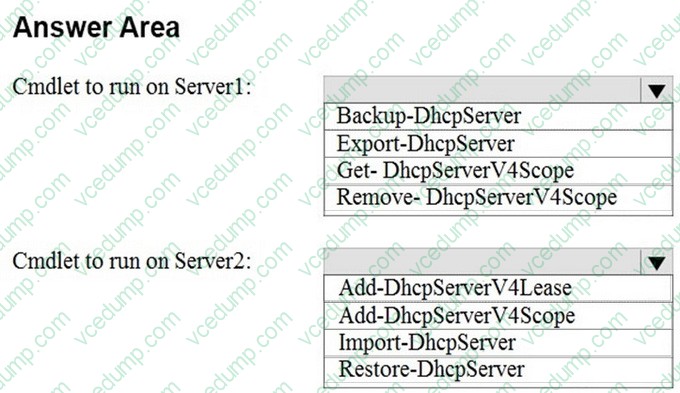
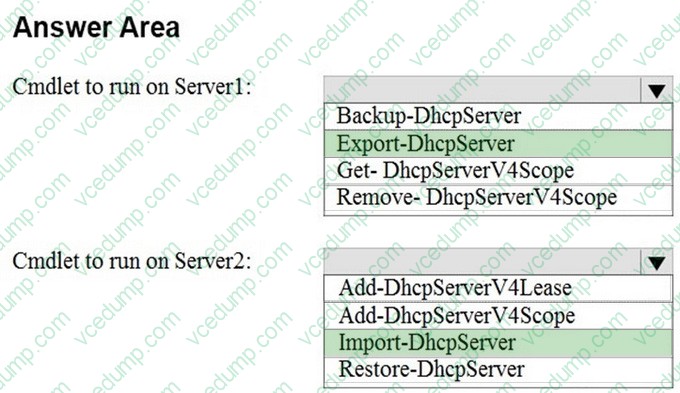
You have a DHCP server named Server1 that runs Windows Server 2012 R2. Server1 has 10 DHCP scopes.
You need to migrate only one scope to a new DHCP server named Server2 that runs Windows Server 2016. The solution must migrate the active leases from the scope.
Which cmdlets should you run? To answer, select the appropriate options in the answer area.
NOTE: Each selection is worth one point.
Hot Area:
-
Question 213:
Note: This question is part of a series of questions that use the same scenario. For your convenience, the scenario is repeated in each question. Each question presents a different goal and answer choices, but the text of the scenario is exactly the same in each question in this series.

Your network contains an Active Directory domain named contoso.com. The functional level of the domain is Windows Server 2012.
The network uses an address space of 192.168.0.0/16 and contains multiple subnets.
The network is not connected to the Internet.
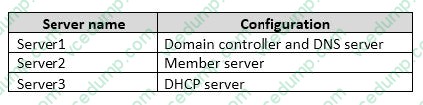
The domain contains three servers configured as shown in the following table. Client computers obtain TCP/IP settings from Server3.
You add a second network adapter to Server2. You connect the new network adapter to the Internet. You install the Routing role service on Server2.
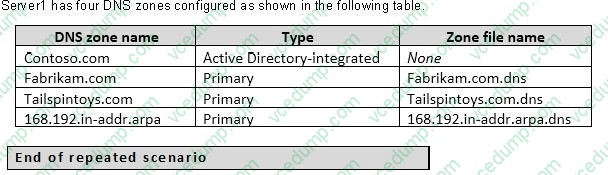
Server1 has four DNS zones configured as shown in the following table.
What should you do to enable Server2 as a NAT server?
A. From Routing and Remote Access, add an interface.
B. From Windows PowerShell, run the New-RoutingGroupConnector cmdlet.
C. From Routing and Remote Access, add a routing protocol.
D. From Windows PowerShell, run the Install-WindowsFeature cmdlet. -
Question 214:
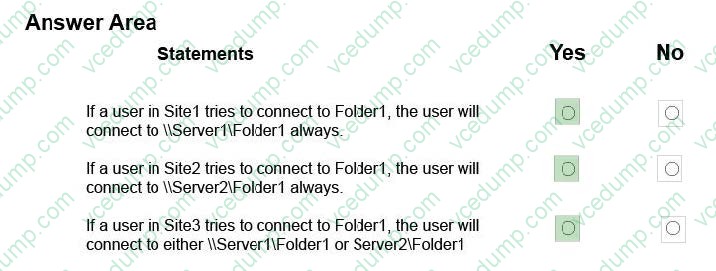
Your network contains an Active Directory domain named contoso.com. The domain contains a domain-based Distributed File System (DFS) namespace named Namespace1. Namespace1 has the following configuration.
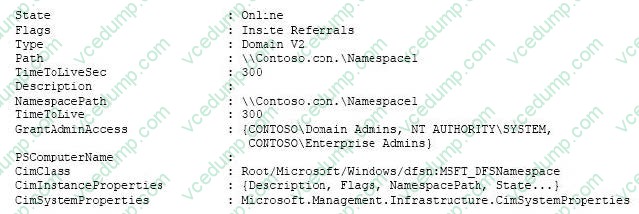
Namespace1 has a folder named Folder1.
Folder1 has the targets shown in the following table.
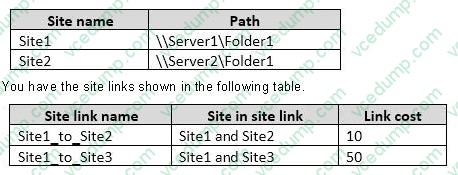
You have the site links shown in the following table.
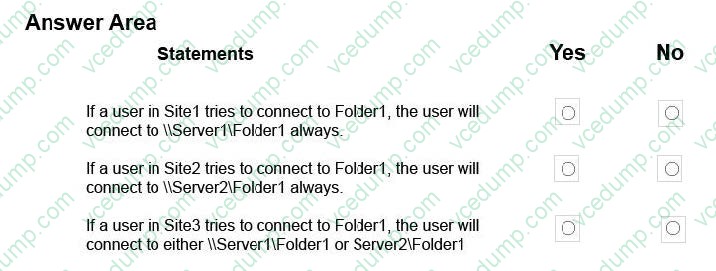
For each of the following statements, select Yes if the statement is true. Otherwise, select No.
Hot Area:
-
Question 215:
Your network contains an Active Directory domain. The domain contains two domain controllers named DO and DC2. DC! and DC2 host an Active Directory-integrated DNS zone named contoso.com
You have two DNS Client Subnets named Subnet1 and Subnet2.
You plan to create two DNS records for www.contoso.com. One record will point to 10.1.23, and the other record will point to 172.23.6.5.
You need to ensure that www.contoso.com resolves to:
•
10.1.2.3 from Subnet1
A. one DNS query resolution policy, two DNS zone delegations, and the DNS records
B. one DNS query resolution policy, two DNS zone delegations, and the DNS records
C. one DNS recursion policy, two DNS zone delegations, and the DNS records
D. one DNS zone scope, two DNS query resolution policies, and the DNS records -
Question 216:
Note: This question is part of a series of questions that present the same scenario. Each question in the series contains a unique solution that might meet the stated goals. Some question sets might have more than one
correct solution, while others might not have a correct solution.
After you answer a question in this section, you will NOT be able to return to it. As a result, these questions will not appear in the review screen.
You have a Hyper-V host named Server1. Server1 connects to your corporate network. Server1 has the virtual switches configured as shown in the following table.
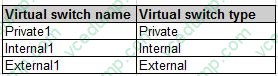
Server1 has two virtual machines named VM1 and VM2 that run Windows Server 2016. VM1 connects to Private1. VM2 has two network adapters.
You need to ensure that VM1 connects to the corporate network by using NAT.
Solution: You connect VM2 to Private1 and External1. You run the New-NetNatIpAddress and the New-NetNat cmdlets on VM2. You configure VM1 to use VM2 as the default gateway.
Does this meet the goal?
A. Yes
B. No -
Question 217:
Note: This question is part of a series of questions that present the same scenario. Each question in the series contains a unique solution that might meet the stated goals. Some question sets might have more than one
correct solution, while others might not have a correct solution.
After you answer a question in this section, you will NOT be able to return to it. As a result, these questions will not appear in the review screen.
You have a Hyper-V host named Server 1. Server1 connects to your corporate network. Server1 has the virtual switches configured as shown in the following table.
Server1 has two virtual machines named VM1 and VM2 that run Windows Server 2016. VM1 connects to Private1. VM2 has two network adapters.
You need to ensure that VM1 connects to the corporate network by using NAT.
Solution: You connect VM2 to Private1 and External1. You install the Remote Access server on VM2, and you configure NAT in the Routing and Remote Access console. You configure VM1 to use VM2 as the default gateway.
Does this meet the goal?
A. Yes
B. No -
Question 218:
You have a server named Server1 that runs Windows Server 2016.
Server1 has two network cards. One network card connects to your internal network and the other network card connects to the Internet.
You plan to use Server1 to provide Internet connectivity for client computers on the internal network.
You need to configure Server1 as a network address translation (NAT) server.
Which server role or role service should you install on Server1 first?
A. Network Controller
B. Web Application Proxy
C. Routing
D. DirectAccess and VPN (RAS) -
Question 219:
Because the network ID bits must always be chosen in a contiguous fashion from the high order bits, a shorthand way of expressing a subnet mask is to denote the number of bits that define the network ID as a network prefix using the
network prefix notation: /<# of bits>.
What is the Network Prefix for Class B?
A. /8
B. /64
C. /24
D. /16 -
Question 220:
HOTSPOT
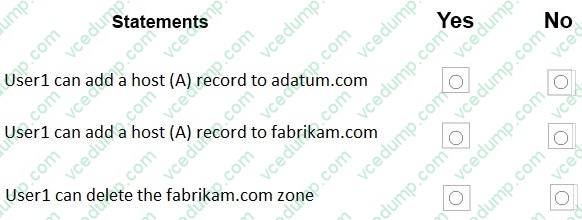
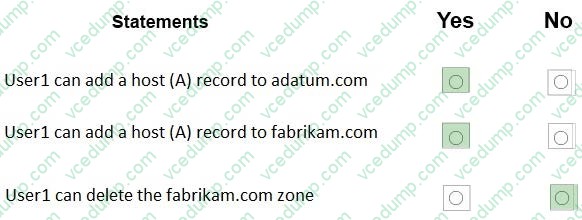
Your network contains an Active Directory domain named contoso.com. The domain contains a domain controller named Server1 and a member server named Server2.
Server1 has the DNS Server role installed. Server2 has IP Address Management (IPAM) installed. The IPAM server retrieves zones from Server1 as shown in the following table.

The IPAM server has one access policy configured as shown in the exhibit. (Click the Exhibit tab.)
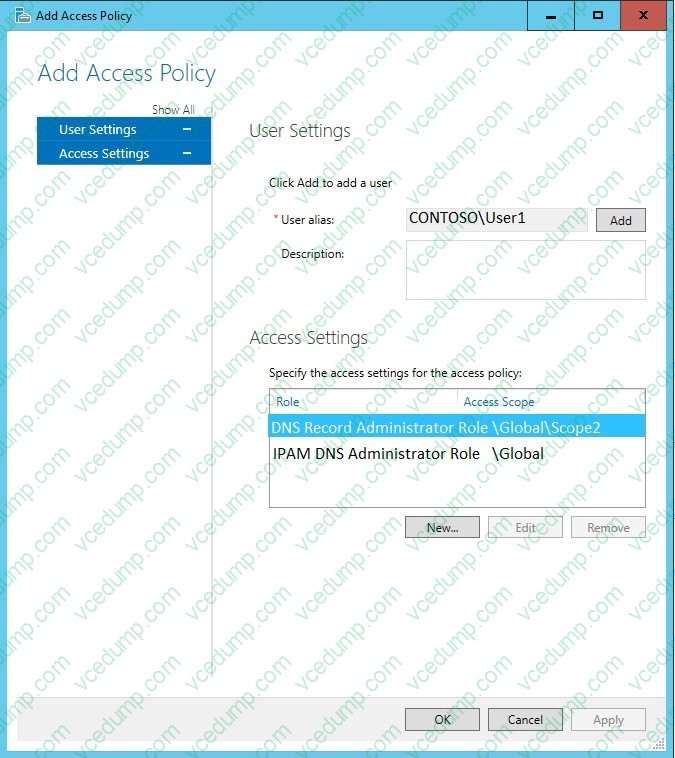
For each of the following statements, select Yes if the statement is true. Otherwise, select No.
Hot Area:
Related Exams:
-
62-193
Technology Literacy for Educators -
70-243
Administering and Deploying System Center 2012 Configuration Manager -
70-355
Universal Windows Platform – App Data, Services, and Coding Patterns -
77-420
Excel 2013 -
77-427
Excel 2013 Expert Part One -
77-725
Word 2016 Core Document Creation, Collaboration and Communication -
77-726
Word 2016 Expert Creating Documents for Effective Communication -
77-727
Excel 2016 Core Data Analysis, Manipulation, and Presentation -
77-728
Excel 2016 Expert: Interpreting Data for Insights -
77-731
Outlook 2016 Core Communication, Collaboration and Email Skills
Tips on How to Prepare for the Exams
Nowadays, the certification exams become more and more important and required by more and more enterprises when applying for a job. But how to prepare for the exam effectively? How to prepare for the exam in a short time with less efforts? How to get a ideal result and how to find the most reliable resources? Here on Vcedump.com, you will find all the answers. Vcedump.com provide not only Microsoft exam questions, answers and explanations but also complete assistance on your exam preparation and certification application. If you are confused on your 70-741 exam preparations and Microsoft certification application, do not hesitate to visit our Vcedump.com to find your solutions here.