70-462 Exam Details
-
Exam Code
:70-462 -
Exam Name
:Administering Microsoft SQL Server 2012/2014 Databases -
Certification
:Microsoft Certifications -
Vendor
:Microsoft -
Total Questions
:324 Q&As -
Last Updated
:Feb 06, 2022
Microsoft 70-462 Online Questions & Answers
-
Question 201:
You administer a Microsoft SQL Server database named Orders.
Users report that during peak usage periods, certain operations are taking more time than expected. Your initial analysis suggests that blocking is the cause.
You need to gather more data to be able to determine which processes are being blocked and to identify the root cause.
What should you do?
A. Schedule a SQL Agent job to run every 60 seconds and insert the results of executing the sys.dm_os_wait_stats DMV into a table.
B. Use System Monitor to catch the Lock Waits/sec event.
C. Use sp_configure to set the blocked process threshold. Start a trace using SQL Server Profiler to catch the Blocked Process Report event.
D. Start a Trace using SQL Server Profiler to catch the Lock: Deadlock event. -
Question 202:
You administer a Microsoft SQL Server database.
You create an availability group named haContosoDbs. Your primary replica is available at Server01\Contoso01.
You need to configure the availability group to prevent data loss. In the event of a database failure, the designed secondary database must come online automatically.
Which Transact-SQL statement should you use?
A. Option A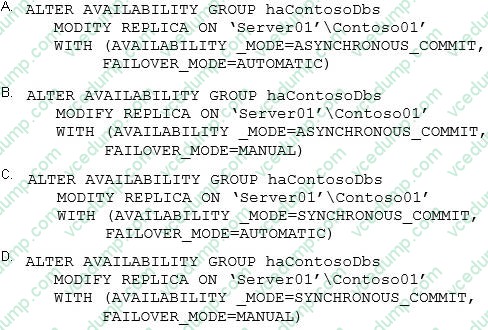
B. Option B
C. Option C
D. Option D -
Question 203:
Which of the following SQL Server 2012 tools coordinates transactions across SQL Servers in a clustered environment?
A. SQL Server Profiler
B. SQL Server Query Optimizer
C. SQL Server Management Studio
D. Microsoft Distributed Transaction Coordinator -
Question 204:
You are a database administrator for a Microsoft SQL Server environment.
You want to deploy a new application that will scale out the workload to at least five different SQL Server instances.
You need to ensure that for each copy of the database, users are able to read and write data that will then be synchronized between all of the database instances.
Which feature should you use?
A. snapshot replication
B. peer-to-peer replication
C. database audits
D. failover clustering -
Question 205:
Which of the following is a valid upgrade path for SQL Server 2012?
A. SQL Server 2000 -> SQL Server 2012
B. SQL Server 2000 -> SQL Server 2005 -> SQL Server 2012
C. SQL Server 7 -> SQL Server 2012
D. Oracle 11g -> SQL Server 2012 -
Question 206:
DRAG DROP
You administer a Microsoft SQL Server database.
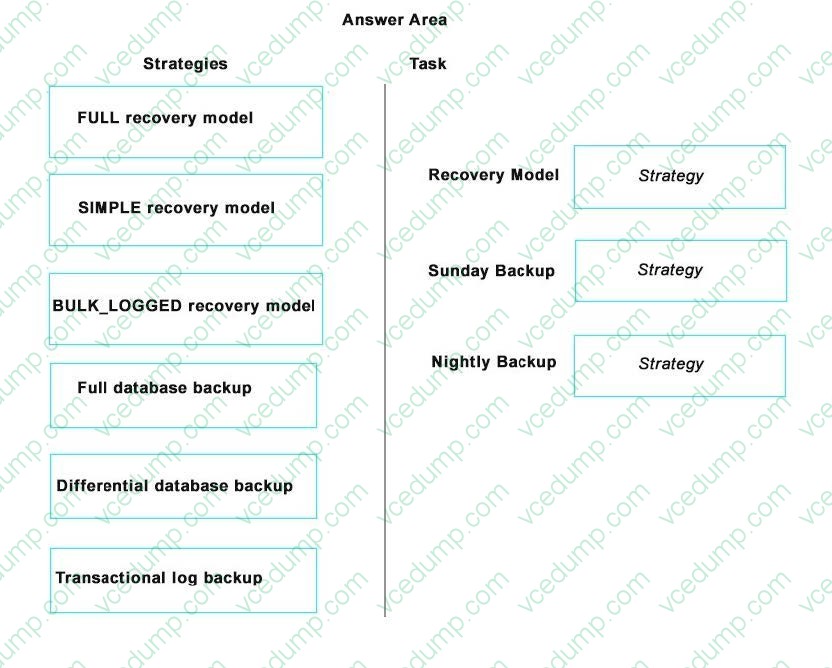
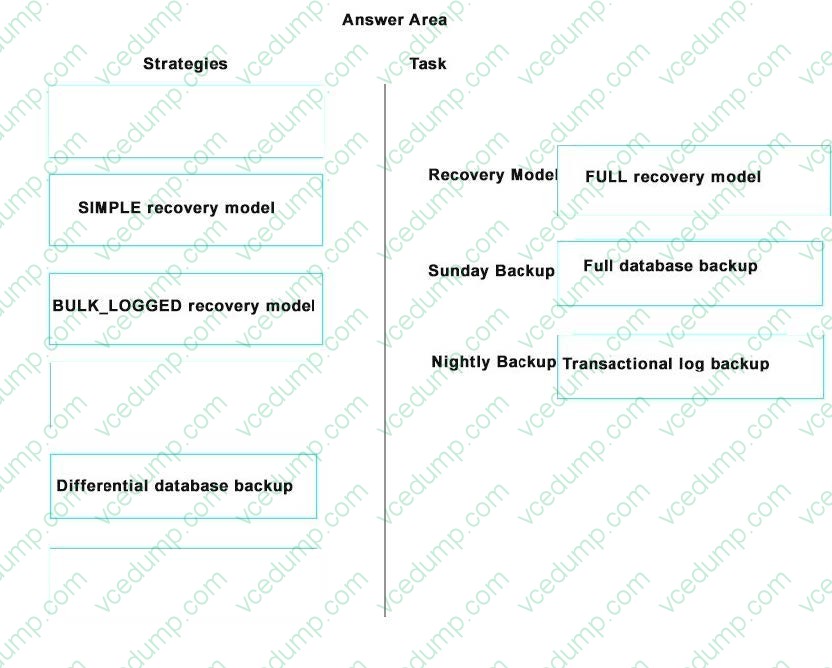
Every Sunday afternoon, a process inserts a large volume of data. Users generate reports and modify additional data throughout the week.
You need to create a backup strategy that:
1. minimizes the size of the transaction log,
2. minimizes the size of the backups, and
3. ensures a 24-hour recovery point objective (RPO).
Which strategy or strategies should you use? (To answer, drag the appropriate strategy or strategies to their corresponding task or tasks in the answer area. Answer choices may be used once, more than once, or not at all. Answer targets
may be used once or not at all. Additionally, you may need to drag the split bar between panes or scroll to view content.)
Select and Place:
-
Question 207:
Note: This question is part of a series of questions that use the same set of answers choices. An answer choice may be correct for more than one question in the series.
You administer a Microsoft SQL Server database server that hosts a transactional database and a reporting database. The transactional database is updated through a web application and is operational throughout the day. The reporting
database is only updated from the transactional database.
The recovery model and backup schedule are configured as shown in the following table:
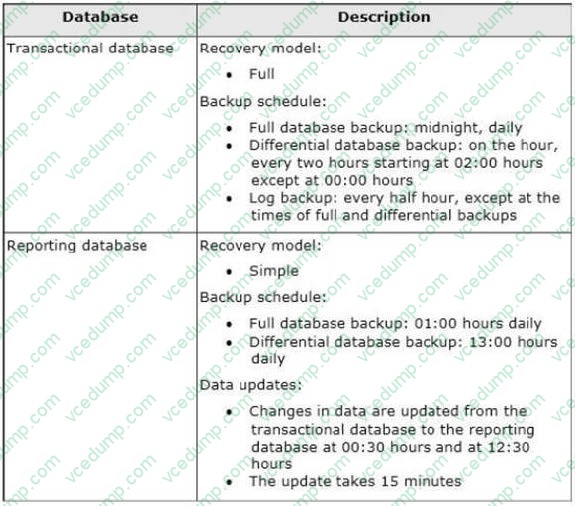
One of the hard disk drives that stores the reporting database fails at 23:32 hours.
You need to ensure that the reporting database is restored. You also need to ensure that data loss is minimal.
What should you do?
A. Perform a page restore.
B. Perform a partial restore.
C. Perform a point-in-time restore.
D. Restore the latest full backup.
E. Restore the latest full backup. Then, restore the latest differential backup.
F. Restore the latest full backup, and restore the latest differential backup. Then, restore the latest log backup.
G. Restore the latest full backup, and restore the latest differential backup. Then, restore each log backup taken before the time of failure from the most recent differential backup.
H. Restore the latest full backup. Then, restore each differential backup taken before the time of failure from the most recent full backup. -
Question 208:
You administer a Microsoft SQL Server instance that has multiple databases. You have a two-node SQL Server failover cluster. The cluster uses a storage area network (SAN).
You discover I/O issues. The SAN is at capacity and additional disks cannot be added.
You need to reduce the I/O workload on the SAN at a minimal cost.
What should you do?
A. Move user databases to a local disk.
B. Expand the tempdb data and log files
C. Modify application code to use table variables
D. Move the tempdb files to a local disk -
Question 209:
On which of the following operating systems can you deploy the 64-bit version of SQL Server 2012 Enterprise edition? (Choose all that apply.)
A. Windows 7 Ultimate (x64) edition
B. Windows Server 2008 R2 SP1 (x64) Standard edition
C. Windows Server 2008 SP2 (x64) Enterprise edition
D. Windows Server 2003 R2 (x64) Enterprise edition -
Question 210:
Which of the following features can you install if you are installing SQL Server 2012 Enterprise edition on a computer running Windows Server 2008 R2 SP1 Enterprise edition in the Server Core configuration? (Choose all that apply.)
A. Database Engine Services
B. SQL Server Replication
C. Analysis Services
D. Reporting Services
Related Exams:
-
62-193
Technology Literacy for Educators -
70-243
Administering and Deploying System Center 2012 Configuration Manager -
70-355
Universal Windows Platform – App Data, Services, and Coding Patterns -
77-420
Excel 2013 -
77-427
Excel 2013 Expert Part One -
77-725
Word 2016 Core Document Creation, Collaboration and Communication -
77-726
Word 2016 Expert Creating Documents for Effective Communication -
77-727
Excel 2016 Core Data Analysis, Manipulation, and Presentation -
77-728
Excel 2016 Expert: Interpreting Data for Insights -
77-731
Outlook 2016 Core Communication, Collaboration and Email Skills
Tips on How to Prepare for the Exams
Nowadays, the certification exams become more and more important and required by more and more enterprises when applying for a job. But how to prepare for the exam effectively? How to prepare for the exam in a short time with less efforts? How to get a ideal result and how to find the most reliable resources? Here on Vcedump.com, you will find all the answers. Vcedump.com provide not only Microsoft exam questions, answers and explanations but also complete assistance on your exam preparation and certification application. If you are confused on your 70-462 exam preparations and Microsoft certification application, do not hesitate to visit our Vcedump.com to find your solutions here.